
Background
Establishing trust and a sense of understanding often play a significant role in psychological recovery and mental health maintenance. Peer support involves helping people by those who have a similar experience, which contributes to better understanding (Hardy et al., 2019). The current study examines the impact of peer support on individuals’ well-being in various contexts. In particular, the assumption that communities can play a significant role in supporting mental well-being through peer support is considered.
Prior research reveals significant benefits of peer support for people. The researchers suggest that it helps alleviate depression, anxiety, grief, and other emotional distresses, while promoting social integration, personal growth, and a high quality of life (Bartone et al., 2019; Hardy et al., 2019; Liu et al., 2022). Notably, peer support helps individuals overcome obstacles that may hinder their access to psychological assistance. In particular, Bartone et al. (2019) and Byrom (2018) believe that such support helps overcome the stigma associated with seeking psychological help and the barrier of a lack of support from others. Moreover, peers’ service may be more cost-effective for providers and recipients of care (Puschner et al., 2019). For these reasons, peer support attracts significant attention for research and application.
For peer support to be effective, it is crucial to understand the conditions necessary to provide it. Its influence may vary depending on the implementation, whether in an individual or group format, online or in-person meetings, the age of the participants, and other similar factors. At the same time, many experts believe this practice should be carried out from the standpoint of values-based theory to be effective (White et al., 2020). Following social determinants of health theory, context significantly influences people’s health while creating unequal conditions (Levonian, 2022). Therefore, one might assume that communities capable of organizing peer support for their members would promote equality and prosperity and would be effective, as aid would be based on local values.
Conceptual Model
The conceptual model (see Fig. 1) identifies the possible relationships between the independent and dependent variables for the proposed study. Peer support is the independent variable, and mental well-being is the dependent variable. The research will focus on various peer support elements in the context of support provided by their communities for people with mental health issues. It is worth considering that individual community members or social support groups can provide peer support.
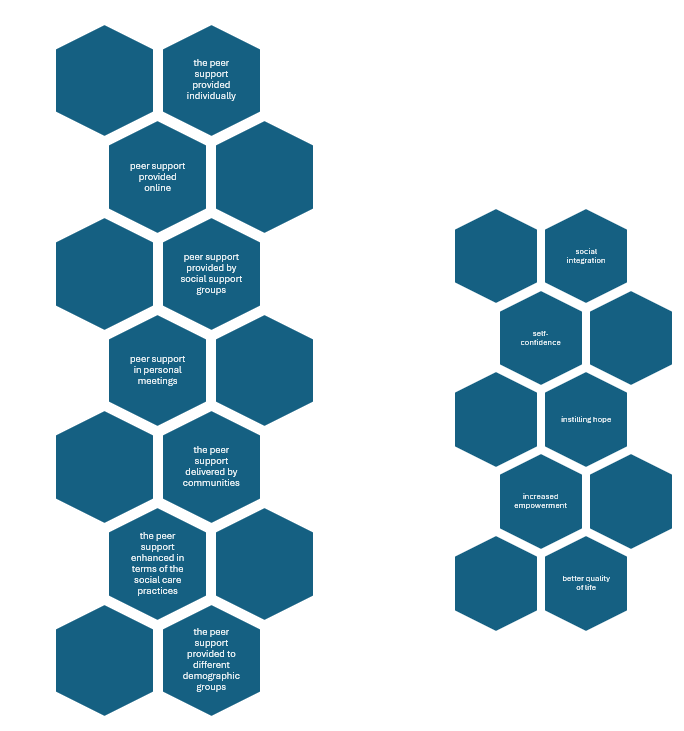
Note. The figure demonstrates the potential influence of independent variables on dependent variables.
It can be held in schools, aged care services, or other settings. For example, hospitals can encourage their former patients to help current patients, or support groups can act independently. No less critical, the indicators of improved mental well-being are currently the focus of numerous studies since they are measured and compared. Therefore, the conceptual model can be created that differentiates between the few dependent and independent variables.
The independent variables will include the types of environments and support provided to individuals with mental health issues. The dependent variables will consist of the types of effects that individuals experience as a result of the support provided. The independent variables are the peer support provided individually, in groups, online, in person, and delivered in communities. The dependent variables include social integration, self-confidence, instilling hope, increased empowerment, and a better quality of life. The selected variables aim to demonstrate how peer support, provided under different conditions, affects various aspects of a person’s mental well-being.
Research Questions
- How does peer support impact people’s mental well-being regarding demographic differences (age, sex, occupation, income level, type of mental illness, culture, race, ethnicity)?
- Which types of peer support show better impact – the individual efforts or the measures delivered within social support groups and community care?
- What are the most critical effects of peer support (social integration, self-confidence, hope, quality of life, empowerment)?
Literature Review
Influence of Peer Support on Well-Being
Peer support is a widely discussed topic in modern literature, and several critical issues have been identified. Most attention is drawn to the issue of the influence of such practices on people receiving support. Researchers widely acknowledge the importance of social interactions and note that peer support has a positive impact on personal well-being. Nevertheless, aspects to which researchers pay attention differ, and there is some inconsistency in the degree of influence.
In particular, Bartone et al. (2019), Hardy et al. (2019), Puschner et al. (2019), and Shalaby and Agyapong (2020) highlight a significant positive impact on the sense of hope. White et al. (2020) highlight quite a modest effect on hope. Researchers have also extensively studied the effects on socialization, self-confidence, empowerment, quality of life, hospitalizations, and other psychological and clinical outcomes (Bartone et al., 2019; Byrom, 2018; Hardy et al., 2019; Puschner et al., 2019; Liu et al., 2022). Their findings indicate a predominantly positive impact, providing rationale to consider peer support an effective practice for recovery.
The impact of this practice is not limited to improving the well-being of people receiving the support. Bartone et al. (2019) and Hardy et al. (2019) argue that peer support also benefits peers, giving them opportunities for personal growth. However, Mancini (2018) and White et al. (2020) highlight that implementing such support presents numerous challenges. In the case of an incorrect organization, peers may be dissatisfied with their work due to stigma, role ambiguity, and similar reasons, and the support will be ineffective. Therefore, the context of peer support is also crucial for its effectiveness.
Different Contexts for Peer Support Application
Peer support can be utilized for various purposes and in diverse circumstances. For example, it can be provided in groups or individually. White et al. (2020) studied one-to-one support and found a less significant effect than in studies where support was in groups. Shalaby and Agyapong (2020) review contexts in detail, noting that support can be directed to different age groups and individuals with varying situations, and all these factors must be taken into account.
For instance, Byrom’s (2018) findings indicate that peer support will not be an effective preventive measure for depression and anxiety in students. However, Liu et al. (2022) believe that this practice may prevent depression in the older generation. A significant trend is also the ability to hold meetings in various formats – in person or online, and using technologies significantly contributes to the availability of care (Bartone et al., 2019; Levonian, 2022; Merchant et al., 2022). Such an online format may be one option for uniting communities.
Community and Peer Support
Communities can have a significant impact on a person’s well-being. Sung and Phillips (2018) and VanderWeele (2019) examine various tools for measuring community well-being, with mental health being a key determinant. Their research demonstrates that communities striving for prosperity must set specific goals, have strong leadership, and build strong social relationships. Communities can therefore organize the necessary psychological assistance for their members.
Hardy et al. (2019) note that peer support at the community level will be more effective as it better aligns with local values and can mobilize social networks, including families, friends, and neighbors. Communities can also form online, making help more accessible to those who have difficulty finding support (Levonian, 2022; Merchant et al., 2022). Thus, communities with sufficient resources can take responsibility for organizing peer support for their members.
Research Contribution to the Organization or Context
The results of the current study will have implications for supporting communities, peer support applications, and future research. VanderWeele (2019) argues that leadership and healthy social relationships within communities contribute to their prosperity. As a result, communities are responsible for providing opportunities to maintain their members’ mental well-being.
The evidence of the positive impact of peer support, as demonstrated by the study, suggests that this practice can be widely adopted. Improving the mental well-being of the population is essential for its development and prosperity. It is especially significant in connection with the global pandemic, which worsened the psychological condition of a substantial part of the population. Therefore, taking measures to support community members is necessary and has a high potential for efficiency.
The learned features and contexts of peer support are also necessary to select the appropriate implementation options. Since the organization of practice also affects its effectiveness, understanding in which cases peers’ involvement is applicable and in which it is not relevant is crucial. The study of this aspect is necessary for both practical applications and future research. Moreover, the research can both add new knowledge and identify new gaps in understanding the features of peer support. It will reveal the correlation between the context of providing peer support, different demographic groups, and the affected elements of well-being.
Annotated Bibliography
Bartone, P. T., Bartone, J. V., Violanti, J. M., & Gileno, Z. M. (2019). Peer support services for bereaved survivors: A systematic review. OMEGA-Journal of Death and Dying, 80(1), 137-166.
Losing family members or friends is one of the most challenging moments when a person may need help. A systematic literature review by Bartone et al. (2019) provides evidence that peer support has a positive impact on individuals who have experienced loss. Their findings demonstrate a reduction in the symptoms of grief, including depression and isolation, support for well-being, and personal growth, thanks to peer support. Peers also benefit from their activities by experiencing personal growth and finding positive meaning in life. The authors also note the importance of experience similarity and the tendency to use the Internet to search for peers.
This source is helpful for the research due to its reliability and the issues it considers. Its authors – researchers and practitioners – deal with supporting the bereaved, recovery from traumatic events, and the development of resilience. The target audience of the article is researchers interested in the experience of grief and the influence of peer support. The source is relevant for the current study as it addresses the impact of peer support on variables such as social inclusion, quality of life, and hope. The study demonstrates the value of this practice and its significance to personal well-being.
Byrom, N. (2018). An evaluation of a peer support intervention for student mental health. Journal of Mental Health, 27(3), 240-246.
Peer support can be considered a valuable tool for reducing symptoms of depression. Byrom (2018) conducted a study on the benefits of peer support groups run by volunteers for students with depression and anxiety. The author reported a positive impact on the mental well-being of students who participated in the program. The study found that individuals with a higher level of well-being may not complete the program, so peer support cannot be considered a preventive measure. However, the practice had a positive impact, which is especially important for students since they often face problems of isolation and loneliness.
The author of the paper is a member of the Department of Psychology at King’s College London, and her research interests include issues of student mental well-being, peer support, and associative learning. The article will be of interest to researchers, practitioners, and educational institutions that support students’ mental health and peer support practices. The source is of interest to the current study as it demonstrates that peer support groups may be valuable in depression and anxiety. Their symptoms pose a severe obstacle to quality of life and socialization; therefore, intervention is necessary.
Hardy, S., Hallett, N., & Chaplin, E. (2019). Evaluating a peer support model of community well-being for mental health: A co-production approach to evaluation. Mental Health & Prevention, 13, 149-158.
Support groups can be created and operated at various levels. Hardy et al. (2019) believe that community-based peer support groups offer benefits, as they can work within the principles appropriate to the local culture and, therefore, are more likely to be effective. Supporters can then utilize available networks, such as family or friends, to enhance the effect. Hardy et al. (2019) collected evidence to evaluate peer support from a review of the literature, documents, telephone interviews, and focus groups. Their results showed that participants in such groups noted the positive influence on matters of social integration, the opportunity to be heard, establishing trust, improving well-being, and many other aspects.
The article will be helpful for use in the research as it is a reliable source on the topic. Its authors represent the School of Health and Social Care and are therefore closely familiar with research on well-being. The study will be of interest to peer support researchers, social care services, and policymakers. This article outlines the features, models, benefits, and potential barriers associated with organizing peer support groups. Moreover, it provides evidence for effects on variables such as hope, quality of life, and self-confidence.
Levonian, Z. (2022). Understanding and facilitating peer communication in online health communities [Doctoral dissertation]. The University of Minnesota.
Individuals can receive support in various ways, and technology provides more opportunities. Levonian’s dissertation (2022) focuses on facilitating peer support through health online communities using a specially designed algorithm. The author notes that offline individuals may face difficulties in finding peers with similar experiences, and online communities can help address this issue. It was found that there was significant demand to search for peers during the research. The author examined the peculiarities of establishing relationships in online communities, where people seek social support, and developed an algorithm for connecting peers and those in need of help.
The author conducted a substantial investigation and provided a detailed discussion of the process of his work, demonstrating the study’s reliability. The dissertation can be helpful for those interested in using such algorithms to connect peers and support seekers. It will also interest researchers of peer support and features online relations aimed at social support. The source highlights the potential for bringing communities together online, which is particularly valuable to the current study. It also highlights the demand for such practices among individuals experiencing psychological crises, underscoring the study’s relevance.
Liu, T., Leung, D., Lu, S., Kwok, W. W., Sze, L., Tse, S., Ng, S. M., Wong, P., Lou, V., Tang, J., Wong, D., Chan, W. C., Kwok, R., Lum, T., & Wong, G. (2022). Collaborative community mental health and aged care services with peer support to prevent late-life depression: study protocol for a non-randomised controlled trial. Trials, 23(1), 1-13.
Peer support can be the only measure the person uses and part of the complex treatment plan. Liu et al. (2022) include it in the community program to prevent depression among the older generation, which they will implement as part of the study. Sharing experiences and discussing productive aging and overcoming problems in older age within peer support groups may be helpful for early intervention to prevent depression. The authors also suggest that community-level supporters will positively affect the involvement of families and other networks in support of mental health.
The protocol’s authors, who are engaged in research in the social and psychological sciences, conducted a significant study to prepare for their trial. It can be helpful to other researchers and stakeholders interested in implementing similar programs. The article is beneficial for current research as it provides valuable insights into the benefits of peer support in preventing depression among older adults. Byrom (2018) notes that this measure is not applicable for prevention. However, Liu et al. (2022) focus on senior participants whose experiences and factors leading to depression may be similar. Therefore, the source offers an alternative perspective for the study of peer support.
Mancini, M. A. (2018). An exploration of factors that affect the implementation of peer support services in community mental health settings. Community Mental Health Journal, 54(2), 127-137.
Peer support groups should be effectively organized to achieve their healing goals and be beneficial for participants. Mancini (2018) presents the perspectives of peers on managing groups and potential obstacles that may arise during the work process. Their results showed that peers could face stigma among colleagues, role ambiguity, and barriers to professional development, among other similar issues. To fulfill their role, supporters must maintain their well-being; therefore, this issue is crucial to research.
The article’s author is interested in the study of psychological recovery and community mental health, and therefore has a significant background in this field. The source is of interest to organizations that embody peer support programs, researchers, and peer practitioners. While Bartone et al. (2019) and Hardy et al. (2019) note the positive impact of such a practice on supporters, it is essential to be aware of potential issues and obstacles. Support can be ineffective due to barriers, and organizations implementing the approach must be attentive to establishing rules and procedures related to peers’ work. Therefore, this source complements the current study by providing perspectives from peers.
Merchant, R., Goldin, A., Manjanatha, D., Harter, C., Chandler, J., Lipp, A., Nguyen, T., & Naslund, J. A. (2022). Opportunities to expand access to mental health services: A case for the role of online peer support communities. Psychiatric Quarterly, 93(2), 613-625.
Technology is increasingly being integrated into people’s lives, including the transformation of how psychological assistance is provided. Merchant et al. (2022) are exploring the benefits of online communities for peer support. The study is relevant due to the global pandemic, which limited the possibilities for personal meetings and worsened the mental health of a significant part of the population. Online communities can provide support, educational resources, and other opportunities, and service users often note the benefits of improved access to help. This form of support has a positive impact on recovery and well-being.
The article is a reliable source of information for the study, as its authors are researchers and practitioners in the field of public health. It will be of interest to researchers, policymakers, and organizations involved in implementing online peer support. The source is valuable to the current study as it demonstrates how communities can make help more accessible. Online support enables access to essential communication and provides opportunities to utilize educational resources and valuable tools. This format can overcome the problem of difficulties in finding psychological assistance since people with psychological issues are often unsure where to seek help.
Puschner, B., Repper, J., Mahlke, C., Nixdorf, R., Basangwa, D., Nakku, J., & Slade, M. (2019). Using peer support in developing empowering mental health services (UPSIDES): Background, rationale, and methodology. Annals of Global Health, 85(1), 1-10.
Individuals seeking psychological help may encounter barriers, particularly in low- and middle-income countries. Puschner et al. (2019) believe that peer support is an underestimated opportunity to assist more people who do not receive enough care and help. They collected evidence of peer support effectiveness to develop an intervention that expands services in mental well-being support. Authors found a significant positive impact of peer support; in particular, it makes care more person-oriented. Such a practice also offers the potential for cost savings for suppliers.
The authors, both practitioners and researchers in the field of psychiatry, have backgrounds that lend credibility to their work. The article will be helpful to researchers and policymakers interested in peer support issues. The source contributes to the current study by confirming positive effects on variables such as quality of life, self-esteem, sense of hope, and social integration. The information demonstrates that through peer support, healthcare can provide the necessary mental care to more people for whom it may not be readily available.
Shalaby, R. A. H., & Agyapong, V. I. (2020). Peer support in mental health: A literature review. JMIR Mental Health, 7(6), 1-15.
Peer support attracts significant attention from researchers interested in its impact. Shalaby and Agyapong (2020) conducted a peer support study collecting data on its evolution, functions, types, tools, potential challenges, and effectiveness in various contexts. The authors considered peer support for addictions and severe mental illness and its application to different age groups, such as youth and seniors. Their literature analysis found that this practice has high potential but requires support and effort from providers and policymakers to implement reliable peer support.
The article’s authors are representatives of the Department of Psychiatry, and their experience contributes to the study of the question. The source is of interest to those seeking to learn more about peer support and the current literature on the topic. The article can serve as a starting point for studying the topic, as it reveals many aspects of peer support.
The study can be helpful for the current research as it presents a holistic picture of peer support. The study by the authors, which explores various contexts for its application, is especially valuable since it allows for considering differences in application and effectiveness. The source also notes the impact of support on variables of hope, quality of life, confidence, and integrity.
Sung, H. K., & Phillips, R. G. (2018). Indicators and community well-being: Exploring a relational framework. International Journal of Community Well-Being, 1, 63-69.
To consider the impact of peer support in communities, it is also essential to understand the concept of the community itself and its well-being. Sung and Phillips’s (2018) study examines various perspectives on community well-being, including the models proposed by researchers, the domains, and the indicators used for measurement. The population’s mental health is an integral part of community well-being. The authors claim that indicators can reflect the situation in the community and help in its governance, thereby enhancing the quality of life for its members. Assessing the well-being of communities is necessary to establish goals and find opportunities for their development.
The authors already have a research background on issues of community well-being. A comprehensive study of literature and proposed ideas underscores the value of the article. Their paper will be of interest to researchers and policymakers. For the current study of peer support practice, the source is also helpful, as the authors draw attention to the fact that communities can set specific goals and take action to ensure their members’ well-being. Communities can take responsibility for organizing peer support if mental health issues draw attention during situation evaluation.
VanderWeele, T. J. (2019). Measures of community well-being: A template. International Journal of Community Well-Being, 2(46), 253-275.
Assessing community well-being can be a complex and labor-intensive process. VanderWeele (2019) notes that many community indicators can be subjective, and communities differ from each other, but they share some common features. The authors argue that communities need prosperous people, relationships play a central role in them, and a joint mission and leadership can substantially impact them. They offer a tool to evaluate communities’ well-being, which can also include an assessment of individual prosperity. Good mental health is integral to personal well-being; therefore, communities should ensure its maintenance.
The author’s research interests encompass mental health issues and ensuring people’s prosperity; therefore, he presents a comprehensive view of community well-being. Researchers and policymakers may find this source useful for their evaluations, studies, and practical applications. The material is of interest for research on peer support as it also draws attention to the role of communities. Communication in communities plays a significant role and can be a source of support for its members. Therefore, they should pay attention to this practice and use it for their benefit and prosperity.
White, S., Foster, R., Marks, J., Morshead, R., Goldsmith, L., Barlow, S., & Gillard, S. (2020). The effectiveness of one-to-one peer support in mental health services: A systematic review and meta-analysis. BMC Psychiatry, 20(1), 1-20.
Specialists can provide peer support in both group and individual formats. White et al. (2020) conducted an extensive literature review examining studies on the effectiveness of personal support. The authors identified significant effects on empowerment, mental symptoms, and recovery reported by patients. Their findings showed that the impact on variables such as hope or hospitalization rates was more modest. The authors also note that peer support interventions discussed in studies are often heterogeneous, with some authors prone to bias, undermining the reliability of the evidence base.
The authors present the Population Health Research Institute and have conducted a comprehensive literature review, demonstrating the study’s robustness. Their article will be helpful to researchers on peer support. This research is of interest as it reflects contemporary literature on the topic and provides evidence of influence on variables of interest. In particular, many other sources also note the significant impact on hope. However, White et al. (2020) mark a medium influence. This article offers a more critical perspective on peer support performance.