
Introduction
China and Saudi Arabia are some of the developed countries with good trade relations at international levels. Petroleum is the leading exporter of oil in Saudi Arabia due to the availability of expansive oil reserves in the country. Meanwhile, China is one of the most industrialized countries in the world.
Consequently, there is a need for a continuous supply of petroleum for industrial activities in China. The country imports crude petroleum from various countries, with Saudi Arabia being the top market as of 2020. The information regarding Saudi Arabia’s petroleum shipments to China indicates how the two countries depend on each other.
Data on Petroleum Export from Saudi Arabia to China
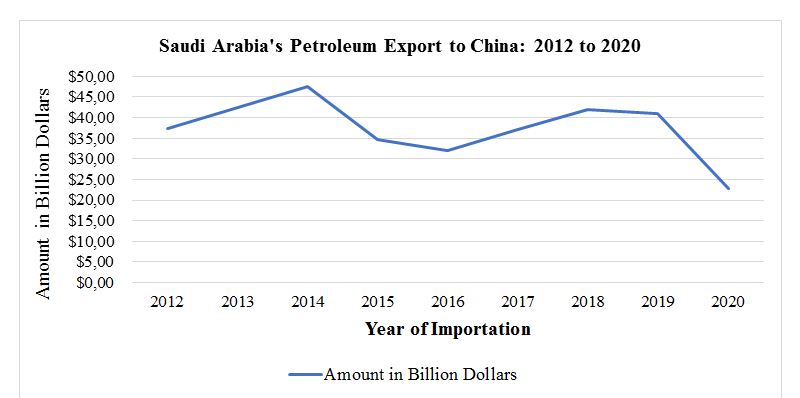
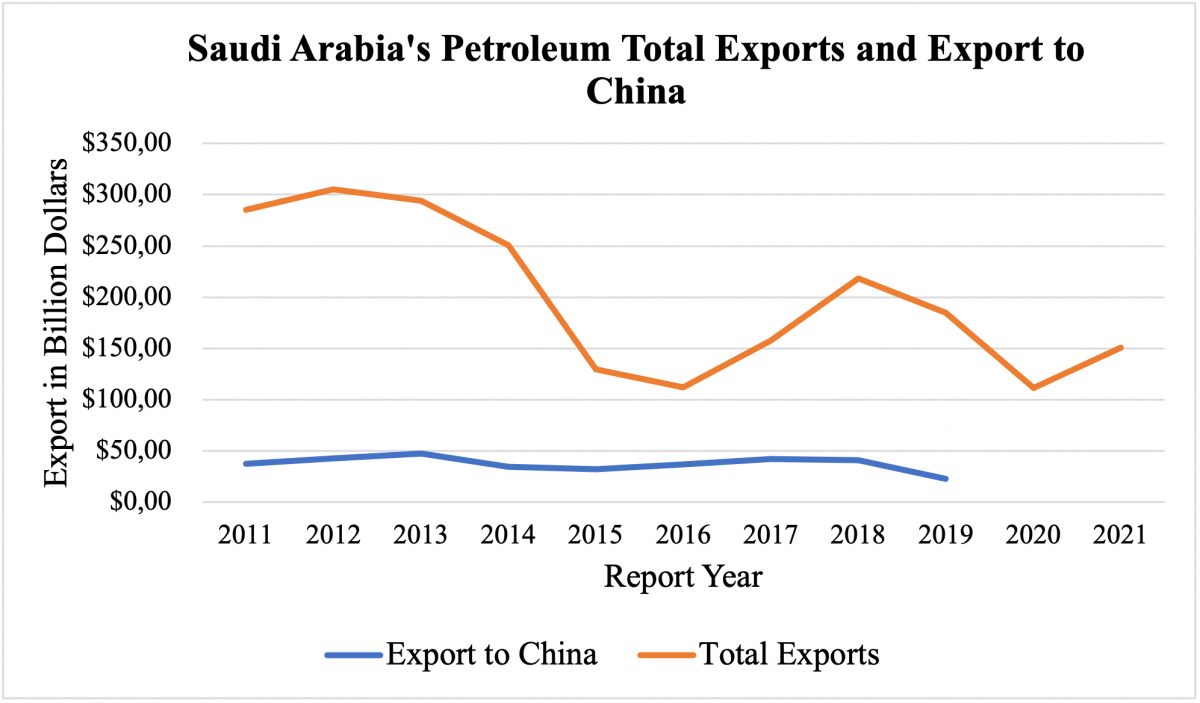
China is a highly industrialized country with a need for petroleum products. In 2020, the country was the largest importer of crude petroleum, valued at $150 billion (Liu et al., 2022). The country imported most of its products from Saudi Arabia, which is valued at $24.7 billion, according to the International Trade Centre (ITC) (2022). According to the ITC’s trade map (2022) data, the monetary worth of petroleum sent from Saudi Arabia from Saudi Arabia to China has been fluctuating, as shown in Figure 1.0. According to the data, 2014 was the peak year for Saudi Arabian petroleum exports to China (ITC, 2022). The data can be compared to the totals of Saudi Arabia’s petroleum oil exports during the same year, as shown in Figure 2.0.
Data Description
The data on petroleum exports from Saudi Arabia to China shows the close trade ties between the two countries. China has consistently imported crude petroleum from Saudi Arabia, as shown in Figure 1.0. 2020 recorded the lowest value of the crude petroleum exported from Saudi Arabia to China. Meanwhile, 2014 recorded the highest value of $47.59 billion (ITC, 2022). The values have consistently decreased and can be attributed to the trade restrictions in the wake of COVID-19, given that there is a sharp decrease in the export value after 2019, as shown in Figure 1.0.
The data on the value of petroleum exports to China can be compared to the total exports. Figure 2.0 shows that whenever there was a decrease in the total petroleum export from Saudi Arabia, there was a consequent decrease in the amount sent to China. Although there was a rapid decrease in the value of petroleum exports from 2013 to 2016, the amount exported to China remained almost the same (International Trade Administration, n.d.). Therefore, Saudi Arabia largely depends on China to consume its petroleum exports. The imported product is used to manufacture petroleum products such as gasoline, jet fuel, and heating oil, among others (Yusuf & Nasrulddin, 2023). Exporting petroleum from Saudi Arabia to China has promoted the inter-country business relationship between the two.
Conclusion
China is one of the world’s largest crude petroleum importers, mainly from Saudi Arabia. The country recorded the highest importation value in 2014, but it was lowered during and after COVID-19. Saudi Arabia exports the majority of its petroleum to China due to their close business ties. Although the value of petroleum exported from Saudi Arabia steeply decreased between 2013 and 2016, China benefited hugely from the products. Unlike many other countries, Saudi Arabia has maintained a constant supply of petroleum to China.
References
International Trade Administration (n.d.). Trade statistics: Comtrade Database (United Nations). Web.
ITC (2022). Bilateral trade between Saudi Arabia and China. Web.
Liu, Y., Sharma, P., Jain, V., Shukla, A., Shahzad Shabbir, M., Tabash, M. I., & Chawla, C. (2022). The relationship among oil prices volatility, inflation rate, and sustainable economic growth: Evidence from top oil importer and exporter countries. Resources Policy, 77, 102674. Web.
Yusuf, N., & Nasrulddin, V. (2023). Significance of international trade and national GDP as two integral components of sustainable economic development in Saudi Arabia. Journal of the Knowledge Economy. Web.