
Investments are always a risky tool for maximizing profits, as stochastic factors can lead to diminishing returns or even losses. However, with adequate management and a thorough understanding of how investment strategies work and which strategies to use, the risks can be minimized and the benefits tangible. In the present context, we are discussing the option of investing $10,000 for one year, which, according to preliminary calculations, would yield a net profit of $5,000 for the company or a return rate of 50%.
For investment strategies, especially short-term ones, such a return on investment is highly favorable and significantly outperforms other investment options (McBride et al., 2023). To evaluate the usefulness and profitability of this strategy, the NPV can be calculated. Strictly speaking, NPV is a measure of a project’s feasibility, with a positive ratio indicating a favorable outcome for the company. In contrast, a negative value indicates huge risks (Fernando, 2023). To calculate NPV for the given data, we need to use the formula:
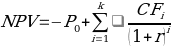
In this formula, P0 corresponds to the initial investment amount, CF represents the cash flow for the accounting year, and r represents the discount rate. Since all the data are known, we can perform the calculation for a one-year project:
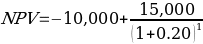



As shown in the calculations, the determined NPV was positive, indicating a positive signal for the investment strategy. In other words, the conducted financial analysis gives the green light for the realization of the described project, as the NPV is positive: the company will be able to generate a profit from this investment with minimal risk. The loan rate of 20% specified in the terms and conditions is lower than the expected repayment rate of 50%, providing an additional advantage: the loan repayment costs will be offset by the investment’s profit (Banton, 2023). Thus, this project is financially favorable for the company and should be implemented.
References
Banton, C. (2023). Return on investment vs. internal rate of return: What is the difference? Investopedia.
Fernando, J. (2023). Net present value (NPV): What it means and steps to calculate it. Investopedia.
McBride, G., Beers, E., & Chavis IV, K. (2023). Average return on investment: What is a good return? Bankrate.