
Introduction
This paper contains an analysis of the differences between private, merit, and public goods in the management of the economy of the United Kingdom (UK). Public goods have a close relationship with private goods based on the levels of efficiency associated with their processes and activities (Krugman & Wells, 2020). Private goods are distinguished by their capacity to be provided efficiently through markets, whereas public goods have inequitable availability in the market (Young, 2022). Compared to other goods, merit goods are characterized by their impact on society.
This paper explores the role of economic theories in explaining the three types of goods defined above. It examines the impact that significant social, political, and economic events have had on the UK over the past three years (2021-2023). The insights generated from this assessment may contribute to understanding why the UK needs to have three different types of goods in the economy (UK Office of National Statistics, 2021a). Similarly, the findings will be crucial in evaluating the efficiency of how the UK provides public, private, and merit goods to its citizens today and in the future. The aim is to enhance the impact of these three goods on society and explain their contribution to the UK’s economy.
Types of Goods in the UK Economy
The basic definition of private, public, and merit goods can be found in economic theories and models discussed by scholars from the Keynesian school of thought. Researchers such as Krugman and Wells (2020) are among the most highly cited in this field. They argue that private, public, and merit goods can be distinguished from each other by evaluating whether they are excludable or rival in consumption. Goods are deemed excludable when suppliers have the capacity and ability to restrict access if people are unable to pay for them.
Comparatively, the concept of a rival in consumption is derived from its name, meaning that consumption involves only one person at a time. The opposite is true because non-rival consumption may involve multiple people (UK Office of National Statistics, 2021a). These definitions explain the basis for differentiating private, public, and merit goods. Goods that share excludable and rival in consumption characteristics are private (Young, 2022). Comparatively, public goods are rival in consumption and are non-excludable because the supplier cannot prevent any one person from using them.
Social Importance
In the UK, public, private, and merit goods share the same characteristics as those defined above. Notably, events that have occurred in the past three years (2021-2023) reveal the importance of having these three types of goods. For example, Russia’s invasion of Ukraine, which occurred in February 2022, highlighted the importance of empowering the UK National Defense Army as a public good for protecting citizens from external attacks.
In terms of understanding the importance of private goods, the COVID-19 pandemic, which dominated global political, economic, and social spaces in 2021, highlighted the need for private goods in the UK to supplement public goods (UK Office of National Statistics, 2021a). The health crisis underscored the importance of private goods, including hospitals and healthcare facilities. Overall, emergency initiatives were broad-based and involved both public and private corporations in a bid to supply hospitals with equipment and expand their capacities to manage the overwhelming demand for services. Therefore, the COVID-19 pandemic exemplifies the need for private goods.
The acceptance and spread of the work-from-home workplace phenomenon exemplifies the importance of merit goods to the UK society. The spread of the work-from-home attitude has accelerated over the past three years, driven by economic disruptions caused by disasters and emergencies. Education is a merit good that has emerged from this trend (UK Office of National Statistics, 2021a). It has the capacity to better prepare future employees for a workplace characterized by a breakdown of traditional norms. Overall, the above examples illustrate why the UK economy requires a mix of public, merit, and private goods.
Governmental Provision of Merit and Public Goods
As highlighted above, merit and public goods are essential for the UK economy’s critical functioning. The government has taken a proactive role in providing merit and public goods to fulfill this goal. For example, in terms of merit goods, government authorities have provided updated services, such as garbage collection, to citizens (UK Office of National Statistics, 2021a). The goal is to improve the living conditions and environments of UK citizens.
In terms of providing public goods, the UK government allocates its resources equitably and in accordance with the needs of its citizens. For example, UK airports are public goods maintained and run by the government (UK Office of National Statistics, 2021b). The funding source for maintaining these installations is through government taxes. Based on this funding source, one could argue that the UK government provides merit and public goods in accordance with the intended purpose of the orders.
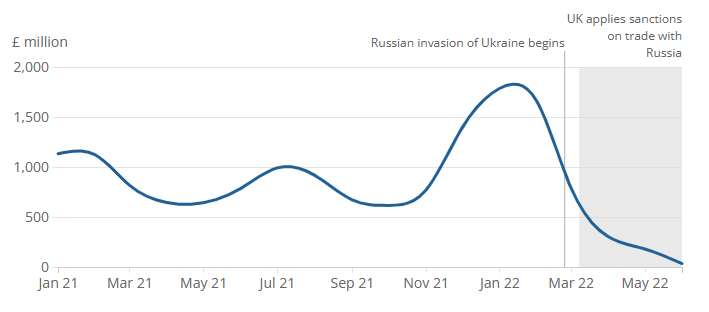
During the 2021 and 2023 case analysis periods, the UK government failed to provide access to private and merit goods on two occasions. The first one was during the invasion of Ukraine by Russia. In this case, UK companies, along with their Western allies, imposed sanctions on Russian goods and services to prevent the regime from making further advancements in the conflict. Unexpectedly, these measures have limited the UK market’s ability to provide merit and private goods to its citizens.
Figure 1 shows the effects of these sanctions on the trade between Russia and the UK. It demonstrates that after the UK imposed sanctions on trade with Russia, its combined trade levels declined significantly. This trend indicates that government policies hindered the free movement of Russian goods in the UK economy, thereby depriving the economy of important private or merit goods that originated from the former Soviet nation (UK Office for National Statistics, 2023). This example illustrates the government’s power to limit access to private and merit goods.
A second example highlighting instances when the government could restrict access to private and merit goods is the promotion of the climate change policy agenda in the UK. It aims to transform the economy to be “greener” and sustainable. To spur the adoption of new “greener” technologies, UK authorities have imposed restrictions on the production and sale of petroleum-powered products in the market by imposing punitive taxes on their ownership and use. This example highlights a unique situation where the UK market may fail to provide its citizens with private or merit-based goods (UK Office of National Statistics, 2021b). Such restrictive policies have created market distortions in the UK.
The UK automotive industry has borne the brunt of policy changes favoring environmentally friendly cars. This trend explains why there has been a 140% increase in the sales of plugged-in electric vehicles in the last three years. The figure below shows that these policies have helped elevate the UK’s position as the second most active market for plug-in electric vehicles in Europe.
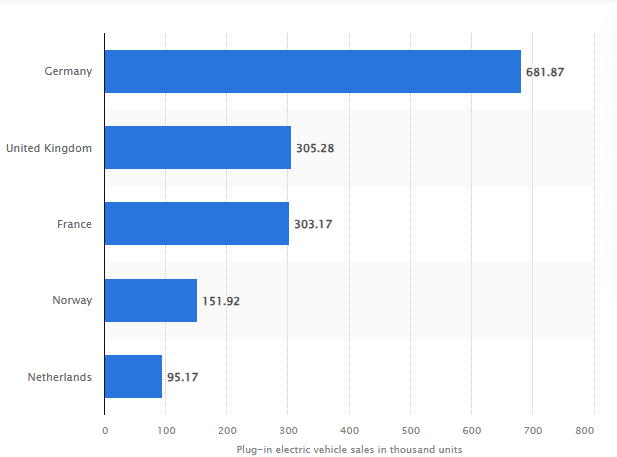
Overall, the graph above indicates that the UK government has distorted the automotive market in favor of companies that produce environmentally friendly cars. Therefore, there are unique situations where the government could restrict access to private or merit goods if it intends to pursue a higher-order goal, such as environmental protection.
Social Welfare
As highlighted in this document, the UK government plays a crucial role in facilitating the operations of companies that provide merit goods. To recap, the consumption of these types of goods has a net positive effect on societies. Social welfare groups play a facilitative role in supporting government initiatives aimed at increasing access to these products (UK Office of National Statistics, 2021a). The UK government and its social welfare partners have had mixed outcomes in promoting fair access to merit goods. This statement is supported by their roles in the provision of public and private goods, as discussed below.
Public Goods
A review of the role of the government and social welfare agencies in promoting fair access to merit goods partly resonates with their involvement in the provision of public goods. This comparison in function is important for the current assessment because public and merit goods share similar goals of improving the well-being of the population (Krugman & Wells, 2020).
Hinged on this philosophy, the involvement of the government and social welfare programs in promoting fair access to merit goods has had mixed outcomes. Notably, it has helped communities become more aware of the availability of these services, as some are provided by investments and humanitarian partners that may be unknown to the citizenry (UK Office of National Statistics, 2021a). The government helps to validate the actions and operations of these organizations, thereby increasing access to merit goods.
At the same time, the government has equally played a role in identifying priority issues affecting communities. This fete has helped social welfare groups to identify crucial merit goods required in the community. Data provided by the government has also helped these organizations develop effective strategies to support their activities and operations in the UK. This initiative has led to more effective resource allocation and enhanced service delivery (Krugman & Wells, 2020). Therefore, the government and social welfare groups have played a crucial role in ensuring an equitable distribution of public goods.
Merit Goods
As highlighted in this document, education is an example of a merit good. The UK government and its social welfare partners have played a significant role in improving access to this resource by making education more affordable and standardized for all. Consequently, vulnerable and minority groups in the UK have had the opportunity to pursue an education in the same manner as their more privileged peers (UK Office of National Statistics, 2021b).
In this regard, the government and its partners have played a positive role in improving fair access to merit products (UK Office of National Statistics, 2021a). A deeper analysis of the equitable distribution of this resource shows that equity has improved in the last three years due to the “Black Lives Matter” movement, which occurred in 2021 due to the death of George Floyd in the US. This event led to the examination of unfair or unjust systems in society that have limited access to justice for minority groups and denied them fair opportunities for growth and development.
The mixed outcomes associated with the UK government’s involvement in providing or accessing merit goods have been reported in several areas of public order and management. However, Figure 3 highlights the provision of internet services as a utility good. It reveals that economic disparities persist in determining how households access the internet at home. Unemployed individuals have the lowest rates of access to computers and the internet. In contrast, those with gainful employment have the highest rates of access to these services.
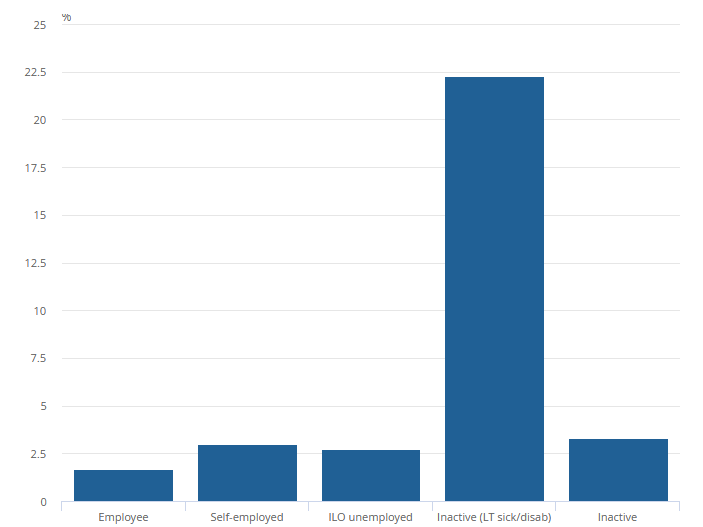
Given the vitality and importance of Internet services to the provision of basic services in the UK, such as education, it is evident how racial minority groups may be disadvantaged in gaining access to quality education services compared to their wealthier counterparts (UK Office of National Statistics, 2021a). This example demonstrates that the UK government has failed to bridge disparities in the provision of some merit goods, thereby perpetuating economic and racial inequalities that characterize UK society today. This example illustrates a case where government and social welfare programs have failed to promote equitable access to merit goods.
Private Goods
Some UK social welfare programs have failed to provide fair access to private goods because of economic considerations. For example, the inequitable distribution of internet services across different age groups in the UK demonstrates this trend. Figure 4 illustrates the distribution of internet users by age.
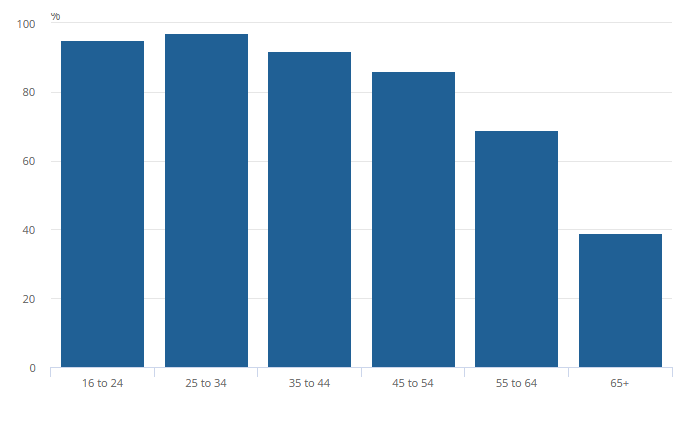
Internet inequity is prevalent in the UK, where young people report a higher rate of internet use compared to their older counterparts. These outcomes suggest that internet inequity exists in the distribution of merit goods in the UK. Social welfare programs have helped to minimize this gap, but the latest assessment of digital service numbers reveals that authorities need to do more work to bridge this gap (UK Office of National Statistics, 2021a). Therefore, the UK government, together with its social welfare partners, has considerable work to do in minimizing inequities in the provision of merit goods.
Conclusion
To conclude, the analysis of private, merit, and public goods in the UK highlights key distinctions. While market forces efficiently manage private goods, public goods are notably inequitable in their market availability, despite a close link to private goods in terms of process efficiency. Merit goods are unique because of their beneficial societal effects. This positive influence is the justification for the UK government’s support, intended to broaden their accessibility within the community.
The formal economic analysis of these three forms of goods has been limited to a few scholars, who have focused mainly on definitions. Nevertheless, the findings in this document are key to understanding the role and need for private, merit, and public goods in the UK economy. They are equally important for evaluating how the UK manages the provision of these three product types, all of which contribute positively to society and the nation’s economic growth.
Reference List
Krugman, P. and Wells, R. (2020) Essentials of economics. New York, NY: Worth Publishers.
Statista. (2022) Sales volume of plug-in electric vehicles in selected European countries in 2021. Web.
UK Office of National Statistics. (2021a) Exploring the UK’s digital divide. Web.
UK Office of National Statistics. (2021b) Fewer adults report accessing the internet “on the go” in the older age groups. Web.
UK Office for National Statistics. (2023) The impact of sanctions on UK trade with Russia. Web.
Young, M. (2022) Economics for business. London: Anglia Ruskin University.