Brief Description of the Product
The new product I want to create on behalf of Apple is a robot vacuum cleaner with built-in artificial intelligence. The product has strict body lines, a stylish design, and a lidar with a button that prevents the robot from getting stuck under the furniture. Technical characteristics help robots navigate space accurately and not leave dirty corners unattended in the house. This robot vacuum cleaner has a full-fledged dual camera embedded in the front of the device. Among other things, the robot vacuum cleaner Apple memorizes four maps of cleaning support, setting “forbidden” walls if the owner suddenly does not want to let it go somewhere, and zoning the premises.
It is worth mentioning that engineers have implemented a new algorithm for its operation. Usually, such vacuum cleaners return to the base either after the completion of cleaning or if the charge level has dropped to a minimum. In the latter case, the robot usually gets up to charge itself, charges to 100%, and then proceeds to finish cleaning (Deng et al., 2023).
The same vacuum cleaner returns to the base, calculates how much charge it needs to finish cleaning, charges to that level, and goes to work, and when it is done, it charges fully. This is precisely the kind of device Apple could have made if it had decided to produce appliances for the home and not limit itself to the HomePod. This product fits into Apple’s mission statement, making the world a better place and making human life easier.
New Organizational Structure
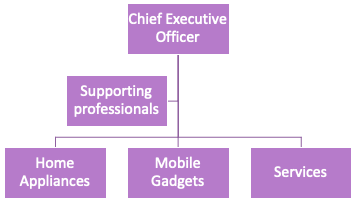
Divisionalization for this corporation solves functional structures’ challenges in dealing with the business’s responsibilities and variety. Divisionalization allows product strategy to be adjusted to the needs of each division and can promote division employee ownership of strategy (Lambertini & Pignataro, 2019). Appendix A depicts a schematic of this organizational system. In contrast to a functional organizational structure, this structure emphasizes a greater level of specialization within a specific unit so that units have the resources and autonomy to adapt to changes in their specific business environment. As a result, each unit frequently contains all the resources and functions required to satisfy the unit’s requirements.
However, in practice, a multidivisional organization has issues, such as disputes across divisions, which frequently originate from internal competitiveness and differences in beliefs and expectations. Furthermore, because each division is determined as a separate structure, and some activities must be repeated, its operation and management are more expensive. This management structure has the following advantages:
- It allows one to respond quickly to changes in the marketing environment.
- It allows for a clear delineation of areas of responsibility in the enterprise.
- Improves coordination between all departments of the company due to their autonomy on the one hand and central management on the other.
- Increases the enterprise’s competitiveness.
The Company’s Short-Term and Long-Term Goals
It is advisable to prescribe both long-term and short-term goals and objectives of the company for a year and then adjust them to changes in the market. The company can do this by forming a goal tree and breaking the main goals into secondary ones (David et al., 2019). I refer to the expansion of products as the company’s long-term goals. These may be improved models of existing gadgets or the creation of new, innovative technologies. This can also include an increase in profitability, the opening of new factories, and branch office stores.
Short-term goals include expanding the staff and hiring new promising specialists who will occupy the narrow areas of the company. Expansion of the research and development department is also necessary for the company’s continued success.
References
David, F. R., David, F. R., & David, M. E. (2019). Strategic Management: A Competitive Advantage Approach, Concepts and Cases (17th ed.). Pearson Education (US). Web.
Deng, Y., Li, T., Xie, M., & Chen, W. (2023). Robot Memorial Path Planning for Smart Access of Indoor Distributed Charging Piles. IEEE Access, 11, 27893-27918. Web.
Lambertini, L., & Pignataro, G. (2019). On the social (sub) optimality of divisionalization under product differentiation. Journal of Economics, 128(3), 225-238. Web.
Appendix