
Introduction
The body composition of every person is a critical factor impacting his/her well-being and health. Thus, body fat percentage is one of the most important factors in body composition, as it reflects a person’s health and potential problems if the situation is not improved. Thus, when making health recommendations, a specialist should assess a client’s body fat as it will impact the prescriptions (Holmes & Racette, 2021).
Furthermore, every person has non-fat and fat mass, and excessive stored fat can lead to heart failure, diabetes, and obesity (Holmes & Racette, 2021). For this reason, a valid method for measuring skin fat that requires little time and incurs low costs is critical. It will show a person’s current state, their fat mass, and whether interventions are required to improve the situation.
The proposed investigation focuses on determining participants’ body fat. The study aims to evaluate the use of skinfold thickness as a predictor of body fat percentage. For this reason, traditional tools, such as skin calipers, are used in the investigation.
The aim of this practical is to evaluate the use of skinfold thickness measured at the right-hand triceps site as a predictor of body fat percentage. It is expected that the research will show that measuring skin thickness will help to determine body fat. In such a way, the following hypothesis can be offered:
There is a positive linear relationship between SFT and BF%, with a strong association.
In such a way, it is possible to assume that by conducting the research, it is possible to determine the importance of body fat and the existing approaches to its measurement. Furthermore, the chosen approach will serve as a simple and effective tool for acquiring desired information.
Method
Participants
The research involved participants who provided informed consent to take part in the study. 41 students comprised the sample size. Among them, N=16 are females, and N=25 are males. The age is 29.5± 8.48 for females and 25.6 ± 0.7 for males. For females, the average height is 160.5±0.7; for males, the height is 179.5±19.09; mass for females is 65.9±14.7; for males, 64.4±7.8. The following table incorporates the given characteristics:
Table 1. Participants’ characteristics
All participants who agreed to take part in the research provided the signed informed consent forms and also outlined their ethnicity.
Equipment
The study was performed using specific equipment. First, skin calipers were employed to measure skin thickness. Furthermore, a scale and a stadiometer were used to measure a person’s height and determine their mass.
Procedure
The procedure included the 6 main steps to collect the required data. First, triceps skinfold thickness was measured by taking three measurements on the right hand. The median data was calculated and recorded.
Second, the height of the person with no shoes was measured. After the socks and shoes were removed, the data were recorded using the Tanita Bioelectric impedance apparatus. The participant stepped onto the apparatus barefoot and held the metal grips with both hands. After the measurement, the body fat percentage was recorded. During the last phase, the number of hours of each activity was recorded.
Data Analysis
A scatter graph with linear regression was produced in Excel (version 16.82), with mean skin fold thickness (SFT) on the X-axis and body fat percentage (BF%) on the Y-axis. The coefficient of determination (R2) was calculated and indicates how well skinfold thickness predicts body fat percentage. The square root of R2 gave the Pearson correlation coefficient (r), and the strength of this relationship between SFT and BF% was determined using Table 2 (Cohen, 1988).
Table 2: Strength of Association of Correlation Coefficient (r) (Cohen, 1988)
Results
Analysis of 41 participants gave a mean SFT of 14.1 mm±8.2 mm, and a BF% as 19.7%±1.4.4%
The following graphs were created using the collected data:
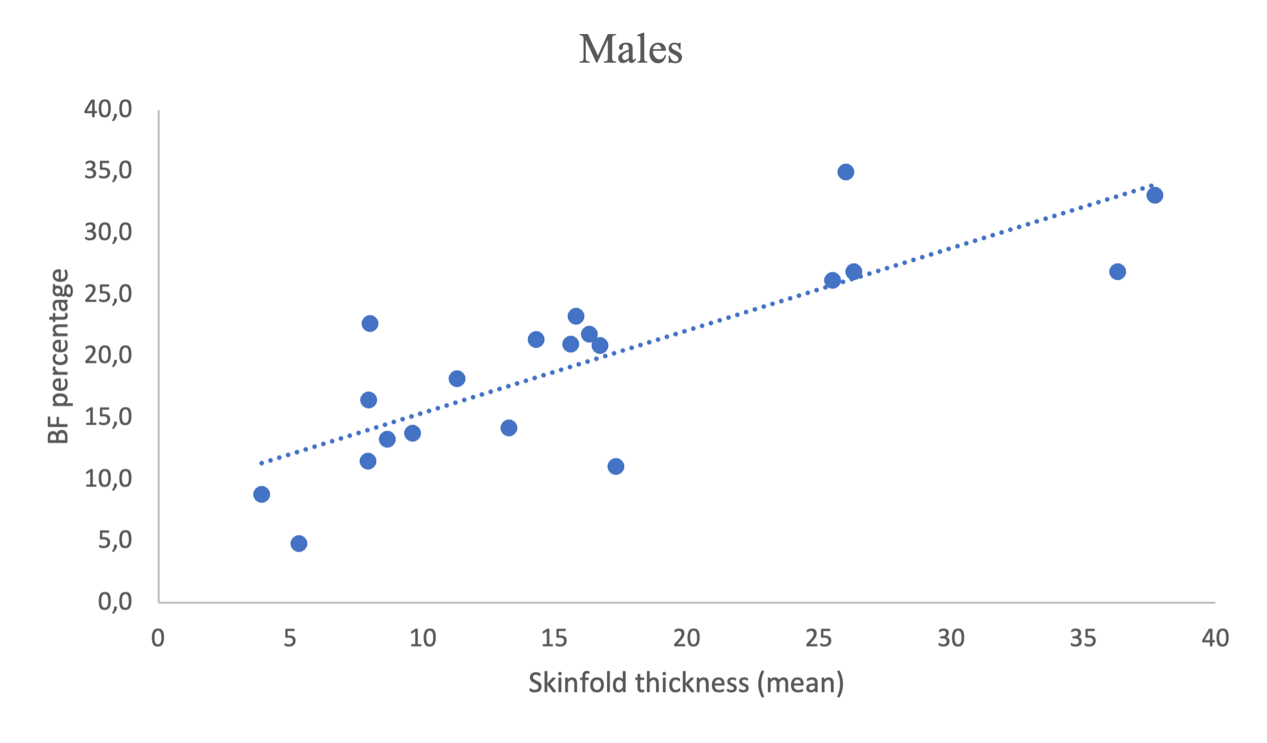
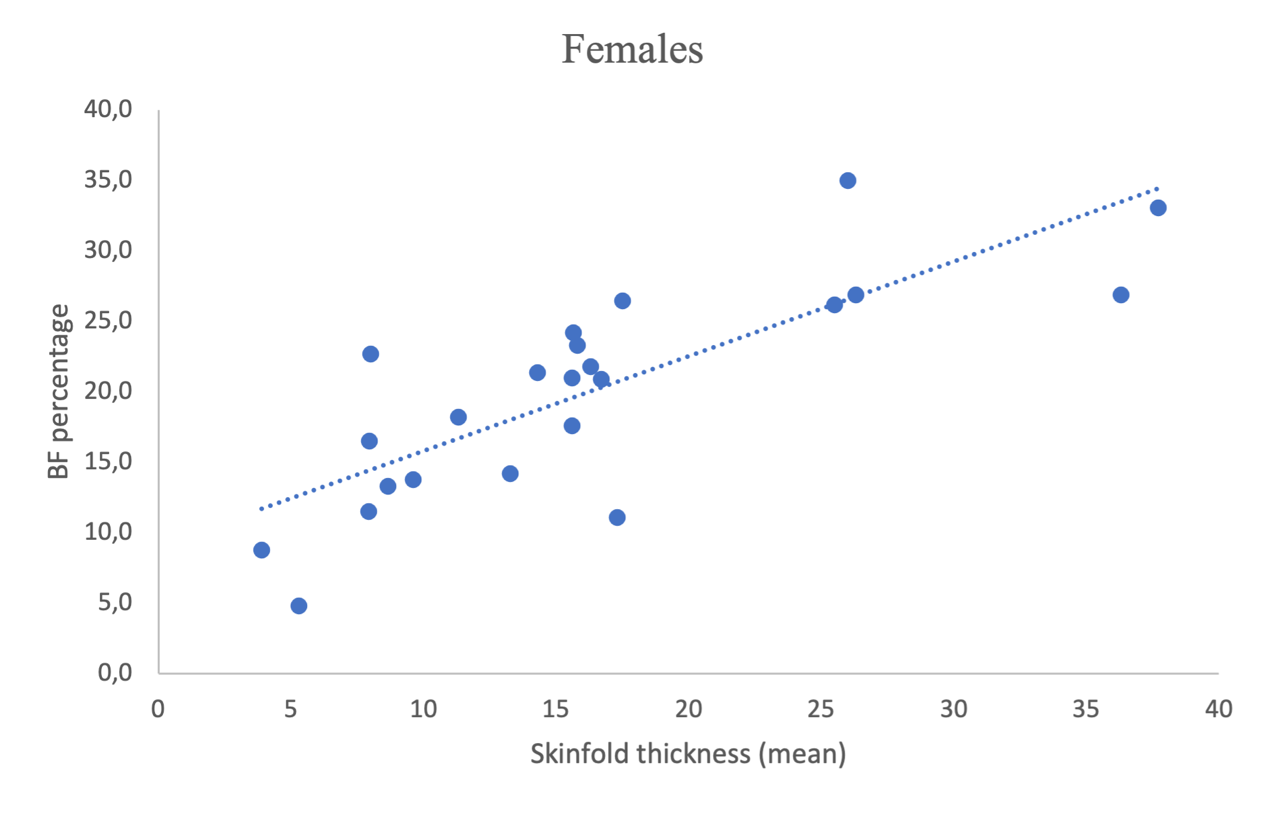
As shown in Figures 1 and 2, the Pearson correlation coefficient of 0.88 indicates a positive linear relationship between SFT and BF% across all participants, including males and females, with a strong association (Table 2, Cohen 1988).
Discussion
In such a way, the central aim of this study was to assess the use of skinfold thickness as a predicting factor of body fat percentage. Additionally, it was assumed that there would be a strong correlation between these two variables. The collected data show that the initial assumption was correct. For most participants, skinfold thickness correlates with body fat mass. The findings are essential, as they demonstrate the validity of the initial assumptions and the reliability of the selected measure and approach.
Thus, the correlation between skinfold thickness and body fat percentage has been documented by other investigators. For instance, Lewandowski et al. (2022) report that caliper measurements are highly accurate and can be used to predict body fat percentage. Furthermore, the researchers compared this measure with an ultrasound scanner and concluded that both tools are effective (Lewandowski et al., 2022).
The data acquired by the investigators indicate a strong correlation between these two variables, similar to the results obtained in the course of the study discussed. Hastuti et al. (2020) also report the strong correlation and the possibility of using the approach to predict body fat percentage. For this reason, it can be concluded that the findings from the study are supported by other research papers on the same topic.
It is also important to discuss the significance of the results. First of all, it shows that measuring skinfold thickness might be used to evaluate an individual’s health. For instance, obesity is one of the critical issues affecting various populations globally. Hastuti et al. (2020) state that the approach can be practical for struggling and for introducing timely responses to changes in body fat. The strong correlation between the investigated variables justifies using the method across various population groups and ensures that quality of life and health status are monitored.
It is also important to acknowledge the experiment’s reliability and the relevance of the measurement technique. For the experiment, only the triceps were measured using the special tool. At the same time, there are other approaches that involve multiple-site measurements to improve data accuracy. However, Elsey et al. (2021) admit that they require more time, while the difference is not critical. It means that the approach used during the experiment was effective and ensured the high relevance and credibility of the acquired findings.
Additionally, the findings obtained during the research are consistent with the normative data. Thus, Sivrikaya et al. (2019) state that the current guidelines emphasize a direct correlation between the body fat index and skinfold thickness. This means that formal recommendations accept this method as a tool to evaluate an individual’s health and conclude about the risks of obesity or excess weight. The findings from the research align with the normative data, indicating that the procedure was organized correctly and effectively.
Finally, the results help to prove the main research hypothesis. The findings indicate that individual skinfold thickness can be correlated with the body fat index and reflects the overall state of the body. Accepting the hypothesis is significant because it demonstrates the relevance of the acquired data, the strength of the study design, and its feasibility, and it provides a basis for future research on the same theme.
Conclusion
Altogether, the findings aligned with the study’s central aim and hypothesis. The acquired data shows that skinfold thickness is a predictor of body fat percentage. The investigation has high practical value, as it can be applied in real-life settings. Measuring SFT can be a cost-effective, fast method to evaluate a person’s state and determine whether interventions to prevent further deterioration are required.
In the future, the study can be improved by using multi-site measurements to compare the effectiveness of methods. It is also possible to include both physically active and non-physically active adults to see whether the correlation is different or the same. In general, the study showed the importance of body fat, body composition, and their evaluation tools.
References
Elsey, A. M., Lowe, A. K., Cornell, A. N., Whitehead, P. N., & Conners, R. T. (2021). Comparison of the three-site and seven-site measurements in female collegiate athletes using BodyMetrix™. International journal of Exercise Science, 14(4), 230–238.
Hastuti, J., Rahmawati, N. T., Suriyanto, R. A., Wibowo, T., Nurani, N., & Julia, M. (2020). Patterns of body mass index, percentage body fat, and skinfold thicknesses in 7- to 18-year-old children and adolescents from Indonesia. International Journal of Preventive Medicine, 11, 129.
Holmes, C. J., & Racette, S. B. (2021). The utility of body composition assessment in nutrition and clinical practice: An overview of current methodology. Nutrients, 13(8).
Lewandowski, Z., Dychała, E., Pisula-Lewandowska, A., & Danel, D. P. (2022). Comparison of skinfold thickness measured by caliper and ultrasound scanner in normative weight women. International Journal of Environmental Research and Public Health, 19(23).
Sivrikaya, K., Ziyagil, M., & Cebi, M. (2019). Relationship between body mass index and skinfold thickness in exercised and sedentary boys and girls. Universal Journal of Educational Research, 7(1), 48-54.