
Introduction
Since its establishment in a San Francisco living room in 2007, Airbnb has transformed the idea of vacation lodgings. Originating as a basic concept to provide air mattresses for rent under the name “Air Bed & Breakfast,” Airbnb has evolved into a worldwide sensation, with more than 5 million hosts and enabling over 1.5 billion guest stays in nearly every nation worldwide (Airbnb Newsroom, 2024). Airbnb serves many guests searching for genuine experiences and home-like amenities, and hosts want to earn money from their underutilized rooms.
The firm has remained competitive by operating in more than 220 countries and leveraging technology to deliver a smooth, dependable service. They have introduced over 430 new features and enhancements in the last three years (Airbnb, 2023). The company’s primary offerings have shifted from providing accommodations for one night to delivering a wide range of activities designed to genuinely facilitate visitors’ engagement with local communities.
Mission
Airbnb’s mission is to create a world where anyone can belong anywhere, providing unique travel experiences in more than 100,000 cities and towns worldwide. This mission focuses on inclusivity and the idea that Airbnb is more than just a service for booking accommodations; it’s about connecting people and fostering a sense of belonging.
Objectives
- Expand the global presence by increasing the number of listings and experiences available.
- Strengthen the Airbnb community by enhancing hosts’ and guests’ trust and safety measures.
- Drive sustainable growth by balancing opening new markets and deepening penetration in existing ones.
- Innovate constantly in the travel and technology space to stay ahead of competitors.
- Prioritize corporate social responsibility, including diversity and environmental impact.
Strategies
Airbnb’s focus on technology and innovation drives its objective by using advanced technology to enhance the booking process and customer experience, and by introducing innovative vacation choices that set its platform apart. The company’s Market Expansion strategy aims to expand its client base by targeting underrepresented markets and broadening the range of experiences available to meet diverse travel needs and preferences (Airbnb, 2023).
Commitment to Community Engagement is demonstrated by building strong relationships with hosts and visitors via consistent community support, educational resources, and responsive customer service (Thompson, 2022). Airbnb actively engages policymakers and stakeholders to navigate and influence the evolving landscape of the sharing economy. They also address the intricate regulatory hurdles that accompany global operations.
Airbnb uses Brand Marketing to enhance its brand story through storytelling, showcasing the distinctive, genuine experiences available on its platform and setting it apart from traditional hotel options. The diversification approach involves expanding the company’s product portfolio through initiatives such as Airbnb Experiences, which enhance its housing services and attract a wider range of customers (Airbnb, 2023).
Airbnb prioritizes Sustainability Initiatives to decrease travel’s environmental impact and promote responsible tourism. Airbnb places great importance on the pillar of Safety and Trust by implementing safety standards and rules to protect the Airbnb community and create a reliable environment for hosts and guests. Airbnb’s strategic areas work together to support its goal of being the most dependable, creative, and community-oriented platform in the worldwide travel sector.
A New Mission Statement
Airbnb’s renewed mission statement reflects its core commitments and strategic ambitions.
- Customers: The company is dedicated to fostering a global community of travelers and hosts, ensuring everyone can belong anywhere and share unique, local experiences.
- Products or Services: Airbnb’s platform facilitates these experiences by offering diverse accommodations and activities catering to various tastes and preferences.
- Markets: By competing across a broad spectrum of geographical landscapes, Airbnb seeks to serve as a universal link between cultures and communities.
- Technology: Innovation is at the forefront of their operations, with cutting-edge technology deployed to streamline and enhance the user experience on their platform, making it both user-friendly and advanced.
- Concern for Survival, Growth, and Profitability: The company is committed to sustainable growth and financial stability, ensuring long-term viability and success in the competitive market.
- Philosophy: Their philosophy centers on inclusivity, trust, and human connection, which are considered pivotal in shaping the interactions and experiences facilitated by their service.
- Self-concept: Airbnb prides itself on a community-driven platform that not only provides economic opportunities for hosts but also crafts memorable experiences for travelers, distinguishing itself from traditional travel options.
- Concern for Public Image: As a socially responsible entity, Airbnb actively works to make a positive impact in every community it engages with, focusing on social, community, and environmental concerns.
- Concern for Employees: The company cherishes its employees, viewing them as essential contributors to innovation and the overall success of the enterprise. This mission statement encapsulates Airbnb’s vision to transform travel and accommodation experiences globally, ensuring a sustainable and inclusive future for all its stakeholders.
Analysis of Airbnb’s Existing Business Model
Airbnb’s business model is based on the sharing economy, using a platform that connects visitors with hosts who offer distinctive accommodations worldwide. Airbnb operates with lower overhead than typical hospitality firms by leveraging existing residences owned by hosts, reducing the need for significant capital investment in property and staff (Aggarwal & Mittal, 2024). Airbnb can expand quickly into other markets without incurring the capital expenses often required to grow traditional hotel businesses (Hui & Srinivasan, 2019).
Airbnb earns its primary income from service fees imposed on reservations, divided between hosts and guests. Airbnb’s revenue in the fourth quarter of 2023 was $2.2 billion, up 17% from the previous year. Airbnb’s commission-based income model aligns its interests with its users: the more successful the hosts are, the more successful Airbnb becomes, driving its rapid growth and popularity (Oe & Liu, 2023). This indicates the company’s ability to produce substantial cash flow despite changing market circumstances.
The platform’s reliance on user-generated content and its peer-to-peer structure create risks. Regulatory issues, such as short-term rental legislation and taxation, pose ongoing dangers. Airbnb’s net earnings were significantly affected by non-recurring tax withholding charges resulting from changes in lodging tax legislation (Airbnb, 2023). Furthermore, a significant and continual investment in technical innovation is essential to remain competitive and satisfy consumer demands.
This has been evident in the implementation of more than 430 new features and updates over the last three years (Airbnb, 2023). Airbnb’s business strategy is excellent because it enables sustained strong growth and adaptation to various market conditions (Destefanis et al., 2020). The platform’s adaptability enabled it to swiftly adjust during the COVID-19 pandemic by implementing more robust cleaning processes and flexible cancellation policies, which helped regain passenger trust and sustain the business.
SWOT Matrix Analysis
A SWOT analysis highlights Airbnb’s strong position in the global accommodation market, supported by its technology expertise and extensive market coverage. However, it highlights the intricacies and weaknesses of operating within a platform-based sharing economy paradigm (Table 1). Airbnb’s global brand awareness and innovative technology offer it a competitive advantage, enabling scalability and adaptability. Airbnb introduced over 430 new features to improve customer experience and efficiency, leading to a 17% revenue growth in Q4 2023 (Airbnb, 2023). These innovations promote operational efficiencies and client happiness and retention.
However, vulnerabilities, including regulatory constraints and reliance on hosts’ and travelers’ opinions, pose ongoing risks. Airbnb’s innovative business model, which challenges conventional hospitality practices, often faces regulatory resistance that may hinder its expansion. The Q4 2023 shareholder letter from Airbnb highlighted complex tax issues and non-recurring tax charges, demonstrating the financial and operational effects of these challenges.
Potential development areas include new countries and long-term stays, particularly as global work trends change. Nevertheless, challenges such as heightened competitiveness and economic downturns necessitate a proactive approach to minimize their effects (Table 1). Airbnb is particularly vulnerable to economic fluctuations because trip expenditures are discretionary and are strongly influenced by global financial conditions.
TOWS Strategy Matrix Analysis
Airbnb should prioritize regulatory engagement and lobbying by increasing its interactions with regulatory authorities worldwide to promote favorable rules. Engaging in legislative procedures will help Airbnb address current and future regulatory challenges, ensuring a more stable operating environment during its expansion (Table 2). Airbnb must maintain a focus on technology developments and data security. Improving the platform’s artificial intelligence capabilities may enhance user experiences, optimize operations, and offer more tailored offerings.
Enhancing data security measures is crucial for protecting user information, building and sustaining trust and dependability, and attracting and retaining users in a digital economy. Finally, it is advised to diversify services to reduce economic and sector-specific risks. Airbnb may broaden its client base by introducing services such as Airbnb for Work, long-term rentals, and distinctive local experiences that appeal to business visitors and digital nomads (Airbnb, n.d.). Diversifying will stabilize revenue and decrease reliance on conventional short-stay tourism sectors.
Group Map Analysis
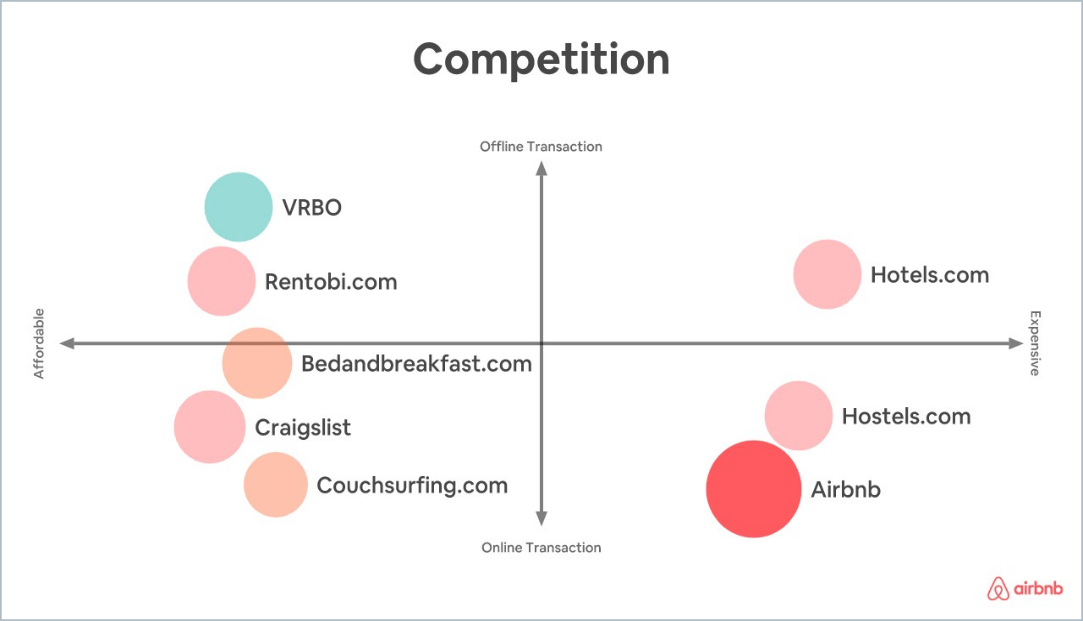
The Group Map for Airbnb is designed to encompass the firm as a whole rather than focusing on a specific Strategic Business Unit (SBU). This approach is selected because Airbnb operates predominantly under a unified business model, seamlessly integrating its accommodation and experience offerings worldwide. This comprehensive view facilitates a more straightforward analysis of its competitive landscape and market positioning. This strategy leverages the increasing customer inclination towards digital ease, immediacy, and the wide range of choices offered by online platforms.
Unlike its competitors, VRBO and Bedandbreakfast.com, which also have an online presence, a substantial amount of their transactions and client contacts take place offline. This may involve phone reservations or face-to-face services that cater to a specific consumer demographic. Competitors involved in offline transactions may offer a more conventional, perhaps personalized, customer care experience (Chart 1). Airbnb’s focus on online transactions enables it to optimize operations and leverage data analytics to deliver customized guest experiences.
Competitive Forces Analysis
Airbnb’s market and competitive landscape are shaped by several variables analyzed in the PESTLE and Porter’s Five Forces assessments. Airbnb operates within an intricate network of rules that vary by country, which impacts its operations. Regulations tailored for conventional accommodations can either impede or facilitate the sharing economy based on how they are adjusted by local legislation. Global financial conditions influence Airbnb’s economic performance: recessions reduce travel expenditures, while economic upturns increase them.
Table 4
Porter’s Five Forces Analysis for Airbnb
- Threat of new entrants: High. Low entry barriers for online marketplaces, though brand recognition and trust are challenges for newcomers.
- Supplier bargaining power: Low. In Airbnb’s case, suppliers are the hosts who, despite numerous alternatives, gain significant value from Airbnb’s vast user base.
- Customer bargaining power: High. Customers have many alternatives for accommodation and experiences, making them price-sensitive and demanding service quality.
- Threat of substitutes: High. Alternatives include hotels, hostels, other vacation rental platforms, and staying with friends or family.
- Competition: High. There is intense competition with other platforms and traditional hotels, all vying for a share of the travel market.
Airbnb benefits from technological advancements by leveraging data analytics and AI to enhance user experiences and operational efficiency. Nevertheless, staying up to date with these technologies requires substantial and ongoing expenditure (Table 3). Legal factors, such as intellectual property and labor regulations, significantly impact operational strategies (Habib et al., 2019). Airbnb may differentiate itself by embracing sustainable travel practices to meet the growing demand for eco-friendly choices. The threat of new entrants is high in Porter’s Five Forces analysis due to low entry barriers in the digital economy (Table 4).
Buyers have strong negotiating power due to the abundance of options available to tourists, which requires Airbnb to improve its value proposition continually. Suppliers have minimal bargaining leverage because hosts receive enormous value from Airbnb’s platform. Airbnb is under pressure to develop and differentiate its services to avoid replacement by hotels and other rental platforms (Cocola‐Gant & Gago, 2019). Finally, intense competition with current rivals requires strategic flexibility and a clear emphasis on preserving competitive edges.
Conclusion
A thorough examination of Airbnb reveals a corporation that has skillfully leveraged the sharing economy to build a robust worldwide presence, employing an inventive business strategy that uses technology to connect passengers with distinctive accommodations. Airbnb has shown substantial financial growth, with a Compound Annual Growth Rate (CAGR) of 43.19% in sales from 2020 to 2023 and a promising outlook for future profits.
The Net Present Value (NPV) calculation indicates a promising return on strategic expenditures targeting technology breakthroughs and market development, highlighting the potential for significant future growth. Airbnb’s strategic orientation, focused on continuous innovation and market adaptation, positions the firm for future success. The dedication to addressing regulatory obstacles, improving customer satisfaction, and broadening sources of income demonstrates a forward-looking strategy.
References
Aburumman, A. (2020). COVID-19 impact and survival strategy in business tourism market: The example of the UAE MICE industry. Humanities & Social Sciences Communications, 7(1).
Airbnb. (2023). Q4 2023: Shareholder letter.
Airbnb. (n.d.). Fighting discrimination and building inclusion.
Airbnb. (2024). About us. Airbnb Newsroom.
Aggarwal, S., & Mittal, A. (2024). Futuristic hospitality conceptualized: DASH – decentralized autonomous and smart hotel system. Journal of Open Innovation, 10(1).
Cocola‐Gant, A., & Gago, A. R. A. (2019). Airbnb, buy-to-let investment and tourism-driven displacement: A case study in Lisbon. Environment & Planning. A, 53(7), 1671–1688.
Doğru, T., Marchio, E. A., Bulut, Ü., & Suess, C. (2019). Climate change: Vulnerability and resilience of tourism and the entire economy. Tourism Management, 72, 292–305.
Destefanis, A., Neirotti, P., Paolucci, E., & Raguseo, E. (2020). The impact of Airbnb on the economic performance of independent hotels: an empirical investigation of the moderating effects. Current Issues in Tourism, 25(21), 3534–3564.
Fernandes, A. D., Cadigan, M., Edwards, F., & Harris, A. (2019). Monetary sanctions: A review of revenue generation, legal challenges, and reform. Annual Review of Law and Social Science, 15(1), 397–413.
Habib, M., Abbas, J., & Noman, R. (2019). Are human capital, intellectual property rights, and research and development expenditures really important for total factor productivity? An empirical analysis. International Journal of Social Economics, 46(6), 756–774.
Hui, L., & Srinivasan, K. (2019). Competitive dynamics in the sharing economy: An analysis in the context of Airbnb and Hotels. Marketing Science, 38(3), 365–391.
Lü, L., Peng, J., Wu, J., & Lü, Y. (2021). Perceived impact of the COVID-19 crisis on SMEs in different industry sectors: Evidence from Sichuan, China. International Journal of Disaster Risk Reduction, 55.
Laloux, L., Cizeau, P., Potters, M., & Bouchaud, J. (2000). Random matrix theory and financial correlations. International Journal of Theoretical and Applied Finance, 03(03), 391–397.
Oe, H., & Liu, L. (2023). The innovative organization of Airbnb: Business model innovation and holacracy structure to enhance innovative business behavior coping with the impact of COVID-19. International Journal of Business Innovation and Research, 30(1), 84.
Quach, S., Quach, S., Martin, K. D., Weaven, S., & Palmatier, R. W. (2022). Digital technologies: Tensions in privacy and data. Journal of the Academy of Marketing Science, 50(6), 1299–1323.
Thompson, A. (2022). Crafting and executing strategy: The quest for competitive advantage: Concepts and cases (23rd ed.). McGraw-Hill/Irwin.
Yahoo. (2024). Airbnb, Inc. (ABNB). Yahoo Finance.
Yao, B. Y., Qiu, R. T., Fan, D. X., Liu, A., & Buhalis, D. (2019). Standing out from the crowd – an exploration of signal attributes of Airbnb listings. International Journal of Contemporary Hospitality Management, 31(12), 4520–4542.
Appendices
Appendix A
Table 1. SWOT Matrix
Appendix B
Table 2. TOWS Matrix
Appendix C
Appendix D
PESTLE Analysis for Airbnb
- Political: Regulatory challenges across different markets, taxation laws, and lobbying for sharing economy acceptance.
- Economic: Economic fluctuations impact travel spending, and exchange rate volatility affects international bookings.
- Cultural: Increasing acceptance of the sharing economy cultural shift towards authentic travel experiences.
- Technological: Advancements in platform technologies, AI, and machine learning for customer service and operational efficiency.
- Legal: Intellectual property rights in technology, labor laws affecting gig economy workers, and property zoning laws.
- Environmental: Sustainable tourism trends, environmental impact of travel, corporate responsibility towards green practices.