
Introduction
Central to social and economic development worldwide is transport. In addition to allowing connectivity, efficient transport supports the production and distribution of goods and services. Sustainable transportation further leads to cost savings on fuel, improved accessibility, reduced carbon emissions, and enhanced energy security.
Moone Valley Council in Melbourne is advancing sustainable transportation to improve the overall safety, efficiency, and affordability of public transit. The Council developed a 10-year plan, the Walking and Cycling Strategy, to create opportunities for improved transportation, in turn, impacting its economic and social status (Moonee Valley City Council, n.d.). This has become a landmark plan that demonstrates the government’s influence on the success of such initiatives. Implementing sustainable transportation options in Moone Valley is essential to achieving the region’s social and economic goals.
Cycle-Ability in Moonee Valley Council
Moonee Valley is experiencing population growth, which implies increased use of public transport. Additionally, the region has an aging population, meaning that few residents will be driving in the near future. As such, Moonee Valley Council is embracing sustainable transport, including prioritizing cycling in planning processes and developing a culture of enjoyable, healthy ways to travel, thereby promoting social inclusion.
In 2007, cycling and walking accounted for approximately 15 percent of all trips in Moonee Valley (Moonee Valley City Council, n.d.). According to National and international research on travel behavior, people comfortably ride bikes up to 5 kilometers (Moonee Valley City Council, n.d.). Despite this, Moonee Valley records lower cycling levels than its neighboring municipalities. Among the objectives of the walking and cycling strategy is to increase cycling for short trips across the region.
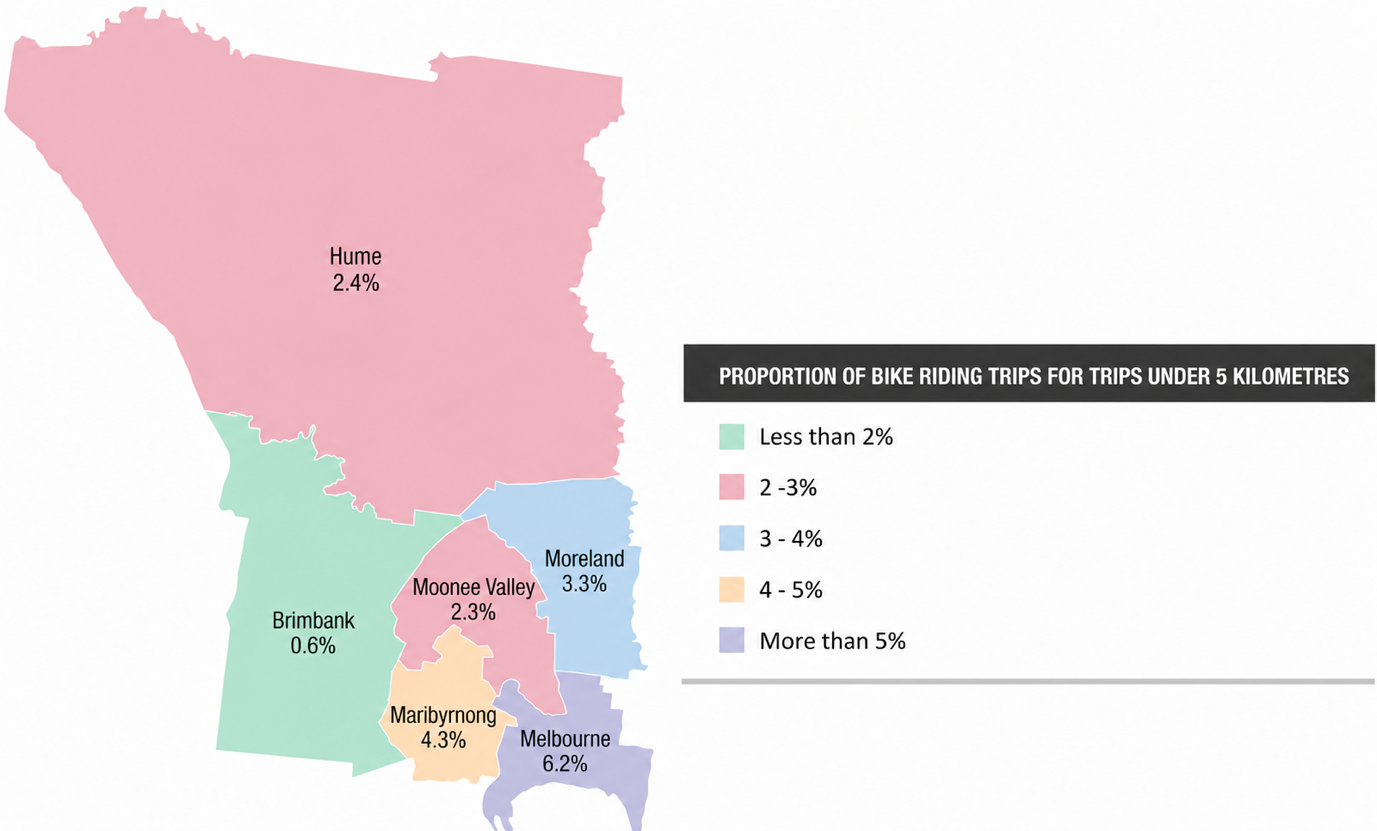
Moonee Valley has numerous cycling routes, from shared to on-road paths. However, for trips covering a distance of 5 kilometers in Moonee Valley, as demonstrated in Figure 1, 2 percent are by bike, while by car is approximately 50 percent (Moonee Valley City Council, n.d.). Therefore, achieving a more connected network of cycling paths has become fundamentally important. The 2006 census data revealed that the municipality has around 48,000 workers, and some of them ride bikes to work. Despite this, there has been a steady decline in cycling as a mode of transport (Moonee Valley City Council, n.d.). The Household Survey indicated that cycling decreased from 27 to 17 percent between 2009 and 2010 (Moonee Valley City Council, n.d.). This presents an opportunity for the Moonee Valley Council to combat declining cycling trends and facilitate sustainable transportation options.
Governance and Transport Sustainability
Creating policies that streamline community projects and transportation access while meeting sustainability goals has become an integral goal across countries. The federal government plays a pivotal role in creating sustainable transportation systems by developing and implementing policies that enforce emission standards and promote public transit. In Moonee Valley, Melbourne, policies incentivize alternative means of public transportation through a combination of efficient strategies, regulations, and investment in walking and cycling infrastructure.
Essentially, the Council has adopted a tailored approach to address Moonee Valley’s unique challenges while advancing sustainable transportation practices. In 2008, the region enforced an Integrated Transport Plan that recognized cycling as a key form of transport. Shared cycling paths were established along the Maribyrnong River, Moonee Ponds Creek, and Steele Creek (Moonee Valley City Council, n.d.). Although Moonee Valley has steadily increased investment in bicycle infrastructure, further improvements are imperative to keep pace with the growing number of active travelers. The built environment can make walking and cycling attractive options despite social norms that favor cars as the primary means of travel.
Operational strategies and traffic infrastructure in Moonee Valley, including road design and signal timing, disadvantage cyclists, especially at roundabouts and intersections. Narrow road widths in certain areas prevent on-road cycling and create a perception that existing paths are dangerous for cyclists. The region’s 10-year strategy identified improvements to cycling networks for increased convenience.
Furthermore, the four guiding principles for action to realize a well-connected and livable city include infrastructure, integration, inspiration, and convenience (Moonee Valley City Council, n.d.). Each action was assigned a budget that covers the construction of cycling facilities and other innovative programs. Collaboration with agencies such as the Federal Government, the Department of Transport, and Melbourne Water has provided external funding for the project and improved decision-making processes related to the development of cycling infrastructure (Moonee Valley City Council, n.d.). By supporting the research and development of sustainable practices, Moonee Valley Council has driven innovation in cycling infrastructure that enhances road safety, transportation accessibility, and equity.
Challenges and Opportunities
Cycling is gaining attention as an environmentally friendly mode of transport. Traditional transport planning has increased greenhouse gas emissions, traffic congestion, road fatalities, and poor air quality (Moonee Valley City Council, n.d.). In addition to heightened road-safety risks, climate change necessitates a shift to more sustainable options. Nikitas et al. (2021) asserted that attaining high cycling rates is among the key ways society can achieve its sustainability goals.
Moonee Valley has made several policy interventions to promote walking and cycling, but faces certain barriers. According to Schmassmann et al. (2024), cycling has been marginalized in modernized transport planning. The lack of adequate funding and leadership hinders the implementation of robust cycling initiatives.
Resistance from other transportation agencies can impede the increased adoption of walking and cycling as sustainable practices. This can arise from concerns regarding the reallocation of on- and off-road space and the reduced importance of other modes. Another potential challenge is the inequitable distribution of cycling resources, which would exacerbate disparities in public transit.
Inadequate planning of the Walking and Cycling Plan can hinder its execution and effectiveness. Existing social norms can make cycling less attractive, as evidenced in Moonee Valley, where more people prefer cars to bicycles (Moonee Valley City Council, n.d.). For these reasons, Moonee Valley Council must implement policies to unlock the benefits of sustainable transportation options.
Most low-income communities have limited access to safe, convenient transport. Cycling is an active travel mode that can improve access to services and numerous opportunities for this population. Investments in active mobility initiatives and infrastructure ensure the safety of cyclists and other road users (Campisi et al., 2020). However, cycling remains underfunded while more emphasis is placed on other transportation projects, such as car-centered design.
The challenges present opportunities for the Moonee Valley Council to improve cycling initiatives. Among these is raising awareness of cycle infrastructure through various promotional activities. Some people may consider cycling unsafe since they believe that they have to encounter traffic on roads. Contrary to this assumption, cycle highways are traffic-free, and with this knowledge, more individuals would inevitably embrace cycling as a mode of transport.
Furthermore, greater knowledge of safe routes and the benefits of cycling would encourage cycling in Moonee Valley. Developing and using communication resources, such as the media, can be key to raising awareness. Equally important is collaboration with adjacent councils to attract funding and build an efficient cycling network. Through this approach, Moonee Valley Council can pool more resources to support its 10-year plan and develop policy thinking on sustainable solutions.
Conclusion
Walking and cycling are sustainable transport options with numerous benefits for individuals and society as a whole. Moonee Valley Council in Melbourne has embraced these means of transport due to its growing and aging population, which will make other modes less efficient. Through effective governance, the region has developed a 10-year plan to revamp its walking and cycling strategy, reinforcing sustainability efforts.
The positive impacts of this strategy include reduced carbon emissions, improved air quality, reduced traffic congestion and road incidents, and fuel cost savings. Walking and cycling are more reliable, convenient, flexible, and safe. Transport supports economic and social activities, and rethinking and improving transit through structural changes would help move toward more sustainable options.
References
Campisi, T., Acampa, G., Marino, G., & Tesoriere, G. (2020). Cycling master plans in Italy: The I-BIM feasibility tool for cost and safety assessments. Sustainability, 12(11).
Moonee Valley City Council (n.d.). Walking and cycling strategy 2012-2022. City of Moonee Valley.
Nikitas, A., Tsigdinos, S., Karolemeas, C., Kourmpa, E., & Bakogiannis, E. (2021). Cycling in the era of COVID-19: Lessons learnt and best practice policy recommendations for a more bike-centric future. Sustainability, 13(9).
Schmassmann, A., Baehler, D., & Rérat, P. (2024). The contrasted evolution of cycling during youth. Determinants of bicycle ownership and use. International Journal of Sustainable Transportation, 18(2), 103-114.