
Introduction
Forming a cultural worldview involves various aspects and factors influencing the respective perceptions. Music is one of the most powerful drivers of this process. It largely determines the mood in society and reflects social trends. The concept of identity, closely associated with culture, is also a phenomenon closely tied to music, as specific interests and preferences allow for describing a psychological portrait and obtaining a basic idea of personality type.
When discussing music in a mass context and its impact on culture and identity, one can think of vivid examples where certain artists or bands have formed unique directions and carried the masses, influencing identity. One such example is The Beatles, the British band that began its activities in the mid-20th century and created a unique cultural legacy. Identity is a characteristic that is influenced by different stimuli. The Beatles’ art can be considered a driving force in many ways, contributing to a change in the cultural perception of millions of their fans.
The Beatles’ Cultural Role
The cultural phenomenon of The Beatles, considered in the context of identity, is revealed through various aspects, including the mass passion for the band’s music, the adoption of a new style, unique lyrics, and other factors. In their case study, Batranu-Pintea and Coman (2021) compare the influence of the Liverpool band on the culture of two countries with distinct socio-cultural backgrounds – Japan and Romania. According to the authors, through interaction with representatives of these two cultures, specific incentives for changing cultural perceptions are considered (Batranu-Pintea & Coman, 2021). Based on the assessment, The Beatles’ work is a driver capable of changing traditional cultural perceptions among citizens of both countries, including their identity as a characteristic that emphasizes unique life trajectories (Batranu-Pintea & Coman, 2021). These findings highlight the profound impact that the band has had on the world of music and culture.
The Beatles’ music is a part of pop culture, one of the broadest layers, involving millions of fans. As Lebovic (2017, p. 43) argues, its art “served to reproduce cultural differences when different social formations projected their own meanings onto the hybridized group”. In other words, through a new interaction style with the audience, The Beatles transformed traditional ideas about the culture by bringing together different directions and building a new common trend. Such a phenomenon can be compared to globalization, when standard convergence mechanisms are promoted despite differing approaches and perceptions, forming close ties. Culture, in this case, serves as the backdrop against which certain interaction principles are established, and music functions as a communication tool.
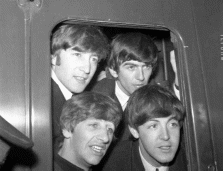
As the Liverpool Four gained popularity, they won the hearts of millions of people worldwide, and their images, depicted in Figure 1, became iconic (Stephens, 2021). According to Batranu-Pintea and Coman (2021), this is evidence of a profound cultural impact. At the same time, along with culture, the concept of identity, which is narrower, was also involved due to the spread of influence.
Impacts on Identity
Due to the essential role of this phenomenon, particular attention is paid to identity as a concept that reflects both individual and class aspects of social development. In their case study, Batranu-Pintea and Coman (2021) focus primarily on musical identity, juxtaposing the interests of various Beatles fans and evaluating the characteristic influences that the band’s music has had. In a broader sense, identity is a concept that affects various manifestations of the worldview, including communication, values, life orientations, and other aspects. For instance, Young (2022) links the concept of identity to place, discussing the origins of the Liverpool Four and describing the iconic locations that were key to the formation of the band.
However, to identify commonalities, it is crucial to determine the extent to which the individual stimuli created through the music of The Beatles influenced personal identities. In the context of music, this influence defines the culture, which, as Batranu-Pintea and Coman (2021) remark, directly reflects the life of the people of that era. When speaking about the heyday of The Beatles, one can note the enormous influence of the band on both mass and individual identities.
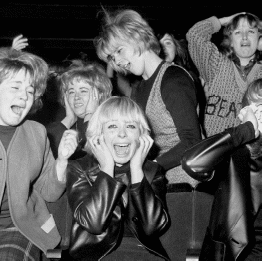
The art of The Beatles has had a significant effect on identity, manifested in different contexts. In Figure 2, one can see the emotions of female fans seeing their idols (Zaleski, 2022). For the middle of the 20th century, such a reaction to art was uncharacteristic, indicating the musicians’ enormous impact on music perception. According to Zaleski (2022), regardless of location, women’s fan movements emerged, and in each of these communities, characteristic identities emerged, such as slogans, greetings, and other features. At the same time, being united by a common passion, these groups formed a single mechanism with an identity that reflected devoted and even hysterical affection (Zaleski, 2022). As a result, one can talk about dividing the concept of identity into particular manifestations within similar systems of thought and perception.
Given the impact of The Beatles’ identity, their performance style, manners, clothing, and other characteristics have influenced cultural perceptions significantly. Being iconic artists, they developed a unique genre that had not previously existed in pop music, allowing them to stand out from other bands. In addition, Trupej (2017) states that musicians have become a symbol of British national identity by popularizing the culture with the masses and thus associating themselves with a particular country.
Such an image is natural and is perceived as a direct association with the origin. Trupej (2017) gives the example of the Sex Pistols, The Who, and other iconic British bands that were also perceived as representing a particular nation. Following this idea, national identity is primarily associated with characteristic cultural perceptions and conveys the corresponding images and ideas adapted and rooted in society.
Identity as a Shared Cultural Feature
While considering the aforementioned findings and conclusions, the idea of identity as a shared feature in the context of culture can be proposed. For instance, according to Bounds (2019), in every song by The Beatles, listeners can find the features and those nuances that are pleasing to each individual. However, given the phenomenon of the Liverpool Four, one can note that, regardless of personal relationships, a common identity was formed against the backdrop of the band’s creativity. Batranu-Pintea and Coman (2021, p. 230) put the concept of “interacting identities” in their discussion and refer to the totality of perceptions about The Beatles and the formation of the band’s overall image. As a result, even though fans differ culturally and globally, the concept of identity can be shared.
The impact on listeners’ thinking is an obvious manifestation of a common identity in the context of The Beatles’ effect. Batranu-Pintea and Coman (2021) draw attention to the changed mentality and outlook of the band’s fans and note the relevance of the cultural effect expressed in identity transformation. Moreover, The Beatles’ longstanding popularity suggests that the perception shifts initiated by the musicians are deeply ingrained in society, thus changing the understanding of music. Even though culture is a broader concept than identity, these two terms complement each other, and shifts in one phenomenon inevitably entail changes in the other. Thus, the art of The Beatles, forever included in the history of world music, can be considered a significant stimulus for the transformation of culture and both individual and shared identities.
Conclusion
The Beatles’ example as an iconic pop band proves that the impact on identity, including personal and shared features, has much to do with societal cultural shifts. As innovators in their genre, the musicians gained millions of fans globally, who formed into communities and, at the same time, adhered to common perceptions. The impact on mentality proves the band’s importance in the history of music. It confirms that these two phenomena are interconnected despite the greater breadth of the concept of culture than identity.
Reference List
Batranu-Pintea, V. and Coman, C. (2021) ‘The effects and cultural impact of one of the most popular bands in the history of music. The Beatles as opinion leaders’, Bulletin of the Transilvania University of Braşov. Series VII: Social Sciences and Law, 14(2), pp. 227-236.
Bounds, P. (2019) ‘The Beatles and British culture: chippy class warriors to eternal spiritual explorers’, Culture Matters. Web.
Lebovic, S. (2017) ‘“Here, there and everywhere”: The Beatles, America, and cultural globalization, 1964-1968’, Journal of American Studies, 51(1), pp. 43-65.
Stephens, R. J. (2021) ‘The Beatles reshaped American culture, explaining their enduring appeal’, The Washington Post. Web.
Trupej, J. (2017) ‘Ideological influences on the reception of Elvis Presley and The Beatles’, in Kennedy, V. and Gadpaille, M. (eds.) Ethnic and cultural identity in music and song lyrics. Newcastle upon Tyne: Cambridge Scholars Publishing, pp. 187-208.
Young, R. (2022) ‘Roll up! For the magical mystery tour: an examination of Beatles fandom, pilgrimage and identity’, Networking Knowledge: Journal of the MeCCSA Postgraduate Network, 15(2), pp. 1-12.
Zaleski, A. (2022) ‘‘It’s a more expansive, inclusive version’: how women reshaped the history of the Beatles’, The Guardian. Web.