
Urbanization Trends
This paper focuses on analyzing the urbanization levels of Eastern Asia countries, including Indonesia, Japan, Malaysia, China, and Thailand. The following conclusions can be drawn based on the World Bank Group website data. There is a clear common trend of increasing urban populations between countries. Large cities attract people from the hinterland with developed infrastructure and opportunities for self-realization.
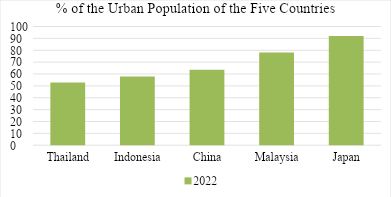
Notably, from 1990 to 2020, there was a significantly sharp jump in the urban population, in contrast to the period from 1960 to 1990. Such a moment is associated with a considerable improvement in the quality of life in large cities, thanks to technologies, innovations, and revolutionary discoveries. It should be noted that Japan stands out in this table since the country, then and now, has a high proportion of urban population compared to other regions.
Table 1. Urban Population (% of Total Population) in East Asia Countries (DataBank: World development indicators, n.d.)
Correlation Between Urban Population and Economic Development
Using the examples of developed countries such as Japan, Malaysia, and China, it can be observed that a significant percentage of the urban population directly depends on the country’s economic development. These are some of the most developed Asian countries, characterized by high human development indicators, and their funds are typically allocated to research and development (Ur Rehman, 2022).
In addition, high-income countries have high urbanization rates, and one can notice more relationships. In these countries, the urban population constitutes at least 60% of the total population. Consequently, developed countries have a large concentration of people in cities. However, China has the highest level of economic development among the designated countries, but it has a relatively small urban population compared to Japan and Malaysia. This phenomenon may be due to cultural differences, geographical conditions, urbanization policy, and other relevant factors.
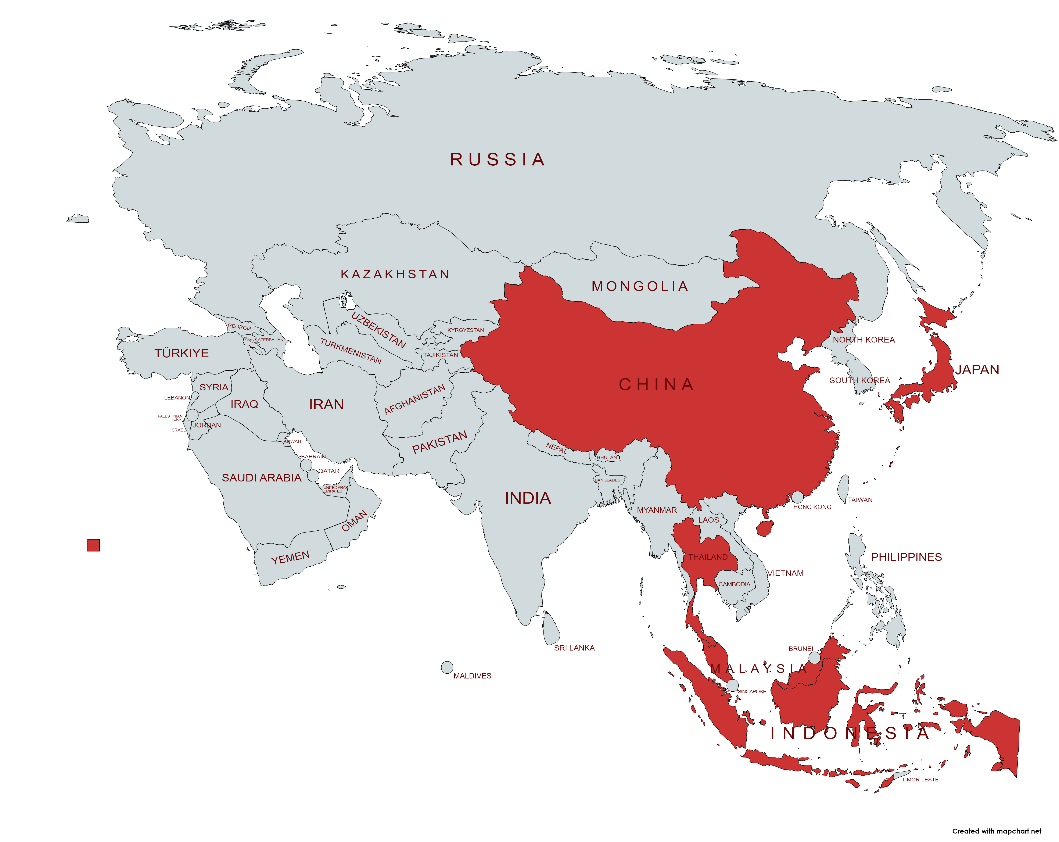
Although China is geographically extensive, the country has a relatively small proportion of its population living in urban areas. Accordingly, the criterion of economic development level is not the only factor affecting the percentage of the urban population. On the contrary, more than 90 percent of the country’s population now lives in Tokyo, and people continue to move there from other regions in search of a more prosperous life.
References
Asia. (n.d.). MapChart.
DataBank: World development indicators. (n.d.). The World Bank Group.
Ur Rehman, H. (2022). 12 Most Advanced Countries in Asia. Yahoo.