
Introduction
This proposal focuses on the affordable housing crisis in Charlotte and how to address it. This paper notes that many people in Charlotte and the US spend more than half of their income on rent, affecting their daily lives. They need more money to access healthy foods, quality medical care, and even to attend to emergencies.
Therefore, for Charlotte to ensure its housing is affordable for everyone, it needs to implement various strategies, including collaboration between private and public sectors, revisiting and reforming land use policies, introducing creative financial options, and preserving and rehabilitating the existing houses. This would help the city offer long-term affordable housing. While implementing these strategies, Charlotte should foster collaboration with different stakeholders, continuously review and update land use policies, and monitor the project’s implications.
In the past years, people from low-income backgrounds have found it significantly challenging to find houses that are affordable to them. According to a study by Anacker, renters from low-, very low-, and extremely low-income backgrounds have experienced a gradual decline of affordable housing in many nations, including the US (Anacker 2). Housing affordability often affects household budgets and leaves people with less to pay for food, work transport, utilities, child care, and other expenditures.
This also reduces their savings for retirement, emergencies, and other opportunities like starting a small business or pursuing higher education (Anacker 2). Due to these challenges, people have fewer opportunities to explore and a lower quality of life. To respond to this issue, this paper proposes the need for collaborative efforts, innovative financing, and policy reforms to foster the development and preservation of houses everyone can afford.
Glossary
- Affordable Housing. These are houses that people and families can afford to live in and only pay 30% or less of their income.
- Inclusionary Zoning. A land use policy that compels house developers to include affordable houses in their projects.
- Density Bonuses. Incentives that developers receive for having affordable housing units in their project.
Needs Assessment
The Importance of Affordable Housing
Housing is a basic need for every person and is significant in overall well-being. An article by the Habitat Organization states that housing is an environment where people reside and includes the physical structure that they use for shelter, and all essential services, equipment, facilities, and devices (Habitat Organization, par.1). When houses are unaffordable, many people do not get a chance to have better and more comfortable ones. As a result, they fail to have a place that would influence their overall well-being.
Rolfe notes, “housing is often cited as an important social determinant of health, recognizing the range of ways in which a lack of housing, or poor quality housing, can negatively affect health and well-being” (Rolfe et al. 1). After a long day from work or studies, people often need a comfortable house, where they call home and can relax and relieve stress. Therefore, housing should be affordable to everyone in the US if the nation considers the health and well-being of its citizens.
Affordable housing does not compel a person to spend most of their income. In many countries, affordable housing must be below an individual’s 30% household income. A study by the US Department of Housing and Urban Development (HUB) reported that if a household is compelled to pay higher than 30% salary to afford a house then it is a significant burden to them (Habitat Organization, par. 1). This means that as much as housing is an essential need for every human survival, it does not have to be a burden.
For many Americans, paying for housing and other daily expenses has become challenging. A higher percentage of people in America pay more for housing, which has become an issue for them. HUD also estimated in its study that about 12 million people in the US are compelled to pay more than half of their salaries to own a house every month (Habitat Organization, par. 1). This equates to about one in four renters in the US. Additionally, a report by the New York Post notes that there were 6 million people in the US who were cost-burdened in 2018 than in 2001 (Passy par. 1). This means that many people are today more burdened with the cost of housing than before.
Causes Behind Housing Problems
Over the years, housing affordability has become a significant issue for many people. Whitney notes that more than a third of US households in 2020 spent more than 30% of their income on housing, an increase of 3.4 million compared to 2019 (Whitney par. 1). This burden is felt by people from low-income backgrounds and those in areas with expensive housing.
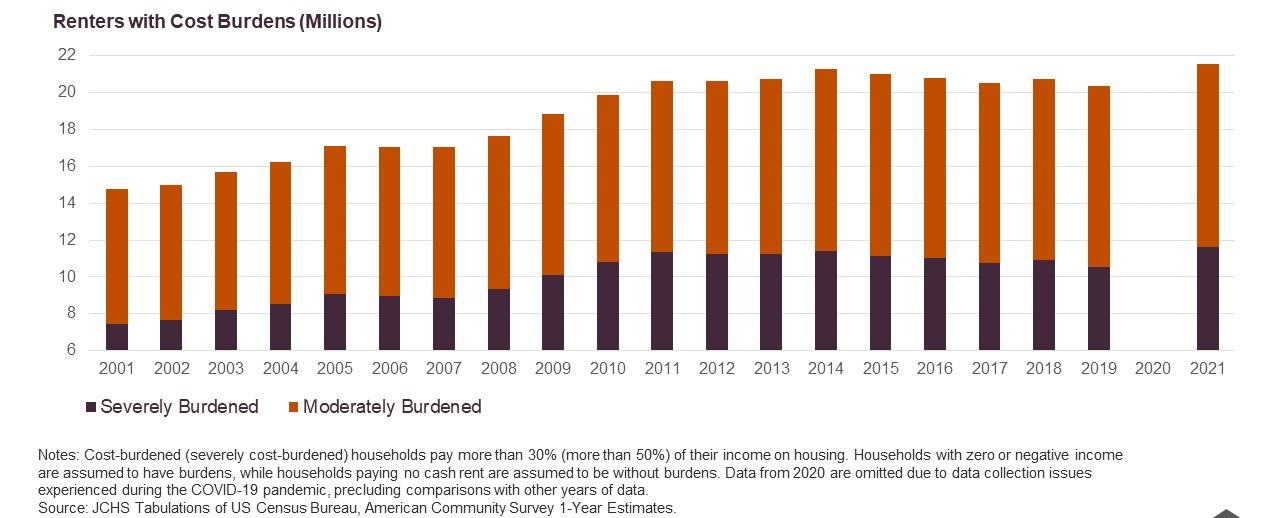
Whitney also suggests that “20.3 million households were severely burdened in 2021, an increase of 2.7 million from 2019.” Most people must pay more than half of what they earn annually. In 2021, the number of renters burdened by the cost of rent increased significantly to 21.6 million, which represented 49.0% of all renters (Whitney par. 3). In the diagram below, it is clear that the number of burdened renters in the US peaked at 21.3 million households in 2014 before it declined slightly in 2019 to 20.4 million.
Post-COVID Income Distribution
In the figure above, many factors have contributed to the increase in cost-burdened renters in the US. For instance, the changes in renters’ income distribution all over the nation after the COVID-19 pandemic can be blamed on the increase of people burdened by the cost of housing (National Alliance to End Homelessness par. 6). Whitney notes that even after adjusting to inflation, the US recorded a decrease in the median income for renter households to $43,500 in 2021 from $44,500 in 2019, which was a 2.3% decline (Whitney par. 4).
Additionally, the study notes that the number of renters with low incomes below $30,000 per year increased significantly by 223,000 households from 2019 to 2021 (Whitney par. 4). Generally, the change in renter income distribution has shifted towards families that have a higher chance of experiencing cost burdens, which explains why many Americans were burdened with unaffordable housing in 2021.
Lower Income Levels
The second factor that influences the increase in the number of Americans burdened with the cost of housing is a decline in income. Whitney notes that even within income groups, “the share of cost-burdened renters increased significantly in 2021, and particularly for middle-income households” (Whitney par. 5). For instance, there was a 3.1% increase in cost burdens among renters that earn between $30,000 and $44,999 and those with incomes between $45,000 and $74,999 experiencing 3.5% rise (Whitney par. 7). Therefore, everyone is affected with unaffordable housing in the US.
Benefits of Affordable Housing
Physical and Mental Health
Affordable, high-quality houses are generally healthier for everyone in the US and all over the globe. For instance, when people live in low-quality houses because they cannot afford better ones, they get more exposed to health dangers, such as water leaks, pests, poor ventilation, and much more (Rolfe et al. 4). Additionally, unaffordable or unstable housing causes stress to a lot of people when they are compelled to pay more. These houses are also in poor condition, which exposes them to physical and mental health dangers (CharlotteFive Staff par. 4). Lastly, when people spend more on their houses, they are left with less to spend on healthy foods or access to better medical care when necessary.
Addressing Homelessness
Affordable housing in Charlotte and throughout the US would also help reduce homelessness. A study by the National Alliance to End Homelessness reported that the number of chronically homeless individuals (127,768 people) reached its highest level in history in 2022. This issue has become a concern in the US, and an intervention to end it would be significant.
Even people and families with the finances to afford high-quality houses in the US must spend more than half of what they earn monthly. This means they have less to spend on other essential amenities. As more people become homeless, the rate of crime in many states in the US is increasing, some develop health problems, and the economy is also affected (National Alliance to End Homelessness par. 11). Moreover, the US federal and local governments have to spend more on emergency room visits, shelters for the homeless, and jail terms.
Children’s Health and Development
Affordable housing for families is also important because it benefits children’s well-being. When children grow up in a safe environment, they are protected from different health dangers and feel more secure and safe (Rolfe et al. 4). Such children grow up with better emotional and behavioral traits, which ensures they are always stable. Additionally, such children often perform better in schools than those with low-quality housing or homelessness (Habitat Organization par. 5). Moreover, if a family has access to affordable housing, they have more money to invest in their education and future.
Healthier Economy
Affordable housing in Charlotte will also benefit the local economy. The first economic benefit of affordable housing to Charlotte is increased discretionary spending. As mentioned earlier, many people in the US have rent as one of the expenses that takes a higher percentage of their income (National Alliance to End Homelessness par. 16). Therefore, when income loss occurs, many people’s ability to meet rent payments is threatened, as is their likelihood of spending money only on important and basic needs. However, affordable housing allows residents to pay more for local purchases beyond their basic needs.
Reducing Payment Stress
Secondly, affordable housing will significantly reduce the number of people being evicted and becoming homeless. With about 108 million people in America living in rental houses, a quarter spend more than half their salaries on housing (Habitat Organization par. 5). Most are always at a higher risk of remaining homeless when unexpected expenses arise.
Many workers who make just enough to pay their landlords monthly are constantly exposed to significant eviction threats. Therefore, when quality houses are made affordable for everyone in the US, fewer will be evicted, affecting the economy. Additionally, affordable housing ensures people have better health and a healthier economy.
Job Places
Affordable housing also creates job opportunities for people in Charlotte and all over the US. When affordable houses are constructed, many people will be employed to work at the sites, increasing the city’s productivity. After the houses are constructed, the real estate company will need more employees, and the housing centers will need people to maintain, operate, and lease them (Whitney 5).
Those who clean the houses will also be required to do much more. Generally, affordable, high-quality housing will offer more long-term job opportunities for people in Charlotte, which will help increase their living standards and improve the economy. Other economic benefits of affordable housing include better investment opportunities, improved government infrastructure, and more.
Discussion
Public-Private Partnership
From the review above, the need for more affordable houses is challenging in Charlotte and the US. Therefore, many strategies can be implemented to ensure affordable homes in Charlotte in 2022. The first strategy is fostering robust partnerships between public and private entities in the city.
Government entities and private institutions in Charlotte can come together and develop strategies to ensure houses are of high quality and affordable for everyone. The public-private partnership would significantly leverage expertise, resources, and funding to build affordable dwellings (Nzau and Trillo 3). This partnership will bring many benefits to Charlotte’s housing issues.
Affordability
The first advantage of the public-private partnership in making houses affordable in Charlotte is that it allows the parties involved to utilize resources effectively. When private and public entities collaborate, each will bring resources to help construct affordable houses (Nzau and Trillo 4). Due to this collaboration, Charlotte will experience increased investment, better outcomes, and improved efficiency.
Expertise and Innovation
Secondly, the public-private partnership will introduce relevant expertise and innovation for creating affordable housing (Nzau and Trillo 4). The private sector will bring its expertise, experience, knowledge, and innovative approaches to developing better, more affordable houses.
Risk Sharing
Collaboration between the private and public sectors will also allow risk sharing. Having affordable houses is a complex issue as Charlotte will need more investments and financial risks that a single party cannot manage (Withrow par. 5). Therefore, when the government partners with private institutions, both will share the risk of the project, and in case it is not successful, they will share losses (Nzau and Trillo 4).
Faster Processes
The fourth advantage of the government collaborating with the private sector is streamlined processes. When they come together, they will share their expertise and make more informed decisions (Nzau and Trillo 4). Additionally, having the government as a partner would mean that all the permitting and approval processes would be faster, ensuring the project takes little time to complete.
Land Use Policies
Another strategy to help create affordable housing in Charlotte would be revisiting and reforming the city’s land policy. According to Debrunner and Hartmann, land use policies are essential in shaping affordable housing development and availability (Debrunner and Hartmann 2). Therefore, for Charlotte to have houses that are affordable to every person, it needs to revisit and reform its land use policies. This will help ensure that the policies reflect the current changes in housing.
Inclusionary Zoning
One way that the city can do this is by inclusionary zoning. This policy involves including some percentage of affordable housing units among developers’ new residential developments (Debrunner and Hartmann 2). This example of land use policy will ensure that mixed-income people and communities live in the same area.
Density Bonuses
Density bonuses are the second example of a land use policy that can help Charlotte have affordable housing for everyone. With density bonuses, developers will be offered additional development rights or incentives when they include affordable housing units. Many developers in Charlotte will have many cheap units that many people can afford (Debrunner and Hartmann 3). The third strategy that would help the city effectively use its land is streamlining approvals for developers, focusing on affordable housing.
Creative Financing Options
The other strategy for ensuring housing affordability in Charlotte is addressing financial challenges related to its availability. These creative financing options would help offer innovative ways for securing funds for building the houses, attracting private investments, and ensuring that there are affordable houses in the long term (O’Donnell par. 2). Therefore, when creative financial options are implemented in Charlotte, the city will be able to increase the number of affordable houses.
LIHTCs
One strategy for implementing creative financing options in Charlotte is introducing low-income housing tax credits (LIHTCs). LIHTCs have often proved beneficial in attracting private sector investors to put their money and resources into building affordable houses (O’Donnell par. 7). Developers in Charlotte will receive tax credits when they construct cheap houses. The city can sell these credits to private investors and attract them to share the idea of building houses.
Tax Increment
The second strategy is tax increment financing, which can attract private investors to include affordable houses in their projects. Tax increment financing involves investing in cheap houses using the revenue generated by part of the increased tax revenue from the development projects (O’Donnell par. 12).
CDFI Collaboration
The third strategy to enact the creative financing options in Charlotte is collaborating with community development financial institutions (CDFIs). When the city collaborates with CDFIs, it can secure the necessary financing to build affordable houses for everyone. CDFIs can offer loans and financial services that can help the project with flexible terms, technical assistance, and lower interest rates (O’Donnell par. 9). This will increase the project’s possibility of success.
Preservation and Rehabilitation
Charlotte can also consider preserving and rehabilitating houses that already exist in the city to ensure affordability. Doing this will help the town maintain affordability, prevent replacing the existing dwellings, and extend their lifespan (Ellen et al. par. 2). There are many strategies that the city could utilize to preserve and rehabilitate existing buildings.
Incentives
The first strategy is implementing preservation incentives to enable developers to consider the option. The town can offer financial incentives, such as grants, tax reductions, and low-interest loans, to encourage developers to preserve affordable housing.
Tenant Protection
Charlotte can also implement tenant protection measures for all houses in the city. Tenant protection measures would help safeguard the residents’ rights to access affordable dwellings. This would include eviction prevention initiatives, rent control policies, and establishing a straightforward process and guideline for renewing leases and more (Ellen et al. par. 3).
Property Rehabilitation
The city can also consider introducing property rehabilitation programs that would offer developers grants, technical assistance, or loans at low interests (Ellen et al. par. 3). This would help improve the quality of affordable houses in the city and ensure their long-term existence.
Conclusion and Recommendations
Charlotte’s acute housing shortage is a serious issue that requires attention. Rent takes up more than half the income for many urban households, impacting their living standards. Nonetheless, the city can employ several tactics to lessen the load and make high-quality homes accessible to many people. The partnership between the public and private sectors is suggested in this study, along with a review and revision of land use regulations, innovative financing solutions, and the preservation and rehabilitation of existing homes. These tactics have the potential to significantly advance the city’s efforts to lower housing costs.
There are a few suggestions for the direct application of these tactics in Charlotte. The first suggestion is to encourage cooperation between the community, business community, and government. Second, Charlotte must continuously review and update its land use policies and affordable housing regulations. Additional suggestions include maintaining and renovating existing homes, forming funding alliances with the business sector, and routinely gathering and tracking results.
Works Cited
Anacker, Katrin B. “Introduction: Housing Affordability And Affordable Housing.” International Journal of Housing Policy, vol. 19, no. 1, 2019, pp. 1-16. Web.
CharlotteFive Staff. “Development reporter Ely Portillo on his 2018 predictions, the apartment boom and why beige buildings may be on the way out!’ Charlotte Observer. 2018.
Debrunner, Gabriela, and Thomas Hartmann. “Strategic Use of Land Policy Instruments for Affordable Housing–Coping with Social Challenges under Scarce Land Conditions in Swiss Cities.” Land Use Policy, vol. 99, 2020. Web.
Ellen, Ingrid, et al. Strategies for Increasing Affordable Housing Amid The COVID-19 Economic Crisis. 2020. Web.
Habitat Organization. Affordable Housing in Developing Countries. n.d. Web.
National Alliance to End Homelessness. State of Homelessness: 2023 Edition. n.d. Web.
Nzau, Bernard, and Claudia Trillo. “Affordable Housing Provision in Informal Settlements Through Land Value Capture and Inclusionary Housing.” Sustainability vol. 12, no. 15, 2020. Web.
O’Donnell, Erin. Five Ways Local Governments Can Spur Development of Affordable Housing. 2020. Web.
Oluwaseyi, Somefun Dolapo. Navigating Ethical Challenges in Qualitative Research. 2022. Web.
Passy, Jacob. “More Americans are Spending over Half Their Income On Housing.” New York Post, 2020. Web.
Rolfe, Steve, et al. “Housing as a Social Determinant of Health and Wellbeing: Developing an Empirically-Informed Realist Theoretical Framework.” BMC Public Health vol. 20, no.1, 2020, pp. 1-19. Web.
Whitney, Peyton. Number of Renters Burdened by Housing Costs Reached a Record High in 2021. 2023. Web.
Withrow, Emma. “New Low-Income Housing Complex Opening in East Charlotte, Rent Starts at $500 per month.” Queen City News, 2021. Web.