
Background
Comcast Corporation, a leading global media and technology company, consistently demonstrates sound financial performance. In 2021, the company maintained its strong financial position, as evidenced by healthy liquidity, assets, debt utilization, and profitability ratios. However, in other years, the opposite is true, with values considerably lower and occasionally varying.
Data for Analysis
Comcast’s ratios are analyzed from 2016 to 2020 below. The data from 2021 onwards is not yet available due to its very recentness.
Table 1 – Ratios During 2016–2020
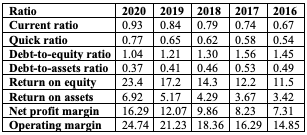
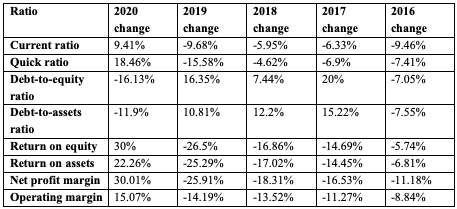
Table 2 – Ratio Changes During 2016–2020
Data Analysis
Comcast Corporation’s financial ratios declined from 2016 to 2020, especially in 2016. This could be due to several factors, such as increased competition, rising costs, and economic stagnation. The current ratio and quick ratio were both decreasing, indicating that the company has greater difficulty meeting its short-term requirements (Google Finance, 2023). The debt-to-equity ratio and debt-to-assets ratio were both increasing, meaning that Comcast is taking on more debt than previously (Infront Analytics, 2023). It is worth noting that this could be risky if the company is unable to generate sufficient cash flow to service the debt. The return on equity, net profit margin, return on assets, and operating margin were all dropping (Infront Analytics, 2023). This, in turn, suggests that Comcast is not making as much profit as it did before.
However, Comcast’s financial performance in 2021 was stronger, with liquidity, asset utilization, debt utilization, and profitability ratios all indicating promising trends. The company’s ability to meet short-term obligations, efficiently utilize assets, maintain a reasonable balance between debt and equity, and gain significant profits highlights its overall financial strength (Google Finance, 2023). This positive financial performance positions Comcast as a practical example of continued growth in the years to come.
Causes of Financial Performance Change
Several factors might have contributed to Comcast’s financial performance in 2021, such as cable services, pricing power, and cost management. The COVID-19 pandemic accelerated the shift to remote work and online learning, driving increased demand for cable services. Moreover, Comcast was able to raise prices for its services without losing customers, which improved its revenue (Block et al., 2021). Last but not least, Comcast focused on controlling costs, which contributed to improved profitability.
Comparison with Competitors
The company has generally been more profitable than its two main competitors, AT&T Inc. and Charter Communications, Inc.
Table 3 – Comparative Analysis with Competitors
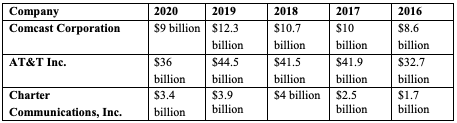
In reality, Comcast Corporation is not making progressive steps compared to the other two companies. Its profitability was declining in recent years, while the competitors managed to maintain it high. Several factors may have contributed to this, including new regulations and cord-cutting (Block et al., 2021). The government is increasingly regulating the telecommunications industry, which could make it more difficult for Comcast Corporation to operate profitably. What is more, the cord-cutting trend may prevail, which could hurt Comcast Corporation’s profitability, causing unpredictable resource and economic troubles. Despite these challenges, Comcast Corporation is still a profitable company.
References
Block, S. B., Danielsen, B. R., Hirt, G. A., & Short, J. D. (2021). Foundations of Financial Management. McGraw-Hill.
Comcast Corporation (2023). Google Finance.
Ratios valuation of Comcast Corporation ( CMCSA | USA)(2023). Infront Analytics.