Introduction
Designing global supply chains for multinational companies is a challenging task. Such an investment creates a positive potential for market expansion and reaching more customers. On the other hand, territorial expansion is associated with geopolitical and economic risks that can lead to liquidity losses, reputational damage, or inefficient investments.
This paper presents a case study of BioPharma, a dual chemical company with manufacturing facilities, warehouses, and sales channels spanning almost the entire world. The central point is that, based on fiscal 2013 results, BioPharma has shown a decline in profitability due to ineffective supply chain management policies. Thus, this paper critically analyzes the aspects of efficiency improvement for BioPharma and answers the questions posed in the scenario.
Biopharma Production Network Structure and Total Costs
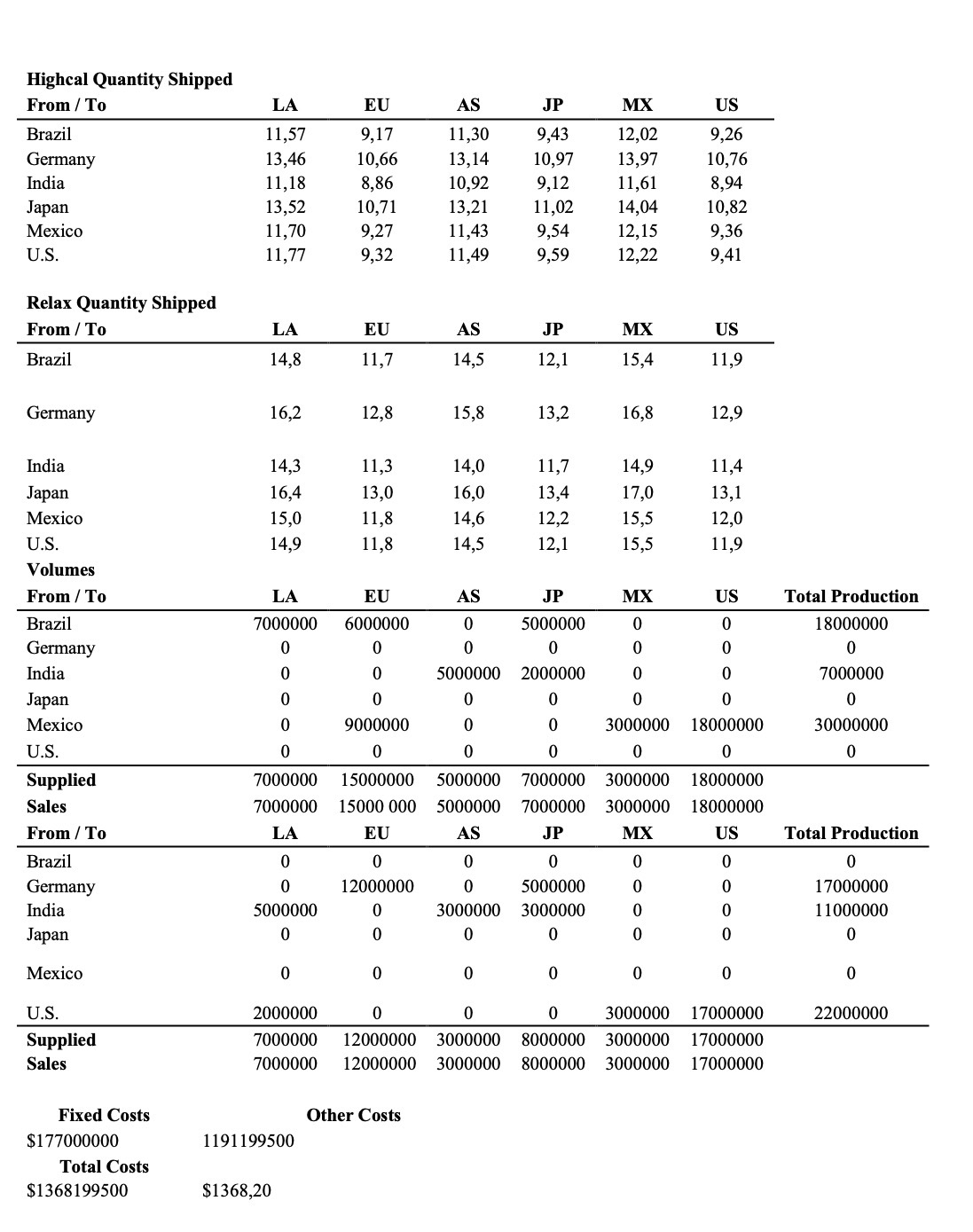
As the scenario shows, by 2013, the Japanese production facility was operating at only 20% of its capacity, meaning the plant was idle most of the time. This was the reason for the falling financial benefit of supporting production that does not generate profits. Similarly, Table 6-18 shows that the German plant utilized only 33.3% of its production capacity, indicating that both plants were functionally unsuitable (Chopra, 2018). Moreover, Japan and Germany did not produce Relax in 2013, creating an additional case for the full or partial suspension of these plants.
The solution to determine the total cost of this proposal was obtained using the Solver function in Excel. Figure 1 below displays the calculation results — the final cost would be $1,368.20 million. In this solution, all plants except the Japanese plant are open. Meanwhile, the German and American plants focus on producing only Relax, while the Brazilian and Mexican plants produce only Highcal; the Indian plant produces both products simultaneously.
Recommendation for Structuring the Global Production Network
Several reasonable recommendations should be made for BioPharma to restructure its global manufacturing network. This part will not propose a one-size-fits-all solution but will describe a comprehensive approach that a company can use to make a restructuring decision. First, in a global supply chain environment, it is necessary to determine which markets or segments offer the company greater profitability and higher growth potential (Adham, 2023).
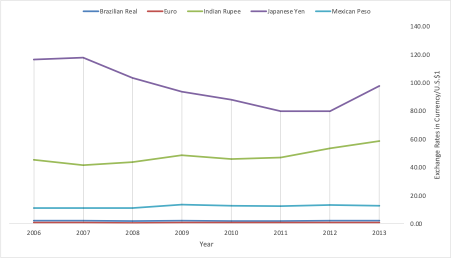
Second, as Table 6-21 shows, the Eurozone is the only region of BioPharma’s operations in which the company operates with a more expensive currency (Chopra, 2018). As shown in Figure 1, the volatility was highest for the Yen-Dollar pair (SD = 16.00), indicating the most significant risk of currency depreciation or appreciation; meanwhile, the Euro against the Dollar had the least variability (Yang & Zhang, 2021).
Third, regional risks and differences in regulations should be considered in restructuring (Barlow et al., 2021). Fourth, the capacities of some facilities are higher — it would be appropriate to consider scalability with benefits to achieve greater flexibility and efficiency in the global production network. Thus, an integrated approach should be taken to assess the risks and benefits when planning chain restructuring.
Capacity Addition Potential
One of the first questions is whether adding production capacity at plants where it is technically and economically feasible is possible (Aksoy et al., 2023). The calculations (Appendix, Figure 1) show that the Brazilian, Indian, Mexican, and American plants are operating at full capacity, the Japanese plant is idled, and the German plant is operating at 38% capacity. This implies that BioPharma has at least 62% spare capacity, which means adding more does not make sense.
Duty Reduction
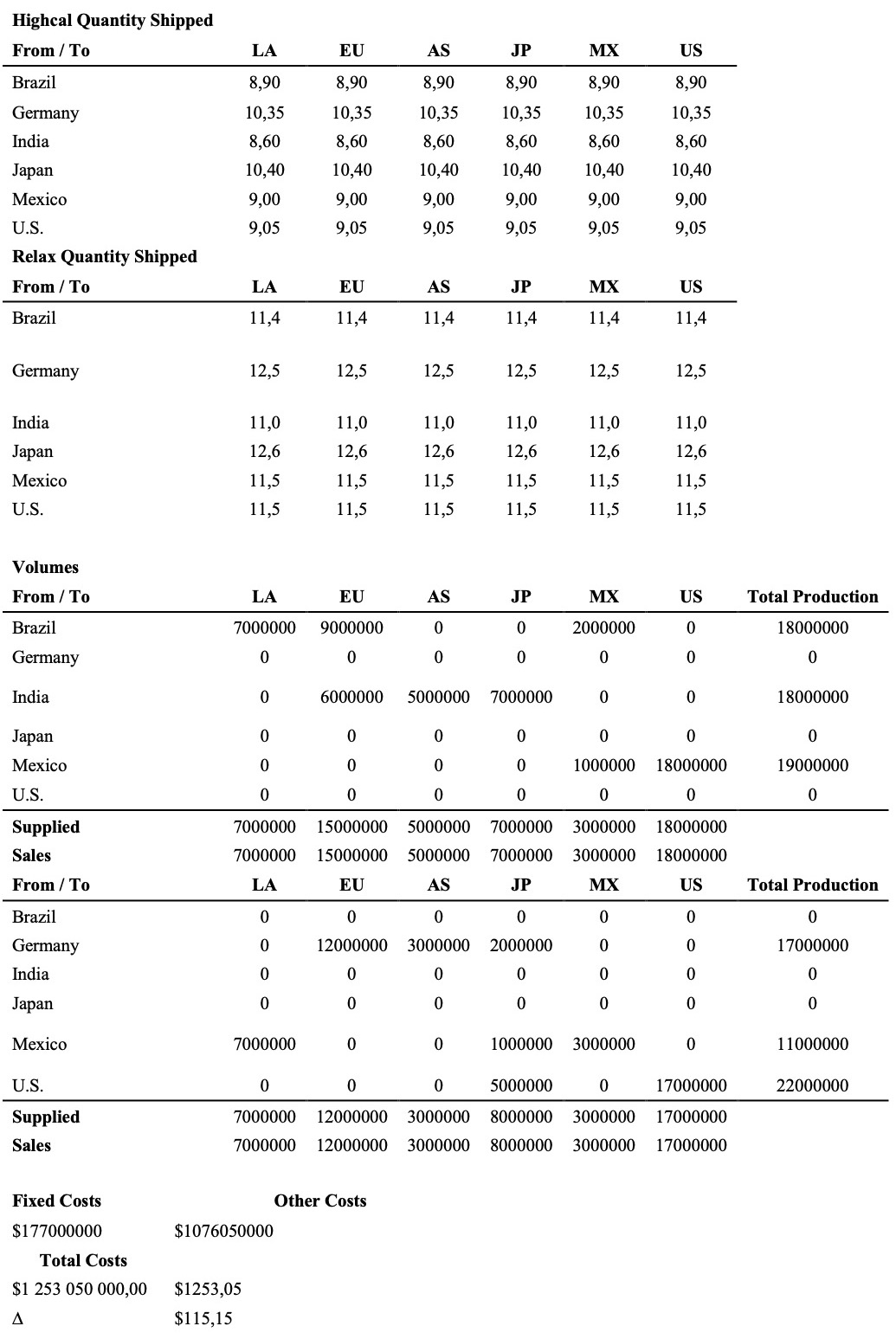
If customs duties were reduced or removed, the value of the product offering could decline. It can be assumed that all trade duties have been reduced to zero, meaning that importing, exporting, and processing international payments are free for BioPharma (Bressan & Mattos, 2023). As shown in Appendix, Figure 2, the total supply cost drops to $1,253.05 million. Changes in production capacity are also evident, with Highcal and Relax production volumes for Mexico and India changing.
Accounting for Errors and Marriage
It was assumed that each factory achieved 100% quality. In reality, no perfect conditions exist, and a company will encounter some defective products (Yang et al., 2020). It would be necessary to adjust each factory’s output to account for the errors. This could lead to a higher final cost because some costs would be spent producing products that are unrealizable.
Recommendations
In addition to the factors used, some other attributes should have been considered. First, uncertainties that could affect the quality of the analysis and lead to shortages or stock-outs were not considered (Barlow et al., 2021). Second, the risks of delays in raw material deliveries, which could disrupt plant operations, have not been considered. Moreover, work environment factors have been completely overlooked, including the risks of strikes and the potential for increased productivity due to employee motivation.
Conclusion
This paper aims to provide a critical analysis of the global company BioPharma. Since the 2013 results showed that not all of the company’s plants were operating efficiently, it was necessary to propose restructuring the global production network. The analysis, conducted in MS Excel, showed that the Japan plant should be suspended. For the remaining plants, it was decided to reassess production volumes, both quantitatively and qualitatively. In addition, the comprehensive analysis discussed how production is affected by eliminating tariffs and the factors that should be considered.
References
Adham, A. (2023). Structural demand for migrant labour: A bottom-up analysis of labour market segmentation in Saudi Arabia. Journal of Ethnic and Migration Studies, 49(7), 1746-1767.
Aksoy, T., Yüksel, S., Dinçer, H., Hacioğlu, Ü., Mikhaylov, A., & Muyeen, S. M. (2023). Assessing the electricity production capacities of emerging markets for the sustainable investments. IEEE Access, 11, 574-590.
Barlow, P., van Schalkwyk, M. C., McKee, M., Labonté, R., & Stuckler, D. (2021). COVID-19 and the collapse of global trade: Building an effective public health response. The Lancet Planetary Health, 5(2), 102-107.
Bressan, R., & Mattos, E. (2023). Nontariff barriers and the elasticity of customs duties evasion.
Chopra, S. (2018). Supply chain management (7th ed.). Pearson Education.
Yang, J., Li, S., Wang, Z., Dong, H., Wang, J., & Tang, S. (2020). Using deep learning to detect defects in manufacturing: A comprehensive survey and current challenges. Materials, 13(24), 1-23.
Yang, Y., & Zhang, J. (2021). Effects of monetary policy on the exchange rates: A time-varying analysis. Finance Research Letters, 43, 1-8.
Appendix