
Executive Summary
The organization’s data will be transferred from the data center to a cloud system as part of the project. As a result, the organization can enhance its flexibility and scalability while reducing its costs (Bommadevara et al., 4). The project will use the cloud platform provided by the vendor of choice. To facilitate the completion of project operations, both internal and external stakeholders will be involved in this endeavor.
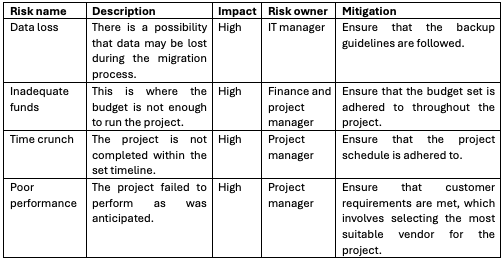
It is strongly recommended that the project’s sponsor provide the amount specified in the budget to facilitate easier operations. Additionally, a suitable plan for risk mitigation is in place, as there is potential for certain hazards to materialize, such as data loss or insufficient funding. Therefore, the organization will increase productivity by moving its data to a reliable cloud service.
Project Summary
Most organizations are transitioning from data centers to cloud services in the contemporary world due to concerns over stability, cost, and security. Due to the rising cost of maintenance and personnel, the company’s executive team has requested a solution. In this case, the project manager will effectively transfer the data from existing data centers to a cloud service compliant with HIPAA.
The migration process will involve identifying stakeholders, assessing the data center and budget, determining the cloud type, developing a migration roadmap, backing up data, initiating the migration, testing, training, and conducting a handover. In this project, one of the most important tasks will be selecting the best vendor for the cloud and outlining procedures for effective migration strategies to the new system.
Project Scope
The process of transforming a data center involves making adjustments to an organization’s information technology infrastructure to enhance its productivity and efficiency levels. This process can be time-consuming because it needs the movement of data from traditional physical servers to more efficient online servers. This project’s scope includes implementing a strategy for transforming data centers by migrating them to a cloud storage platform, which will help ensure that customer requirements are fulfilled and that data is effectively stored in the cloud. Azure, Amazon Web Services (AWS), and Google Cloud are the three cloud computing providers to be vetted for the project. The project’s criteria will ultimately determine which company is chosen, although each of the three businesses has both positive and negative aspects.
Project Goals and Objectives
Project goals are the anticipated outcomes that provide overall context for what the project aims to achieve. For this project, the primary goal is to prepare a guide for moving the existing data to the cloud, improving the workload’s efficiency and agility. A successful cloud migration will reduce costs, improve scalability, and significantly mitigate the risk of a cyber incident that could derail the organization (Bommadevara et al., 4).
The second goal is to ensure that the company complies with HIPAA, which will enable the organization to reduce data breaches, litigation, and reputational damage. The third goal will ensure the organization does not lose data during cloud migration. As a result, this project aims to ensure an effective transition from the current data center to a cloud service.
The project has several objectives to be met for it to be considered successful. They include:
- The objective is to ensure that the data is transferred from the current data center to the chosen cloud service within six months. This will enable the project to operate within the budget and attain its goals.
- To reduce lead time by 50% in the next six months by introducing an effective cloud service to the system. The organization will experience reduced processing time because all data operations will be connected to the cloud.
- To reduce the possibility of losing data through data breach by 98% through the cloud service platform and ensure that the employees are trained and adhere to the HIPAA rules and regulations.
Project Stakeholders
Key Customers
The project customer is the beneficiary of the project’s outcomes, which are described as the ultimate deliverables. The primary customer is the XYZ organization, which has been using data centers to store its information and intends to migrate to a cloud service compliant with HIPAA. A data center is a facility that provides residential computer services, including storage systems and telecommunications (Alaperä et al., 71).
Additionally, with the existing data center, the company has been incurring significant expenses on maintenance and management due to the need for continuous supervision. The customer wants to transition to a cloud service to reduce costs, enhance data security, and improve operational efficiency. Therefore, the main customer of the project is the organization that wants to transform to the cloud.
Internal Stakeholders
- IT manager. The manager will assist in the transition process, particularly by ensuring that the data is backed up before the migration begins, thereby preventing the possibility of data loss.
- HR manager. The manager will help during the training session for the new system. The employees affected by the new cloud service will be trained to enable them to understand the system.
- Finance manager. The manager will help with budget development to ensure there are no cost overruns in the project.
- Project sponsors. The sponsors will ensure that the project gets adequate funds to operate effectively. They are highly interested in the project because they are likely to benefit more when it succeeds, and the organization can operate effectively.
- Communication manager. The manager will help communicate during the project by ensuring that the appropriate message is conveyed to stakeholders at the right time.
External Stakeholders
- Microsoft Azure. This is one of the fastest-growing and most reliable cloud service providers in the market. They want the organization to use their cloud services to help store and manage their data.
- Amazon Web Services (AWS). AWS is a vendor interested in delivering its cloud operations to the organization. This is an online platform that offers flexible and affordable cloud computing solutions (Dutta and Prashant 982). AWS is a popular cloud platform that enables users to perform various tasks on demand.
- Google Cloud. Google Cloud is a group of services that Google offers to the public for cloud computing. It allows people to try its services for free for a year; if they don’t like them, they can switch to other plans. In Google Cloud Storage, users can do various tasks quickly and effortlessly (Dutta and Prashant 985). Users can store both organized and interactive data in it.
Project Deliverables and Milestones
Deliverables
- The project launch document will prove that the project was allowed to start. It will have the signatures of all project sponsors and the project manager.
- Customer documentation standards will include details of the user requirements for an effective cloud service. The documentation will help ensure that the project chooses the best vendor.
- The meeting plan document for relevant stakeholders will provide details of the times, purpose, and meeting venues for the projects. This will help the project team meet during its progress to discuss the deliverables.
- Progress report will be sent to the project sponsor to inform them of its status, as well as the wins and possible requirements. The sponsors need to know how the project is progressing to gauge its success.
- The cloud service vendor agreement will indicate the cloud service provider chosen for the project and the possible agreement. For example, trial periods and a warranty for the services.
- A training manual will detail how the employees will be trained during the project to enhance their understanding of the new system. The trainers will use the manual as a guide to their activities to equip the staff with the required skills.
- A test result report will document how the test was done and the outcome. This will demonstrate whether all the user requirement was incorporated.
- The completed project report will include acceptance statements from project sponsors and their signatures confirming that they are satisfied with the project.
Milestones
- Project initiation and planning. This is a phase where the idea is defined, examined, and then authorized to kick-start by project sponsors. Other stakeholders in the project will be informed of the timeline and other requirements.
- Project design. It will involve activities such as creating a budget plan, sending proposal requests to Google Cloud, ASW, and Microsoft Azure, vetting the vendors, and awarding the tender to the best. Additionally, it will involve discussing the requirements and assigning roles to various stakeholders.
- Implementation of execution. It will consist of activities such as backing up existing data, initiating the migration, and ensuring that the organization’s data is securely stored in the cloud. All the IT infrastructure will be integrated with the cloud, enabling easy transfer and acquisition of information.
- Testing phase. This is a crucial stage in the project, as it determines the project’s success or failure. The project will be deployed, and its operations will be verified based on user requirements and standards. Defects identified will be resolved immediately before the unit is handed over.
- Training. Employees will be trained to understand the new system using the training manual. For example, the IT staff will be trained on how to maintain the cloud service and ensure it delivers value to the organization.
- Final approval and handover.
Additional Considerations
Table 1: Project Cost.
A contemporary organization should consider using cloud services to enhance data security and reduce costs. The organization’s data will be moved from the data center to the cloud as part of the project. This will enable the organization to be more flexible and grow while reducing its costs.
The chosen vendor’s cloud platform will be used for the project. Internal and external stakeholders will be engaged to ensure the project’s operations run smoothly. To ensure a smooth process, it is strongly recommended that the project’s sponsor cover the budgeted amount. Furthermore, there is a good plan in place for mitigating risks, as some risks, such as data loss or insufficient funds, could occur.
Works Cited
Alaperä et al. “Data Centers as a Source of Dynamic Flexibility in Smart Grids.” Applied Energy, vol. 229, 2018, pp. 69-79.
Bommadevara et al. “Cloud Adoption to Accelerate IT Modernization.” McKinsey Digital, 2018, pp.1-8.
Dutta, Pranay, and Prashant Dutta. “Comparative Study of Cloud Services Offered by Amazon, Microsoft & Google.” International Journal of Trend in Scientific Research and Development, vol.3, no.3, 2019, pp. 981-985.