
Introduction
The Enlightenment was a major scientific, political, economic, and artistic phenomenon that affected countless areas of life. The new era has signified a new outlook on traditional values such as knowledge, religion, and human life. In the current analysis, the time period will be assessed from the perspective of its spread through salon discussions, thinkers, and scientists who shared the ideas with middle and high-income classes, and the political and social impact that the new order has generated.
The Enlightenment Era in Paintings
Ideas generated during the Enlightenment were spread through venues such as salons and coffeehouses, where young people shared them. For example, John Wallis notes the importance of gatherings in London and Oxford for sharing interest in various topics (Wallis, 1700). This painting depicts gatherings in which intellectuals read Voltaire’s “The Orphan of China” (Lemonnier, c. 1812).
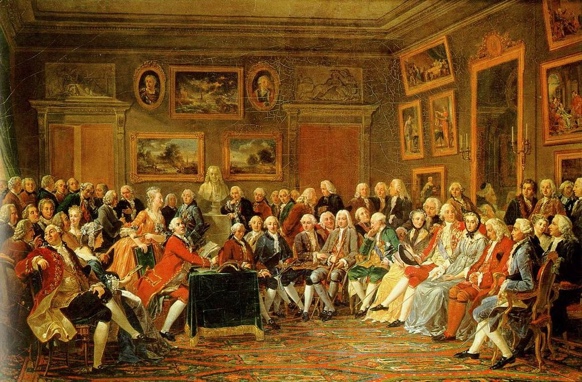
 quot;.” width=”582″ height=”382″/> Fig. 1 – Voltaire’s “The Orphan of China”.
As a result, the ideas have spread and found a wider audience, particularly among intellectuals. The cultural movement was mainly promoted by prominent thinkers, authors, scientists, and philosophers. One of the main figures was René Descartes, who formulated the famous quote that came to represent the movement, namely, “I think, therefore I am” (Descartes, 1637). Another example is Sir Isaac Newton and his Principia (Newton, 1687). The audiences ranged from students to emerging elites to the middle class. For example, Swift (1729) used satire to reach the lower economic class. He published a piece that ironically recommends consuming poor children.
The new ideas had major impacts on European politics and culture during the 18th century. The French Revolution depicted in “La Liberté” was established as a result of a transformation in the minds of the protestors (Vallain, 1794). The international economy has also changed in line with Adam Smith’s philosophy, which exemplified the benefits of a free market and limited government in “The Wealth of Nations” (Smith, 1999). The scientific culture also became more prominent as famous scientists were more likely to engage in communication and freely promote their ideas in various circles (“Galileo-Kepler correspondence”, 1597). Revolutions have occurred in all areas of life and have had a lasting impact on all societies.
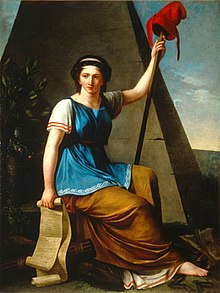
 quot;.” width=”220″ height=”293″/> Fig. 2 – Vallain’s “La Liberté”.
Conclusion
In conclusion, the Enlightenment era was a critical point in European history. The political, economic, and social changes have marked the beginning of a new social order. The impact is still lingering in the area.
References
Descartes, R. (1637). Discourse on Method. Internet Modern History Sourcebook.
Galileo-Kepler correspondence, 1597. Famous Trials. (1597).
Lemonnier, A. C. G. (c. 1812). Reading of Voltaire’s tragedy of the Orphan of China in the salon of Marie Thérèse Rodet Geoffrin in 1755 [Painting]. Château de Malmaison, Rueil-Malmaison, France.
Newton, I. (1687). Principia. Internet Modern History Sourcebook.
Smith, A. (1999). The Wealth of Nations: Books 1-3. Penguin.
Swift, J. (1729). A Modest Proposal. Art Bin.
Vallain, N. (1794). La Liberté.
Wallis, J. (1700). The Origin of The Royal Society. In Account of Some Passages of His Life. essay.