
Introduction to the Area
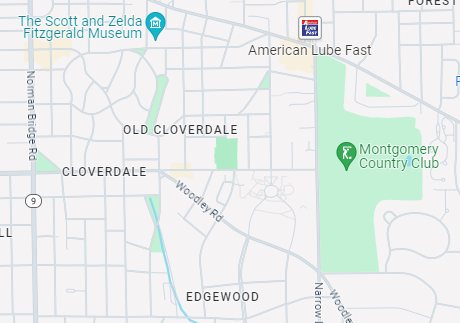
Old Cloverdale, formerly known as Cloverdale, was a small area east of Montgomery, Alabama (Figure 1). The area was known as a farmer’s dream due to its fertile loam and abundant water for agricultural production. Before being marked as a fantastic suburb, Cloverdale lay bare with no decent roads or structures for settlement. Its identity emerged after William Graham purchased the land in 1817.
The population was relatively small in the early days, and people lived in isolation. A few years into the 19th century, the area underwent massive transformations, driven by the European invasion. A shift from total agricultural land to a suburban area with tarmacked paths, business development, magnificent architectural designs, and multicultural occupancy accompanied it.
The Geographical and Cultural Factors
The first reason why I chose Old Cloverdale for this study is that it is my home area. Growing up here, I have always marveled at the spectacular urban planning that is in place. Despite notable cultural differences, I like the buildings, the streets, and the people who coexist. Moreover, the area is an excellent case study, packed with a wholesome way of life. There are entertainment parks that also serve as picnic grounds.
Some museums preserve cultural elements for future generations (Wilkins, 2023). I also love the dedication to the long-standing cultural traditions of the people. Venturing into the geographical, historical, and cultural details will help me better understand my background. It will also help us understand the area’s evolution and, more specifically, the role Europeans played in shaping it into what it is today.
Old Cloverdale is a small community in Montgomery known for its rich historical features. On the larger map, Old Cloverdale is located in Sonoma County, 45 miles north of San Francisco. Montgomery is to the east and bordered by Narrow Lane on the East and South and Cater Hill Road on the North. As the name suggests, the neighborhood is an old town with prehistoric buildings that host about 2000 residents (Wilkins, 2023). I chose this area for my study because of its fascinating historical development from the 19th to the 21st centuries and its attractive geographical typology.
Geographically, Old Cloverdale is a lush, green neighborhood that enjoys cool, sunny weather year-round. Photos of the area capture its beautiful grass and trees in the most natural state. What makes the environment green are the surrounding hills and valleys. The Russian River flows across the middle of the area, providing pleasant scenery for residents and visitors. Since the 19th century, Old Cloverdale has been dotted with pine yards that purify the air and keep the weather favorable for its inhabitants.
The rich vegetation, the surrounding hills, and the valleys have always kept the weather great for farming. However, people in the area need to practice farming while working in the city (Montgomery). The weather is very bearable for the residents. During summer, temperatures reach 32 degrees Celsius, while during winter, they fall to 10 degrees Celsius (Wilkins, 2023).
Spring and summer are the best seasons for residents because of the pleasant atmosphere. Today, Old Cloverdale bears the physical characteristics of a suburban area with tall trees forming a canopy. There are marked walkways for strolling and jogging with cottage houses close together over a vast piece of land. In all seasons, including summer, the area maintains its greenery with fresh air and an amazing ambiance.
The area’s cultural heritage is a marvel, an attractive focal point for this study. Old Cloverdale is defined as a culture of communism. People live close to each other, and they know their neighbors. Westernization’s individualism has yet to take over the people, as they still love socializing together. Social events are held daily in the area as both entertainment and a way to attract visitors.
Playing live bands is a vital characteristic of the people’s culture. The people enjoy water activities such as kayaking, fishing, and swimming on the Russian River (Wilkins, 2023). Enjoying these activities reinforces the community by giving people a chance to interact. They hold livestock shows where farmers showcase their work, including well-fed, healthy livestock.
As a historical area, the area’s architectural style is a signature of the people’s culture. The style is Gothic and was adopted by the European settlers who made the town what it is today. Walking through the neighborhood, all one can see are Victorian Cottages, Craftsman Bungalows, and colonial homes. The designs are unique and fascinating to locals and visitors alike. Traces of colonial days live on in the neighborhood’s historic churches.
The area is home to the First Methodist Church and Cloverdale’s first Presbyterian Church, both of which are tourist attractions. Cloverdale Park also provides a good picnic site and playground for children. Old Cloverdale’s Gold Shaw House Museum is home to the area’s historical pieces. The people’s farming tools, remnants of colonial tools, and the people’s foods showcase their culture. All these features enrich people’s culture, fostering a sense of pride among locals.
Pre-European Activities and Post-European Activities in Old Cloverdale
Old Cloverdale came into being as a piece of land bought by William Graham in 1817. When the 160-acre tract was accepted, the area was known as Graham Woods for its thick virgin pines. The purchase, followed by the marking of the area, gave it its identity, and people began to dwell there.
The pre-European era commenced later in the mid-1800s. During this time, Europeans arrived and settled in the area, hoping to take advantage of the favorable weather for agricultural activities. The Europeans realized the potential as the area grew into an agriculturally productive place. The area grew due to commercial activities as people traded farm produce for their livelihood. Towards the late 19th century, European investors streamed into the area to leverage the well-developed Woodley Road, Fairview Avenue, and Huntingdon College.
In my interview with one of the area’s older residents, the most significant impact left by Europeans was the blueprint for the infrastructure. According to the interviewee, Europeans introduced an English way of doing things that was readily accepted because the original inhabitants saw them as better. Physical memoirs of the architecture cited by the interviewee include an architectural drawing of a famous house located on Felder Avenue and Norman Bridge Road (Wilkins, 2023).
For years, the house demolished in 1940 attracted the attention of tourists and engineers worldwide. The interviewee also notes that the area benefited from European work until around 1910 (Lacey, 2023). During this time, each party developed selfish interests. This resulted in extreme panic and tension, leading to a stall in economic development.
Rapid development in the area led to the establishment of legal frameworks for habitation, business conduct, and property ownership. As the order was reinstated, Old Cloverdale became an excellent place to live. It became one of Montgomery’s suburban areas. This period laid the foundation for the post-European era and contemporary Old Cloverdale.
In the 1900s, Old Cloverdale experienced significant economic growth, changes in land ownership, and the emergence of social classes. One European, Mr. John Sellers, took over a large portion of the economy. He developed the Alabama Feed Factory and a fertilizer and ginning factory that stimulated Old Cloverdale’s economy (Lacey, 2023).
Following these developments, European settlers scrambled for the land and finally split it into the East and West Areas. East Old Cloverdale was the residence of the European Settlers, while the West was left for the natives. Today, the East area is associated with affluent people who lead better economic lives.
In the post-European era, Old Cloverdale experienced homogeneous growth throughout the area. Europeans became widely spread throughout and mingled with the locals. Gradually, the general population grew, motivated by economic progress. Schools are designed to provide children with an education (Lacey, 2023).
Healthcare facilities also came up, but were managed by Europeans. What stood out during this time was that the Europeans and the locals shared the amenities. In 1927, the small area of Cloverdale was annexed to Montgomery City. This move provided city government funding for development, and the area continued to experience marginal growth.
Far from community development, the post-European period brought forth conflict in the community’s treasures. Essentially, the community wanted to preserve its treasures in the museums and the day-to-day activities. One monumental activity during this period was the collection and donation of 65,000 artifacts to families in Cloverdale (Wilkins, 2023).
Museums were established to host the artifacts and restore the community’s culture. In 1996, Gould Shaw’s management issued a grant to the National Trust for Historic Preservation to facilitate cultural preservation. Subsequently, the trust built the Historic Garden at the center of the small town. These advances in the post-European era gave the area its identity, attracting more residents and investors and revitalizing it.
Impact of Old Settlements and the Original Inhabitants
The old settlements in Old Cloverdale have been instrumental in cultivating the spirit of communism in the area. The narrow streets and close compounds allow people to socialize, intermarry, and engage in cultural exchanges. The original inhabitants of Old Cloverdale were Miwok, who came from South Francisco in the 15th century.
They inhabited Old Cloverdale before the area was named. This indigenous community relied on natural resources for its livelihood. Economically, hunters and gatherers sought food from plants and hunted wild animals. A few people pioneered fishing as an economic activity that was later perpetuated.
Another community considered to be the original inhabitants of Old Cloverdale is the Pomo Indians. This community moved into Old Cloverdale from the Pomo territory in ancient times. They espoused traditional Indian culture in food, dress, and worship.
Like the Miwok, they depended on hunting and gathering for their livelihood (Lacey, 2023). Little is known about their presence in Old Cloverdale due to the small population. It is assumed that they moved out into the city after European settlement for jobs and better living standards.
Before the arrival of Europeans, the Miwok community lived in small, semi-permanent structures. They lived in small villages that resembled today’s cottages. Besides their cultural heritage, they had a strong religious life, worshiping in nature.
The underlying belief was that the surrounding hills were home to supernatural forces. European settlers in the 19th century displaced Miwok; some left Old Cloverdale, while some remained in the valleys—those who stayed clung to the fertile soils and abundant water for farming as a way of life. Over time, Europeans and Miwok people assimilated into one community.
Today, Old Cloverdale is a very diverse small community home to the original inhabitants, Europeans, and non-US citizens. The total population is about 15,000 people, with 43% male and 53% female (Wilkins, 2023). Due to economic growth, school development, and increased visitor numbers, the town is marked by business development in residential areas.
Population statistics indicate that Old Cloverdale is highly diverse in terms of economic activities, age, and job types. 82% of the population works in white-collar jobs, while 18% still engage in blue-collar jobs (Wilkins, 2023). These outcomes portray the submersion of the original inhabitants’ culture with that of Europeans and Americans.
References
Google (2024). Old Cloverdale.
Lacey, P. (2023). Historic Hayward and Sawyer County sketches. Xlibris Corporation.
Wilkins, L. C. (2023). Welcome 2 Houston: Hip hop heritage in Hustle Town. University of Illinois Press.