Introduction
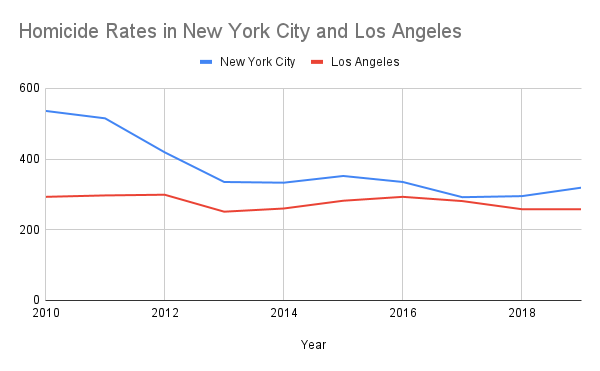
One of the most common and serious crimes in the country that is perpetrated every day is homicide. Homicide is the willful killing of one person by another (Beirne & Messerschmidt, 2011). While some states and cities have lower rates of criminal activity than others, some states exhibit extraordinarily high levels, underscoring the need for law enforcement and policymaker initiatives. Despite a notable drop in homicide rates from 2010 to 2017, as seen by the cases in New York City and Los Angeles, these crimes continue to be serious problems and, in the absence of action, could return to the levels seen in 2010.
Comparison
The first glaring similarity between the two cities is that, between 2010 and 2013, both large municipalities saw a sharp drop. The rate fell from 536 in 2010 to 335 in 2013 in New York City (Federal Bureau of Investigation, n.d.). According to the Federal Bureau of Investigation (n.d.), the rate in Los Angeles decreased from 293 in 2010 to 251 in 2013. As a result, the changes in New York City and Los Angeles were negative, 37.5% and 14.3%, respectively. In this instance, improved law enforcement and policing practices may affect such a pattern. Policies that prohibit violence may also be the cause of this development.
The rising trend from 2013 to 2016 is linked to the second similarity between the two cities’ crime rates. In both localities, the homicide rate gradually increased during those years. However, in Los Angeles, the rate rose by 16.7%, and in New York City, the rate returned to its 2016 value of 335 (Federal Bureau of Investigation, n.d.). This illustrates how a variety of things might influence these kinds of changes. For example, socioeconomic factors can be pretty important; the major drivers of this are rising rates of inequality and poverty. In addition, bad governance might also affect these kinds of results.
Lastly, there are minor variations between the two cities between 2016 and 2020. Unlike the last time, New York City’s incidence is still rising quickly, despite Los Angeles’s limited progress in keeping the rate the same. To be more precise, the rate of homicide in 2020 was 468, the highest level for the decade, up 39% from 335 in 2016 (Federal Bureau of Investigation, n.d.).
Los Angeles’s homicide rate, which was 258 in both 2018 and 2019, did not change (Federal Bureau of Investigation, n.d.). However, it did rise, going from 293 in 2016 to 351 in 2020, a 19% increase (Federal Bureau of Investigation, n.d). Isolation and the start of the worldwide epidemic may be essential factors in this case. Consequently, several factors may influence the rate, and the increasing trend suggests that measures are required.
Conclusion
In conclusion, homicide rates significantly decreased between 2010 and 2017, as seen by cases in Los Angeles and New York City. However, these crimes remain serious issues and could revert to 2010 levels in the absence of action. The first obvious parallel between the two cities is the steep decline both major municipalities experienced between 2010 and 2013.
The second commonality in the crime rates of the two cities is related to the rising trend from 2013 to 2016. On the other hand, the rate increased by 16.7% in Los Angeles and returned to 335 in New York City. Finally, there are a few little differences between the two cities in 2020 and 2016 that show how urgently change is needed.
Reference
Beirne, P., & Messerschmidt, J. W. (2011). Criminology: A sociological approach (5th ed.). Oxford University Oxford.
Federal Bureau of Investigation. (n.d.). Crime data explorer.