
Introduction
Communication within an organization is one of the most important components of organizational change to achieve better employee engagement, and it also requires extreme critical thinking and understanding. The case of Lakeside Automotive Ltd. presents a professional dilemma in which Katri Sidhu, an HR manager at the company, is faced with introducing a new technology, the Thumbs Up digital employee recognition system (Huo & Peng, 2019). This paper examines the organizational communication problems in this case, which are related to Sidhu’s management of the business. The report also outlines possible outcomes that will help the business grow successfully. Despite the potential benefits of Thumbs Up for employee recognition and engagement, Sidhu must carefully consider organizational factors and employee perspectives to determine the system’s viability and ensure effective implementation.
Key Organizational Communication Issues
In the case study of Lakeside Automotive Ltd., one of the main organizational communication issues is the launch of the Thumbs Up digital employee recognition system without a clear understanding of the staff’s opinions. Many factors affect employees, including variations in attitudes toward the new system (Huo & Peng, 2019). For instance, Samuel Okafor likes the Thumb-up method and sees it as a novel way to show appreciation and foster teamwork. On the other hand, individuals like David Smith express cynicism and a tendency to lean toward traditional face-to-face communication, handshakes, and personal touch (Huo & Peng, 2019).
The gap these viewpoints create underscores the importance of recognizing and managing diverse employee consensus and attitudes toward change (Huo & Peng, 2019). As per Campos-Moreira et al. (2020), competent communication channels that are affordable across different employee diversity and job categories are a key factor for the smooth implementation. In this case, the HR manager has to reconcile the two opposing views on the new system to promote unanimous acceptance and employee involvement in the matter.
Another concern is the discontent of long-time employees, for instance, those in the service, parts, and rental cars department, who attach importance to direct interaction and history. Ron Patel’s viewpoint touches on the inherent difficulty of redefining cultural or institutional behavior (Huo & Peng, 2019). In such a case, Sidhu needs to address this resistance by recognizing the critical role of real interaction and by emphasizing the complex advantages Thumbs Up digital tools offer in reducing recognition difficulty and increasing communication efficiency (Huo & Peng, 2019). In addition, the department was concerned about the inadequate badge exchange described by Pascal Rahal; hence, a proof of challenges that might hinder sustained participation in the system (Huo & Peng, 2019). Hence, the biggest barrier Sidhu faces is developing a communication plan that highlights the benefits of Thumbs Up to all staff at Lakeside Automotive and addresses resistance to it.
Implementation of the Thumbs Up Digital Employee Recognition System
The implementation of the Thumbs Up digital employee recognition system at Lakeside Automotive elicited a mixed response, reflecting the complexity of organizational shifts and communication patterns. The Technology Acceptance Model (TAM) is a relevant theory in this case, as it posits that an individual’s perceived usefulness and ease of use of a new technology influence their intention to adopt it (Mogaji et al., 2024). For example, employees like Samuel Okafor see Thumbs Up as a simple, functional tool for expressing gratitude, thereby sharing the principles of TAM, as they find the system easy to use. As such, individuals like David Smith may take Thumbs Up more as an ordeal to use than in actual practice and dismiss it as unhelpful.
In addition, Social Identity Theory (SIT) explains the levels of influence Thumbs Up has on employees with the self-attributed identification, administrative roles, and norms. Long-serving employees, especially in the rental cars department, may be resistant to traditional forms of communication and recognition. From that viewpoint, using SIT principles, Thumbs Up might be perceived by older employees as a system that lacks a clear identity and a sense of belonging to the organizational group, which may lead to some form of resistance (Riepl et al., 2024).
As per Huo and Peng (2019), Alex Frederick, on the other hand, is a young hire and is more in line with the latest tech, and might just be more receptive to Thumbs Up because it aligns with modern organizational norms (Huo & Peng, 2019). It can therefore be argued, in the context of the Diffusion of Innovations theory, that different Lakeside employees will differ in the rate at which they adopt the Thumbs Up idea (Menzli et al., 2022). Innovators, early adopters, and people who avidly try the system, like Pascal Rahal, may take it to heart. Still, the majority may fall into the early and late mainstream, taking a cautious or hesitant approach.
Recommendations
If I were Katri Sidhu, I would request that Thumbs Up at Lakeside be persevered positively. The system has numerous positive features, including streamlining employee recognition, fostering a culture of appreciation, and leveraging digital resources to accommodate diverse workforce profiles. The positive outcomes of student mentorship with Lakeside business owners align with Lakeside leadership’s goals.
These attract and retain young professionals in the community who can imbue the people with its deep organizational culture (Huo & Peng, 2019). However, drawbacks from people like David Smith, who has been around serving for years, must be allowed to think about the effectiveness of the system and communication in general (Huo & Peng, 2019). Consequently, Sidhu should be collaborative in addressing the concerns by providing sufficient training and support to ensure the staff is comfortable.
Action Plan
Table 1. Action plan to enhance the system’s effectiveness and drive employee adoption
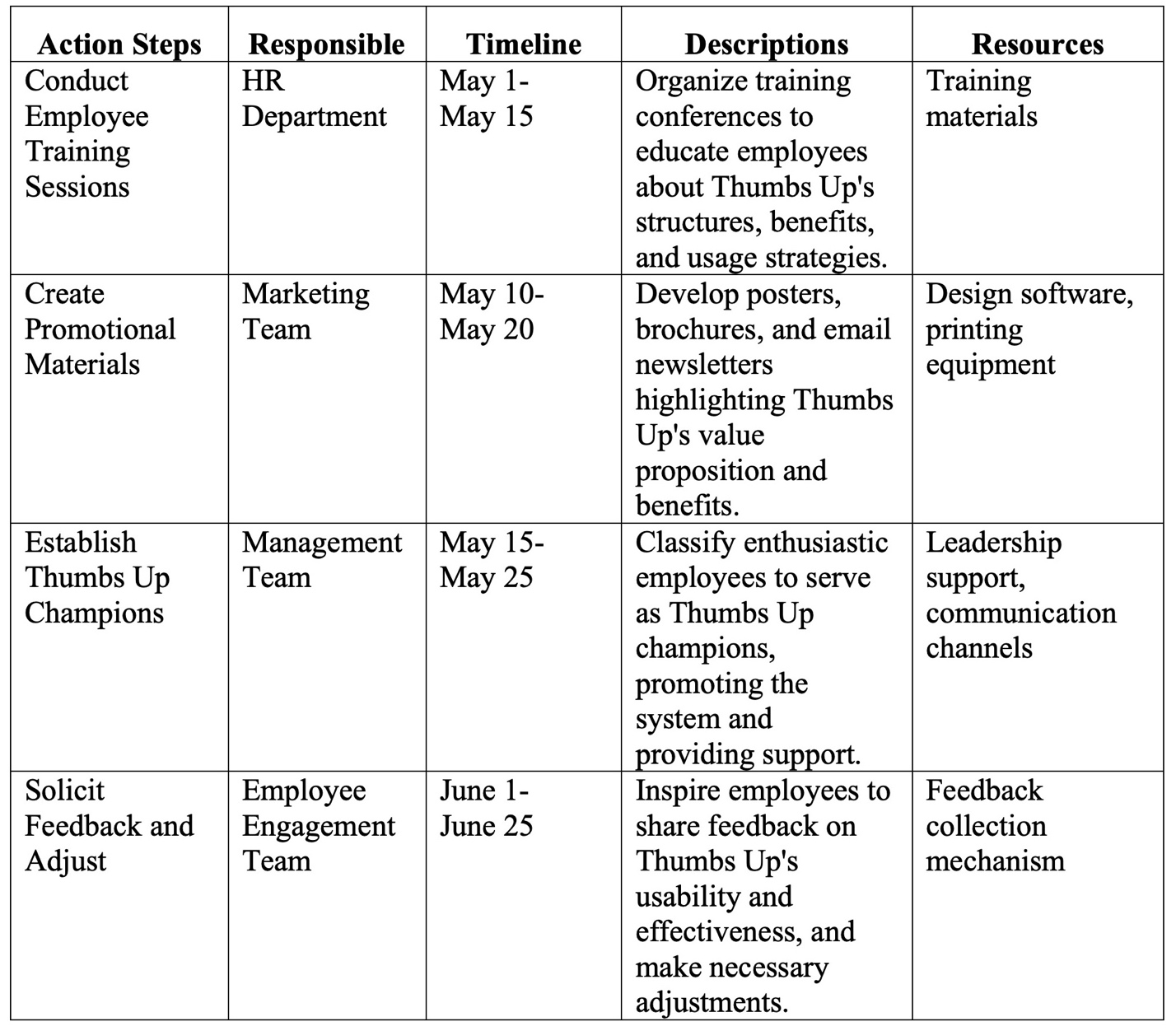
The above action plan aligns with the theory of planned behavior (TPB). According to TPB theory, an individual’s behavior is most affected by their attitude, subjective norms, and perceived behavioral control (Ajzen, 2020). Through various training sessions conducted by the HR Department, Lakeside Automotive can influence employees’ beliefs about the Thumbs Up system and promote its favorable consequences through engagement and recognition.
To achieve this, the Marketing Department will venture into the production of promotional materials designed to create desire and shape the organization’s image in the public eye. In line with Thumb-Up’s commitment to supporting employees, the Management Team will be highly committed to addressing employees’ concerns about the implementation of the new system (Aizen, 2020). In addition, providing company employees with a feedback mechanism through the Employee Engagement Team will address the perceived behavioral control, which is influenced by employees’ contributions to the platform.
Alternative Strategies
Sidhu could adopt, as a separate strategy, a more comprehensive internal communication strategy that combines traditional and digital channels to expand employees’ preferences. The approach will involve organizing regular meetings, developing departmental newsletters, and using internal collaboration platforms, such as intranet forums or chat apps. As per Ajezen (2020), an internal communication strategy ensures the organization is perceived as open and transparent as possible. Lastly, by accounting for Lakeside’s growth and transition, Sidhu would be able to focus on building a strong organizational culture and uniting individuals during the company’s tough phases.
Furthermore, optimizing the workforce should be achieved through training programs focused on personnel’s digital literacy and technical abilities. In this regard, Lakeside can empower its workforce not only to be well-informed but also highly productive by fostering openness to continuous learning and development (Ajzen, 2020). This will enable the workforce to adapt to digital tools and platforms and handle digitization effectively, thus keeping pace with the evolutionary automotive industry landscape.
Implications of the Case
The case of Lakeside Automotive well illustrates the role of careful communication and tactical planning in the change management process, especially when it concerns the new (to them) technologies. From Campos-Moreira’s (2020) perspective, leaders must keep in mind that their staff consists of people with diverse preferences and perspectives and thus require changes better tailored to their needs. Proper communication encourages employee buy-in and minimizes the risk of issues in 2020 or later. Strategies such as fostering openness, encouraging collaboration, and promoting continuous learning should be prioritized and adopted to ensure the organization’s success in the digital era. Supports the role of leadership in anticipating and preventing organizational communication problems, creating an open communication channel, and providing a learning and training environment in which employees embrace new technology and methods.
Conclusion
In summary, Lakeside Automotive Ltd. may be used to establish the fact that organizational communication is a key factor in managing change and onboarding employees in the digital age. Unfortunately, implementing the Thumbs Up employee recognition software in the system might run into several challenges, such as conflicting views and fears of productivity. The critical analysis of key organizational communication problems is closely coupled with the evaluation of the Thumbs Up attempt and recommendations, as this knowledge provides insight into the challenges and yet offers support for Lakeside’s future development. Support for recommending Thumbs Up to continue implementing the strategic changes can be demonstrated through surveys to gauge employees’ viewpoints, by examining organizational theories, and by suggesting concrete action steps as described above.
References
Ajzen, I. (2020). The theory of planned behavior: Frequently asked questions. Human behavior and emerging technologies, 2(4), 314-324.
Campos-Moreira, L. D., Cummings, M. I., Grumbach, G., Williams, H. E., & Hooks, K. (2020). Making a case for culturally humble leadership practices through a culturally responsive leadership framework. Human Service Organizations: Management, Leadership & Governance, 44(5), 407-414.
Fussell, S. G., & Truong, D. (2022). Using virtual reality for dynamic learning: An extended technology acceptance model. Virtual Reality, 26(1), 249-267.
Huo, K., & Peng, A. (2019). Lakeside Automotive Ltd.: Digital employee recognition amid organizational change. Ivey Publishing.
Menzli, L. J., Smirani, L. K., Boulahia, J. A., & Hadjouni, M. (2022). Investigation of open educational resources adoption in higher education using Rogers’ diffusion of innovation theory. Heliyon, 8(7), 1-12.
Mogaji, E., Viglia, G., Srivastava, P., & Dwivedi, Y. K. (2024). Is it the end of the technology acceptance model in the era of generative artificial intelligence?. International Journal of Contemporary Hospitality Management.
Riepl, J., Mitter, C., & Kuttner, M. (2024). Risk management during the COVID-19 crisis: Insights from an exploratory case study of medium-sized family businesses. Journal of Management Control, 1-27.