Obesity Prevalence in the US
The US is currently considered to be one of the most obese nations in the world. According to the Centers for Disease Control and Prevention (CDC) (2022), obesity prevalence in the country is at 41.9%, having increased by almost 11% in the past 20 years. Obesity is associated with increased risks of diabetes, heart disease, stroke, cancer, and premature death.
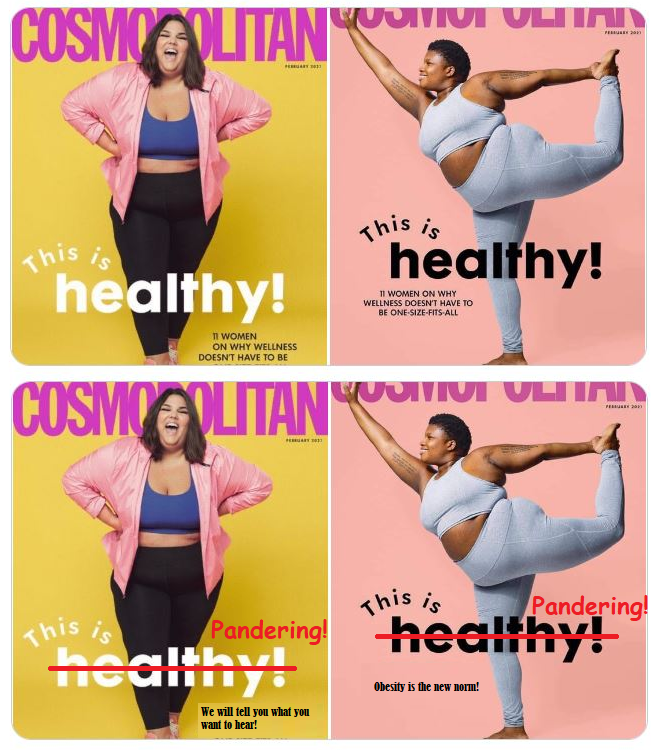
An obese person spends almost 2,000 USD more on medical bills compared to people who do not suffer from it. It is a significant burden on the US healthcare system as well, with medical costs estimated at over $ 200 billion annually (CDC, 2022). And yet, major tabloids like Cosmopolitan publish controversial images like the ones presented in the Appendix.
Impact of Media on Social Perception
According to Sturken and Cartwright (2017), imagery is intrinsically linked to ideology. What is considered the norm is what society makes of it. With obese people becoming more and more prevalent in society, they are becoming the new norm and the way the average American perceives themselves to be.
At the same time, the US exists as a deeply consumerist society. The main objective of the Cosmopolitan is to sell its magazines and the messages they convey. The safest way of achieving that is to pander to the audience. They are doing so by transmitting a feel-good message.
Critique of the Cosmopolitan Cover
Despite medical evidence to the contrary, the message transmitted in the original image is as follows: “You do not need to work on yourself, eat healthy, or exercise. You are fine the way you are, so you can continue your unhealthy habits while feeling good about it! This message is the unhealthy hyperbolization of body-positivity – an idea that was originally conceived to protect people with weight problems from bullying and help them find self-confidence(Brathwaite & DeAndrea, 2022).
It has, however, been warped into a belief that obesity is healthy and that not only should people stop shaming it, but also find it appealing and even attractive and desirable (Brathwaite & DeAndrea, 2022). Cosmopolitan is attempting to appeal to these ideas. The image presented also has an element of anti-ads, running stark contrast with traditional beauty pageants, which present non-obese women in revealing clothes (Sturken and Cartwright, 2017).
Adjustments to the Cover
The oppositional image created for this paper replaces the feel-good message with the intended purposes of Cosmopolitan. These purposes are purely self-serving and are in accord with the principles of a consumerist society (Brathwaite & DeAndrea, 2022). Telling harsh truths, even with the intent to benefit readers, no longer sells, as there is the potential for public backlash and lost sales and money. The easier approach is to gauge public opinion and present messages that best appeal to the audience. The edited image aims to call out both the practice of putting the bottom line before societal well-being and the objectives presented in the headline text.
In a way, the front page of Cosmopolitan reflects reality. While obesity is not healthy, like they claim, it is certainly common. As such, appealing to a large common denominator will happen, in one way or another. It does not make the practice good or right, though, as in their chase for clout and money, misinformation is being sold to individuals who want their destructive behavioral patterns validated. In capitalist societies, profit often trumps concerns about delivering truthful or genuinely positive messages, as seen in the example provided.
References
Brathwaite, K. N., & DeAndrea, D. C. (2022). BoPopriation: How self-promotion and corporate commodification can undermine the body positivity (BoPo) movement on Instagram. Communication Monographs, 89(1), 25-46.
Sturken, M., & Cartwright, L. (2017). Practices of looking: An introduction to visual culture (3rd ed.). Oxford.
Centers for Disease Control and Prevention. (2022). Adult obesity facts.
Appendix