Research Topic
Ensuring the well-being and health of human resources is one of the most critical components of running a successful business. This is because the efficiency of operations, the organization’s profit, and its competitive position in the market largely depend on this aspect. Therefore, company managers need to devote significant effort to creating and implementing measures to ensure a positive work environment. It will improve workplace performance and limit physical and psychological harm to employees.
In particular, this aspect concerns project professionals, who are strategically important to organizations. In this context, the involvement of stakeholders, which will increase the effectiveness of these approaches, is significant. Thus, within the framework of this research proposal, the topic of ensuring the well-being of project professionals and the initiatives that companies can implement for this will be explored.
Background and Rationale
The first step in this work is to bring the proposed research to a rational level. To do this, it is necessary to examine scientific literature, which will be based on providing evidence of the academic welfare of project professionals. For this purpose, references to previous works and readings will also be included, which can help strengthen the arguments supporting the need for this kind of research.
To ensure the well-being of project professionals, it is necessary to take into account a large variety of influencing factors. The most important of these are resources and communication, control, balanced workload, job security, work relationships, and job conditions (Cheung et al., 2019; Chiocchio et al., 2010). These criteria contribute to a high degree to such characteristics as the psychological and physical condition of employees.
Darvishmotevali and Ali (2020) point out that “stress is the result of the unsuccessful interaction between individuals and their environment” (p. 2). It follows from this fact that managers and heads of organizations have a responsibility to create a favorable environment to facilitate the most productive work and the satisfaction of professionals in the project.
Particular attention should be paid to aspects such as stakeholder engagement. This aspect implies the involvement of third parties in initiatives aimed at ensuring employee welfare. With the development of the field of business, stakeholders began to play a significant role in this context (Kujala et al., 2022). Thus, they are valuable agents in ensuring the availability of the necessary resources that will allow the implementation of the strategy (Pedrini & Ferri, 2019). This aspect includes both a financial component and experience, knowledge, and expertise.
In addition, stakeholders include not only other companies but also managers, employees, and business customers. Providing indicators such as transparency, responsibility, and engagement will also positively impact communication between them and, as a result, the well-being of project professionals (Stocker et al., 2020). Thus, stakeholder involvement is an integral part of the policy discussed in any company.
Separately, it is also worth paying attention to such an aspect of business activity as corporate social responsibility. It is closely related to stakeholders and employees of the organization; hence, more careful consideration should be given. Paruzel, Klug, and Maier (2021) indicated that there is a positive relationship between corporate social responsibility and identification, engagement, attractiveness, turnover, commitment, job satisfaction, and organizational citizenship behaviors” (p. 14). Thus, as part of developing programs to improve the well-being of professionals, companies can also significantly improve this component (Stojanovic et al., 2020). It can also enhance the effectiveness and success of their market activities.
Project Aim
The overall aim of the dissertation project is to investigate and establish evidence-based strategies, focusing on stakeholder engagement and corporate social responsibility. Specific focus will be on enhancing the well-being of project professionals by addressing key factors such as resources, communication, workload, job security, work relationships, and working conditions.
List of Objectives
- Investigate the factors that have an impact on the well-being of project professionals, including resources, communication, workload, job security, work relationships, and job conditions, through a detailed review of relevant academic literature.
- Assess the role of stakeholder engagement in strategies focused on the promotion of the well-being of project professionals.
- Evaluate the relationship between corporate social responsibility and the well-being of project professionals.
- Identify best practices from literature research to develop recommendations for organizations to improve the well-being of project professionals.
Project Relevance and Impact
The main problem that this project aims to solve is the identification of approaches that will help find ways to ensure the well-being of project professionals. This is because an unfavorable workplace environment causes a high degree of turnover in companies. Thus, research pointed out that “the pace of employee turnover is forecast to be 50-75% higher than companies have experienced previously, and the issue is compounded by it taking 18% longer to fill roles than pre-pandemic” (Tupper and Ellispara, 2022, para. 2). This statement follows that there is a critical need to implement approaches and strategies to improve employee well-being, as well as increase engagement and motivation.
Furthermore, the importance of this dissertation project lies in its potential to positively affect project performance. This occurs because the higher the satisfaction level of project professionals, the greater the project’s efficiency and productivity (Yan et al., 2020). Hence, pinpointing the factors affecting the well-being of these individuals and devising strategies to engage with them offer opportunities to benefit both companies and the employees themselves.
This project holds significant value as it furnishes managers and company leaders with insights into the significance of corporate social responsibility for employees. Kim and Kim (2020) stated, “as society includes employees and other stakeholders as well as customers, employees in socially responsible companies feel secure, less stressed and supported in their work-life balance” (p. 2040). Thus, with the help of this project, it is possible to spread knowledge about the importance of this component as a way to improve the well-being of individuals.
For stakeholders, this work can also have a benefit, as it highlights the critical need for collaboration between the various parties involved in the business. In other words, managers will be able to understand strategies that positively contribute to staff well-being. On the other hand, companies will be able to focus more on developing partnerships to encourage these initiatives and strengthen their position in the industry.
Outline Research Methodology
An essential part of the proposal is the choice of research approach and methodology. The benefits of future work and the information it will provide largely depend on these aspects. Thus, a systematic literature review was chosen to obtain the necessary data, with a focus on empirical evidence. This process includes both the collection of information from primary sources and from secondary data related to ensuring the well-being of project professionals.
The chosen approach has several requirements that must be met to ensure maximum efficiency. First of all, sources will be selected based on criteria that align with the chosen topic. In other words, they should explore employee welfare and strategies to foster a more favorable environment. In addition, sources that explore areas such as corporate social responsibility and stakeholder engagement as factors of influence on project professionals are valuable.
The following criterion is the choice of literature that was written at least five years ago. With this approach, research characteristics such as credibility and relevance will be achieved, as it will provide the most up-to-date information. In addition, it is crucial to consider the evidence-based nature of the sources, as this will ensure compliance with the reliability criterion by providing empirical substantiation of the information. Thus, it is also possible to prevent ethical issues related to bias and interference with personal judgments (Page et al., 2021; Thekdi & Aven, 2024). These features can cause conflicts of interest and problems such as misinformation.
Project Plan
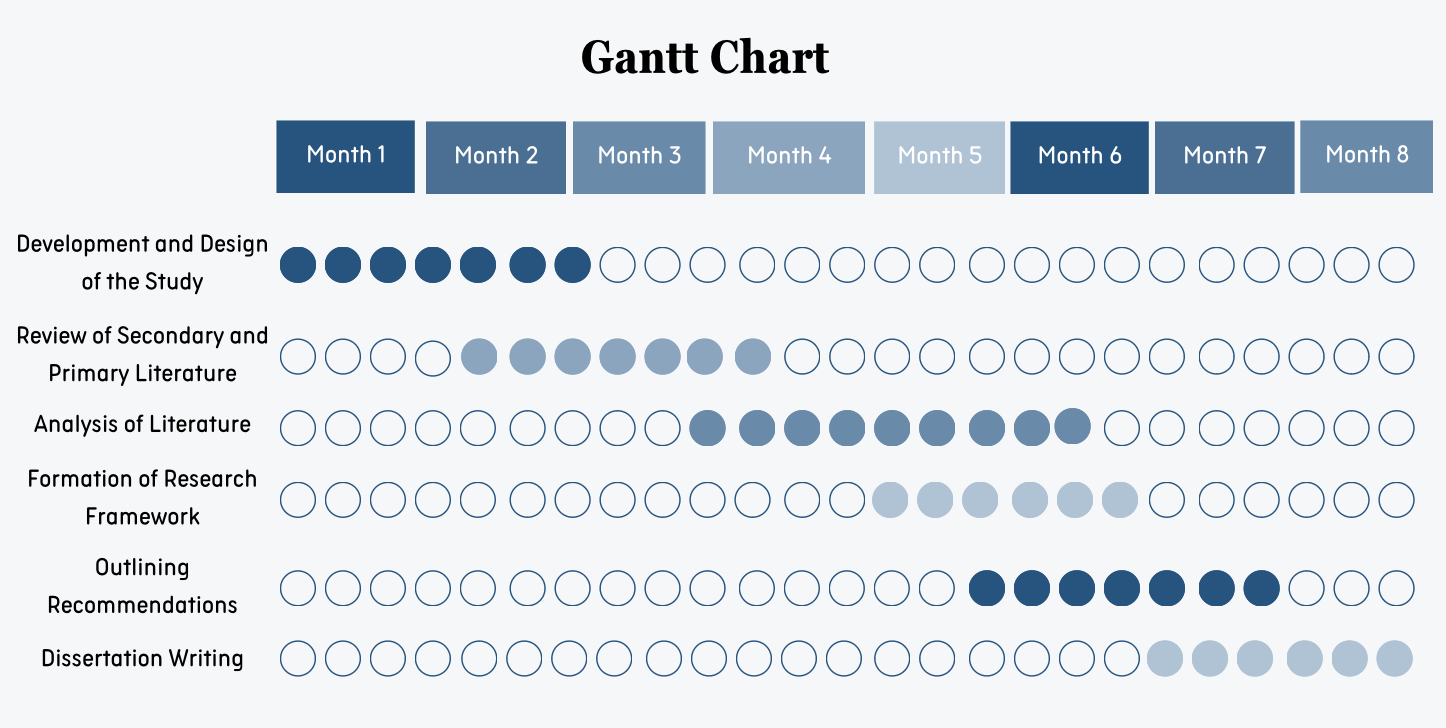
The next stage is developing a project implementation plan that outlines all the main stages it must go through. The inconsistency of this process is due to the difficulty of establishing a realistic timescale that allows researchers to allocate effort and time effectively to achieve the most productive outcomes. In addition, it will affect the limited possible problems associated with schedule compression or delays, as it will provide a clear deadline for completing each stage of the project. To increase the convenience of understanding and visualizing the project’s timescale, a Gantt chart showing the activities associated with the dissertation was developed, which can be found in the appendix.
Before proceeding with data collection, it is necessary to pay attention to the study’s development and design. This aspect involves the study of data collection instruments and strategies that will help you most successfully acquire the most valuable and reliable data. In addition, this process will ensure the prevention and mitigation of potential problems such as bias and conflicts of interest. It is necessary to allocate a month for this stage.
The project is based on a combination of secondary research and primary research. This process requires a comprehensive literature review and the collection and analysis of empirical data. Therefore, in order to obtain the most useful results, it is necessary to allocate significant time to this stage when forming a plan.
The first stage will be a review of secondary and primary literature related to the study of project professionals’ well-being, stakeholder engagement, and corporate social responsibility. This process may take from one to two months, depending on the quality and credibility of the information (Appendix). It is necessary to note that examining both types of sources also affects the time required.
The next step is to analyze the data obtained from the sources. It will focus on identifying the main themes, strategies, and theoretical frameworks that can be useful for the dissertation’s argumentation and on highlighting recommendations for improving the well-being of project professionals. In the future, after synthesizing and researching this type of literature, it is necessary to develop a framework on which the research and the entire project will be based. Two months will be allocated for each of these stages (Appendix). Thus, sufficient time will be provided for a more complete analysis and allocation of valuable outcomes.
After completing these steps, it is necessary to identify the main recommendations to ensure the well-being of project professionals. At this stage, the study should provide the most relevant and effective strategies and policies that will also ensure information about the value of stakeholder engagement and corporate social responsibility. After this step, directly writing the dissertation and checking it for compliance with all requirements and standards should already be underway. It is planned to devote two or three months to this stage (Appendix).
Reference List
Cheung, C. et al. (2019). ‘The well-being of project professionals,’ Association for Project Management.
Chiocchio, F. et al. (2010) ‘The project involvement index, psychological distress, and psychological well-being: Comparing workers from projectized and non-projectized organizations,’ International Journal of Project Management, 28(3), pp. 201-211.
Darvishmotevali, M. and Ali, F. (2020) ‘Job insecurity, subjective well-being and job performance: The moderating role of psychological capital,’ International Journal of Hospitality Management, 87.
Kim, M. and Kim, J. (2020) ‘Corporate social responsibility, employee engagement, well-being and the task performance of frontline employees,’ Management Decision, 59(8), pp. 2040-2056.
Kujala, J. et al. (2022). ‘Stakeholder engagement: Past, present, and future,’ Business & Society, 61(5), pp.1136–1196.
Onkila, T., and Sarna, B. (2022) ‘A systematic literature review on employee relations with CSR: State of art and future research agenda,’ Corporate Social Responsibility and Environmental Management, 29(2), pp. 435-447.
Page, M.J. et al. (2021) ‘Investigating and dealing with publication bias and other reporting biases in meta‐analyses of health research: A review,’ Research Synthesis Methods, 12(2), pp. 248-259.
Paruzel, A., Klug, H. J., and Maier, G. W. (2021) ‘The relationship between perceived corporate social responsibility and employee-related outcomes: A meta-analysis,’ Frontiers in Psychology, 12.
Pedrini, M. and Ferri, L.M. (2019) ‘Stakeholder management: a systematic literature review,’ Corporate Governance: The International Journal of Business in Society, 19(1), pp. 44-59.
Pfajfar, G. et al. (2022) ‘Value of corporate social responsibility for multiple stakeholders and social impact–Relationship marketing perspective,’ Journal of Business Research, 143, pp. 46-61.
Stocker, F. et al. (2020) ‘Stakeholder engagement in sustainability reporting: A classification model,’ Corporate Social Responsibility and Environmental Management, 27(5), pp. 2071–2080.
Stojanovic, A. et al. (2020) ‘Corporate social responsibility as a determinant of employee loyalty and business performance,’ Journal of Competitiveness, 12(2), pp. 149-166.
Thekdi, S. and Aven, T. (2024) ‘Characterization of biases and their impact on the integrity of a risk study,’ Safety Science, 170.
Tupper, H. and Ellis, S. (2022) It’s time to reimagine employee retention.
Yan, R. et al. (2020) ‘Role of psychological factors in employee well-being and employee performance: An empirical evidence from Pakistan,’ Revista Argentina de Clínica Psicológica, 29(5), p. 638.
Appendix