
Introduction
International business expansion is a widespread process in contemporary business. It provides companies with access to new marketplaces and capabilities, and the techniques the corporations use for international expansion include partnerships, direct exporting, licensing, and joint ventures (Luthans & Doh, 2021). Starbucks, the global chain of coffee shops, is not an exception, and it now has approximately 28,000 locations in more than 60 countries (Peetz, 2019).
Starbucks offers clients tea, cakes, drinks, snacks, and various types of coffee, and most stores also sell goods like customized cups (Peetz, 2019). Starbucks’ expansion to the Indian market, as described in the case study, has several peculiarities. Even though the Indian market is large and growing rapidly, there are significant cultural challenges.
Motivation to Venture, Early Concerns, and Obstacles
Starbucks decided to enter India because of the potential for growth and resources this country offers to businesses. Nevertheless, Starbucks faced several critical obstacles and concerns at the beginning of its path. Since diversifying the corporate culture to reflect regional character and traditions requires significant time and resources, problems are inevitable (Luthans & Doh, 2021).
The first issue Starbucks faced in India was significant social disparities within the local community, which were a barrier to entrepreneurship (Luthans & Doh, 2021). The second point was the absence of a tradition of coffee drinking, given their long history of tea drinking, which might lead Indians to be opposed to coffee (Luthans & Doh, 2021). These cultural aspects were crucial in the initial expansion to the Indian market.
Labor standards directly affected the quality of products or services. As a result, Starbucks had to look for higher-standard employees who are experts at producing premium coffee using state-of-the-art equipment and facilities (Vogt, 2019). Additionally, there were concerns regarding the cost of the coffee, as Starbucks sold more expensive coffee than any other chain in the country. Another concern for the corporation was land acquisition, as they had to identify the profitable location for their standard precisely (Vogt, 2019). Therefore, economic issues were vital in opening the first Starbucks shops in India.
Approach and Cultural Adaptation
The approach Starbucks used to enter India was a partnership. Starbucks partnered with Tata Global Beverages to identify a strategic entry point into India (Luthans & Doh, 2021). It illustrates an emerging market company working with a company in a developed country. Starbucks provides the traditional resources of a business venturing into emerging markets, including technological know-how, intangible assets, and a readiness to share knowledge, as well as a renowned brand amply displayed (Luthans & Doh, 2021). Partnerships helped Starbucks to share possibilities and risks, which was critical in emerging markets like India.
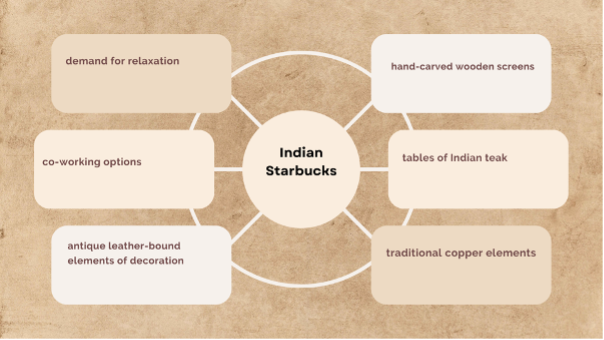
As mentioned, India is a tea-drinking country, and Starbucks adapted its cultural strategy to local peculiarities to meet market demand. For the average Indian, tea has become a habit, while most Americans drink coffee on the go. On the other hand, Indians sip tea to rest and feel rejuvenated. The Starbucks locations in India offer additional space and a social atmosphere with free WiFi and co-working options so people can unwind and spend time together (Luthans & Doh, 2021). Starbucks has altered the layout of its Indian locations to accommodate the demand for relaxation.
Additionally, Starbucks has altered the inside decor of its locations by incorporating regional handicrafts, artwork, and goods. For instance, the first store in Mumbai features antique leather-bound elements of decoration, hand-carved wooden screens, and tables made of Indian teak. Copper reflects Pune’s rich past, and the city’s first Starbucks features copper antiques (Luthans & Doh, 2021). In addition, Starbucks offers several Indian culinary items on its menu, including Konkani Twist and Reshmi Kabab (Luthans & Doh, 2021). These details of the Indian Starbucks are represented in Graph 1. National culture shapes Indian business culture, and Starbucks has successfully implemented these aspects.
Joint Venture
The joint venture format was profitable for the Tate Group and Starbucks. Starbucks focused on global expansion, leading it to enter India through a joint venture (Peetz, 2019). The business made numerous unsuccessful attempts to get admittance for over five years. The advantages of collaborating with Starbucks included a more robust local brand image, a focus on coffee and related beverages, a global client base devoted to the brand, and the distinction of being the largest coffee shop chain in the world (Babu & Hisrich, 2023).
Regarding the Tata Group, it is the most prominent integrated coffee plantation firm globally. Their distinctive quality stems from their ability to consistently produce significant quantities of exceptional, premium, estate-specific, and strain-specific coffee (Babu & Hisrich, 2023). They are involved at every stage of the coffee manufacturing process. Tata Coffee has dominated worldwide markets through this lobby, as the main coffee-consuming markets are Arabica-centric (Babu & Hisrich, 2023). The two companies’ synergies were crucial in helping them open more locations and expand more carefully in the market. They were committed to providing coffee lovers nationwide with the distinctive Starbucks experience, unmatched service, handcrafted beverages, extensive food offerings, and a distinct coffee aroma.
Benefits and Challenges of Expansion Through Joint-Venture Partnerships
Social responsibility issues are among the concerns the company faces through joint venture partnerships. Starbucks faces challenges due to the lack of empowerment and accountability in cooperative systems that transcend global supply chains and share commitments within developing countries (Ferreira & Beuster, 2019). It also encountered difficulties regarding employee welfare due to resource constraints, health concerns, and fair trade agreements, all of which depended on customers’ choices to buy fair trade products (Ferreira & Beuster, 2019). These details constitute the cultural environment that impacts the entry strategy. Starbucks needs to find a compromise between its Western principles of social responsibility and the local Indian context.
If Starbucks wants to be successful in India, it needs to pay attention to the eating patterns of this nation, particularly the current and future beverage market. Starbucks’s approach to the Indian beverage market is another factor contributing to its success (Ferreira & Beuster, 2019). The location influences taste and drink preferences, much like Indian eating customs (Ferreira & Beuster, 2019). Most Northern Indians are occasional tea and coffee drinkers, and Starbucks can figure out a way to turn them into regular coffee drinkers (Ferreira & Beuster, 2019). New potential clients are an opportunity for Starbucks, and finding the approach to them is essential to increase financial benefits.
Starbucks has a strong chance of growing in India, as younger people are more open to global culture than their parents and older people. The younger generation in India will be drawn to social media trends, which will fundamentally alter their society. Limits on foreign direct investment (FDI) will rise, and FDI will be distributed more widely among metropolitan areas (Schröder et al., 2019). Regarding the worldwide brand image, innovation will never stop. Enhancing its focus on capacity utilization and inventory efficiency are two areas in which Starbucks might thrive (Schröder et al., 2019).
Integrated marketing initiatives should be supported by improved and maintained total quality management procedures. Starbucks should continue expanding internationally, as this would increase the number of customers it can serve (Schröder et al., 2019). In addition, the corporation can improve its understanding of global culture and values to enhance its cultural strategy. One advantage of joint-venture agreements is that they allow Starbucks to enter markets it is unfamiliar with, while leveraging its partners’ advice them about what to do and how to accomplish it.
Potential problems in expanding into new markets stem from conflicting ideologies. For instance, Starbucks is a globally recognized American brand, while nations and regions have distinct cultures and lifestyles (Schröder et al., 2019). Therefore, when Starbucks wants to expand into a new market, its potential partners can explain that this idea will not succeed because most people do not share the required values.
However, Starbucks can achieve both diversification and worldwide expansion through joint venture agreements. It is more practical and desirable to share costs and risks with an associated company. Other advantages include broadening horizons, gaining new insights, forming temporary collaborations, and gaining more resources (Schröder et al., 2019). Starbucks also worries about restrictions on outside activity.
At the same time, the project is underway, and requirements include signing exclusive arrangements or contracts, as well as non-compete clauses that prohibit undermining or conducting business that could harm competing market brands. Starbucks faces additional challenges when entering foreign markets through joint venture partnerships. It would require sharing earnings with linked businesses and with existing vendor alliances. The major benefits and challenges are summarized in Table 1.
Table 1: Benefits and Challenges of Expansion Through Joint-Venture Partnerships
Lessons Implementation
The goals for increasing competitiveness and diversification are outlined in Saudi Vision 2030. The objective of Saudi Vision 2030 is to attain more economic, social, and cultural diversity, which is the “foundation for economic prosperity” (Bin Abdulaziz al Zaud, 2023, p. 12). It is organized around three primary themes that outline specific goals.
Among them are urbanization, equal employment for women, global competitiveness, the empowerment of local small businesses, foreign direct investment, and the emphasis on “Islamic heritage” (Bin Abdulaziz al Zaud, 2023, p. 16). These issues are consistent with Starbucks’ case study because it shows a direct investment in a new market that creates jobs, provides employment opportunities, and supports small businesses. In addition, it emphasizes the country’s connection to the rest of the world, which is essential in cultural terms.
Conclusion
India presents a challenging investment opportunity for Starbucks products, particularly given the country’s low coffee consumption and high tea consumption. The business must be committed to achieving its strategic marketing objectives. In India, Starbucks faces fierce competition due to its higher costs compared to other coffee shops. Economic, cultural, and political variables will undoubtedly impact how the marketing techniques work out. Starbucks demonstrates Western culture in several ways, and the business must make a significant effort to overcome people’s mistrust. To be sustainable in this industry, one must assimilate into Indian culture and way of life.
References
Babu, V., & Hisrich, R. (2023). Negotiation for entrepreneurship: Achieving a successful outcome. Anthem Press.
Bin Abdulaziz al Zaud, S. (2023). Saudi vision 2030. Vision2030.gov.sa.
Ferreira, S., & Beuster, L. (2019). Stellenbosch coffee society: Societal and locational preferences. Urbani Izziv, 30, 64–81.
Luthans, F., & Doh, J. P. (2021). International management: Culture, strategy, and behavior (11th ed.). McGraw-Hill Education.
Peetz, D. (2019). The realities and futures of work. ANU Press.
Schröder, A., Völker, N., Winkler, R. A., & Clucas, T. (2019). Futures worth preserving: Cultural constructions of nostalgia and sustainability. Verlag.
Vogt, M. (2019). Variance in approach toward a ‘sustainable’ coffee industry in Costa Rica: Perspectives from within; Lessons and insights. Ubiquity Press.