
Introduction
Within the framework of the educational process, a sufficiently large number of problems may arise that may prevent the achievement of the most productive results. One of the most challenging aspects for management is the manifestation of deviant behavior among students. This aspect requires special attention and involvement of a specialist in the field of behavioral analysis to carry out measurement measures and identify initiatives that will help limit the problem in the educational environment. Of particular importance in this context is the application of the scientist–practitioner model and the recording of measures that will contribute to the acquisition of the most valuable data on deviant behavior for research.
Scientist–Practitioner Model
When conducting research, the use of specialized models that contribute to obtaining the most valuable results is particularly valuable. Within the framework of applied behavior analysis (ABA), the use of the scientist–practitioner model as a behavior analyst is of the utmost importance. It provides an opportunity to benefit both professionals who use it and clients, as well as the overall field of ABA.
First, it is worth determining what applied behavior analysis is. Research stated that “it uses the general principles of learning and behavior to solve problems of social relevance” (Fisher et al., 2021, p. 10). Thus, the center of applied behavior analysis lies in how people study and apply specific patterns and strategies for interacting with others. In other words, this approach focuses on the study of behaviors that may be important for the social sphere of individuals’ lives (Cooper et al., 2020). Thus, the value of studying this approach lies in gaining knowledge about the process of forming a particular behavior and contributing to the development of ways to modify it.
Of particular value when considering ABA is the use of the Scientist–Practitioner model in the field of behavior analytics. This aspect is due to the fact that it provides an opportunity to better understand the problems faced by the client and how they can be solved. Research indicated that it must “be informed by research, and how research should also be responsive to the realities of clinical practice” (Douglas & Cox, 2019, p. 3). This criterion is one of the leading applications of the scientist–practitioner model. This is because behavior analysis is a complex process that should be supported by evidence-based knowledge, which provides the most comprehensive understanding of approaches to it.
The use of various evidence-based practices within the Scientist–Practitioner model offers several benefits for both clients and the broader ABA field. Firstly, it is essential to identify the most effective and appropriate treatment strategies and policies that meet the needs of patients. In addition, the use of proven approaches will provide an opportunity to achieve the most productive behavior change, limiting the occurrence of issues. In the context of the overall field of ABA, the use of the Scientist–Practitioner model encourages the expansion of knowledge in this area, as new aspects and nuances are acquired depending on each case of clients.
In addition to evidence-based research, it is necessary to consider the advantages of implementing a Scientist–Practitioner model, such as the use of reliable and valid measurements. The primary benefit of this criterion is to ensure the most accurate monitoring of the client’s progress when changing behavior. Additionally, this model facilitates a more efficient decision-making process for any adjustments to the treatment process. Thus, these advantages for the client can ensure not only the achievement of favorable results but also a high level of satisfaction and trust.
Defining and obtaining reliable and valid measurements also contributes to the improvement of the ABA area. This is due to the allocation of universal measuring indicators that can provide a general picture of individual behavior. In addition, it contributes to the expansion of knowledge about the unique individual aspects that may arise when implementing the model under study.
The following essential aspect of the Scientist–Practitioner model is social validity. It is defined as “the evaluation of the degree of acceptance for the immediate variables associated with a procedure or program designed to change behavior” (Carter & Wheeler, 2019, p. 2). Therefore, as part of the process of behavior change, interventions should meet not only scientific criteria but also social ones. This will provide an opportunity to improve customer patterns that will meet their goals and requirements. Within the scientific field of ABA, the concept of social validity and its application will provide an opportunity to expand knowledge regarding effective interventions. Additionally, taking into account the individual needs of the client will have a positive impact on building relationships with a specialist, which in turn will contribute to better treatment outcomes.
The last but no less critical indicator of the Scientist–Practitioner model is treatment integrity. It implies the appointment of treatment procedures in accordance with the issue with which the client turned to a specialist. In other words, treatment integrity provides the most effective treatment for the client without any deviations or omissions.
In the scientific field, the introduction of treatment integrity provides a more complete understanding of the aspects that should be included in this process. Research pointed out that “continued program monitoring is required to assess the integrity of services and provide any needed support” (Rodriguez, 2020, p. 295). Therefore, it is helpful to identify indicators that professionals working with ABA should follow to ensure ethical behavior.
Measurement Procedures
The case study that becomes the focus of this work concerns fifth-grader Frank, who experiences several behaviors that cause concern to teachers. It is noted that the boy is placed in the general education classroom setting, except for mathematics, in which he shows notable success (“Unit 4 assignment case study,” n.d.). The student exhibits several operational behaviors that become obstacles both to his learning process and to the general academic success of the class. The study of these behaviors will provide a more complete understanding of which data recording methods are most appropriate for each behavior change.
First, it is noted that Frank exhibits off-task behavior in Language Arts or Social Studies. Research defined it as “one of the students’ learning behaviors indicated by doing activities that are unrelated to learning, in which the students completely lose control in the learning environment and tasks” (Saripah & Widiastuti, 2019, p. 175). In Frank’s case, it consists of “requiring frequent prompts to get started on his work” and unwillingness to open books, play with materials, and engage in other activities besides those set by the teacher (“Unit 4 assignment case study,” n.d., p. 1). Therefore, it significantly slows down the work the teacher is doing in the classroom and requires additional attention from the student, detracting from the whole-class effort, which reduces the effectiveness of the educational process.
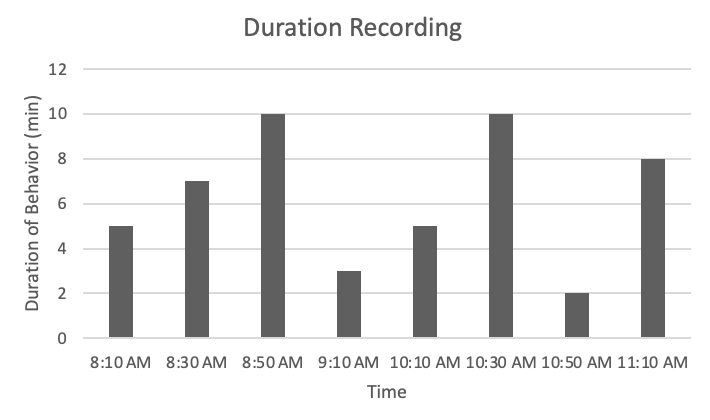
When considering and analyzing this problem, the duration and frequency of recording of deviant behavior may be effective. This is to provide an opportunity to determine the moments when a child most often exhibits this behavior in class and how often it occurs. The involvement of a behavior analysis specialist, who can determine whether the individual is off-task at specific moments, can be helpful in this context. The main advantage of this approach is that it eliminates additional distractions for the teacher, allowing for an objective assessment of the student’s problem severity.
The instances when Frank shouts out, kicks the desk or other classroom furniture, or bangs on the desk become a particularly critical manifestation of Disruptive Behavior in the presented case study. It is determined that the main reason for the manifestation of these emotions is the offer to engage in a non-preferred task. Several reasons can be given for this negative manifestation, the main one being that “transitioning from elementary to middle school is a time of particular vulnerability for students with behavior problems” (Wills et al., 2019, p. 213). Thus, mitigating this behavior requires special attention due to undesirable consequences such as disruption of the educational process and the risk of potential harm to the student.
As a data recording method, it is necessary to implement event recording in this case. In other words, it is necessary to use a tool that provides an opportunity to track the frequency of undesirable, destructive behavior. It is also essential to identify the time frame and factors that trigger this emotional reaction in the student. In this way, behavioral analysts and teachers will gain a fuller understanding of how often these behaviors occur, highlighting specific trends and a plan to help change them.
Excessive bathroom breaks are the next highlighted operational behavior that Frank exhibits in the educational process. It consists of events in which a student leaves the classroom and stays in the bathroom for extended periods, engaging in other activities (“Unit 4 assignment case study,” n.d., p. 1). This example of off-task behavior has a significant negative impact on classroom attendance and, consequently, academic success.
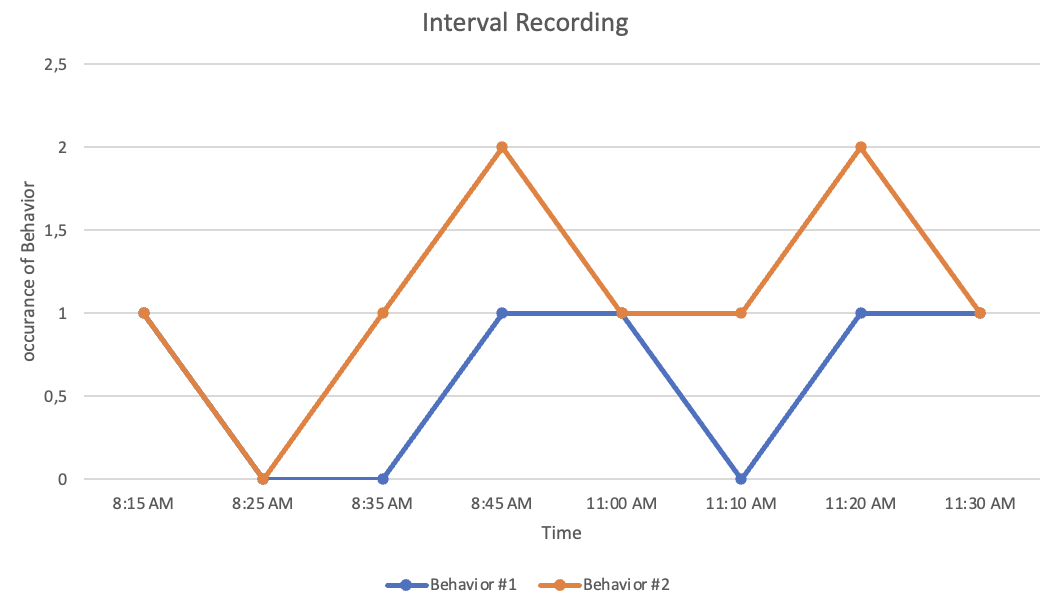
Within the framework of this problem, the most valuable and informative approach will be the use of interval recording. The peculiarity of this method is that it focuses on highlighting the intervals that the teacher spends outside the classroom to determine the degree of disinterest in the material being passed (Bicard & Bicard, 2012). To do this, the study time can be divided into intervals, and the allocation of periods can be identified when Frank is in the classroom or the bathroom.
Data Reliability and Validity
A critical aspect of conducting various kinds of recordings is accountability regarding indicators such as reliability and validity in measurement procedures. When considering reliability, it is necessary to limit this aspect by avoiding bias. To fulfill this criterion, it is necessary to involve an additional specialist or teacher who will record data for analysis.
It is vital, as visual analysis requires meticulous attention to detail to gain the most knowledge (Ledford et al., 2017). This step will provide an opportunity to gain a comprehensive view of the collected information and ensure its objectivity. Another essential characteristic is the consistency in the selected dimensions. In other words, a clear definition of the criteria for each behavior is needed, which will be analyzed. With this step, it became possible to avoid any deviations that could compromise the study’s results.
Validity is a crucial criterion in ensuring the validity and usefulness of the study. First, to ensure this, it is necessary to ensure that the operational definitions of behaviors correspond to the behavior an individual exhibits in a school setting. This will provide an opportunity to obtain the most valuable conclusions for the creation and implementation of the necessary intervention. This aspect also concerns consulting in relevant research in the field to provide evidence-based criteria. Thus, if the validity and relevance of the research work are observed, the maximum accuracy and effectiveness of behavior analysis will be achieved.
Conclusion
In conclusion, the conduct of this work provided an understanding of the aspects included in the identification, monitoring, and analysis of human behavior. Using the example from the case study, a study was conducted to examine the allocation of operant behavior that interfered with the educational process and to identify measures that can be taken to address this deviant behavior. Based on the conducted duration and interval recordings, the tendency of the formation of a student’s pattern was highlighted, which will provide awareness of what interventions can be applied in the future to limit it.
References
Bicard, S. C., & Bicard, D. F. (2012). Measuring behavior. IRIS Center.
Carter, S. L., & Wheeler, J. J. (2019). The social validity manual: Subjective evaluation of interventions. Academic Press.
Cooper, J. O., Heron, T. E., & Heward, W. L. (2020). Applied behavior analysis. Pearson UK.
Douglas, K. S., & Cox, D. N. (2019). Violence risk assessment: Science and practice. In R. Roesch & K. McLachlan (Eds.), Clinical forensic psychology and law (pp. 3-38). Routledge.
Fisher, W. W., Piazza, C. C., & Roane, H. S. (Eds.). (2021). Handbook of applied behavior analysis. Guilford Publications.
Ledford, J. R., Lane, J. D., & Severini, K. E. (2017). Systematic use of visual analysis for assessing outcomes in single case design studies. Brain Impairment, 19(1). 4–17.
Rodriguez, K. A. (2020). Maintaining treatment integrity in the face of crisis: A treatment selection model for transitioning direct ABA services to telehealth. Behavior Analysis in Practice, 13(2), 291-298.
Saripah, I., & Widiastuti, H. T. (2019, August). Profile of off-task behavior in primary school students. in elementary school forum. Mimbar Sekolah Dasar, 6(2), 174-184.
Unit 4 assignment case study. (n.d.). Purdue Global.
Wills, H. P., Caldarella, P., Mason, B. A., Lappin, A., & Anderson, D. H. (2019). Improving student behavior in middle schools: Results of a classroom management intervention. Journal of Positive Behavior Interventions, 21(4), 213-227.