
Introduction
The application of modern technology in various areas of human life is largely determined by its ergonomics and ease of use, as well as its direct impact on critical spheres such as health and safety. It is essential to note that many modern technologies people take for granted have emerged relatively recently. A unique example is the smartphone market, the year of which can be considered 2010, when the iPhone was introduced. These gadgets have quickly become an integral part of people’s lives, carrying out numerous crucial tasks that simplify daily life (Yang et al., 2019).
It is essential to note that among the software installed on smartphones, there is a vast array of apps that, for instance, access and process users’ personal data, including their health indicators (Warmington-Lundstrom & Laurenti, 2020). The above factors underscore the importance and necessity of a comprehensive study of the smartphone sales market from both technological and economic perspectives. This factor determines the study’s relevance and applicability to the practical application of the data obtained.
Objective
As the study’s objective, it is essential to stress the aim of researching the situation of smartphone sales in the US from 2017 to 2022. Other objectives include comparing sales of various smartphones, analyzing profits from smartphone sales by different manufacturers, and examining the particular specifications that influence the popularity of smartphones. The paper’s main argument is that the popularity of smartphones impacts the high demand in the market, as well as the particular company’s marketing and economic strategy. In addition, it is vital to construct the research question, which will highlight the purpose and discover the argument. The primary question is the importance of researching and addressing customers’ needs in the US smartphone market, in line with the company’s strategy, and in comparison to other market players.
Review of Literature
Various sources of information were considered to obtain relevant and trustworthy facts about smartphones, their manufacturers, and sales figures in the US from 2017 to 2022. For instance, Bauer et al. (2020) emphasize the exploration of various aspects of using smartphones during work moments, linking technology’s demand and functionality in the medical field. The authors highlighted specific attributes of smartphones, which make them popular in the medical sphere and increase their demand. Wi-Fi adapters, GPS systems, cameras, speakers, and others (Bauer et al., 2020). These data help to identify specific aspects that affect the growth or decline of smartphone sales.
The second resource is a study of the US smartphone market by Fan & Yang (2018). This article examines how changes in competition impact the variety and number of items supplied, as well as whether competition leads to too few or too many products on the market from a welfare standpoint. In the context of the US smartphone market, the authors consider these two factors.
The study’s findings demonstrate that there are insufficient items on the market, and that less competition leads to a decline in the number of products and their diversity (Fan & Yang, 2018). These findings suggest that adjusting the product mix may enhance the merger’s beneficial effects. It will also aid in defining the features of the strategy of big companies in the context of their orientation to a different audience.
Another source of information relevant to the study is the article by Guo et al. (2023). The authors examine current events and the connection between the growth of the sharing economy and US smartphone sales. According to Guo et al. (2023), the rapid adoption of smartphones and associated apps over the past several years has driven the explosive growth of the online sharing economy. From this vantage point, the study’s empirical results are consistent with other studies that have suggested that network externalities can considerably impact firm strategy and the course of market competition. This data is crucial for determining the characteristics of technology companies’ actions and their impact on smartphone sales.
When examining the smartphone market, privacy and the collection of personal data are crucial. Despite claims by companies like Apple and Google about the absolute confidentiality and security of users’ data, for many, it is not a convincing enough factor. Older people seriously consider smartphone alternatives (Zhao et al., 2019). This element also plays a role in influencing smartphone sales in the US.
This question is discussed in the research described in the work by Zhao et al. (2019). For example, the authors define four types of personal information manufacturers can access. These include demographic attributes, psychological status, personal interests, and personality traits (Zhao et al., 2019). Collecting personal information is a crucial aspect that influences people’s decisions to buy or not buy a smartphone.
Another critical study and statistical data essential for the current research are in the book by Arezes (2018). There is some interest in surveys regarding the use of various devices for convenience. The primary comparison was made between smartphones and tablets. For example, the results showed that many people (22.2%) experienced physical discomfort when using smartphones (Arezes, 2018). Only a small number of tablet users (5.5%) complained about this problem (Arezes, 2018). In the context of ergonomics and usability, which significantly impact smartphone sales, this information will be necessary.
The paper will contribute to the body of knowledge by considering and exploring various aspects stated in the abovementioned articles, books, and internet sources. The graphs and charts from these resources will mainly be used to consider detailed statistical data. It will be crucial not only to understand the entire situation concerning smartphone sales in the US market but also to help define specific factors that mark Apple’s, Samsung’s, and Google’s functioning and economic strategies.
Economic Analysis
Economic analysis should draw on relevant information from different sources. Since the study’s main objective is to investigate the various factors that affect smartphone sales in the US from 2017 to 2022, as well as to consider the features of Apple’s sales, specific statistics will be needed. Statista provides data on smartphone sales exceeding $1 billion. Given that the current study spans from 2017 to 2022, paying attention to this part of the graph is crucial.
Apple, Samsung, Google, and LG were the largest suppliers of smartphones in the US last year. There was also increased demand for mid-range smartphones, such as those from Huawei and Xiaomi, in 2017. This is because such smartphones offered a more affordable price but retained good functionality and quality. It is evident how Apple and Samsung have dominated the market share over the years.
At the same time, less favored brands do not have the room to maneuver in these circumstances. Oppo, T-Mobile, and other lesser-known companies have few options for earning their shares in the market. To understand the economic factors behind this phenomenon, it will be helpful to examine the characteristics of smartphones and their ongoing improvements. The market experienced dramatic leaps in technological progress.
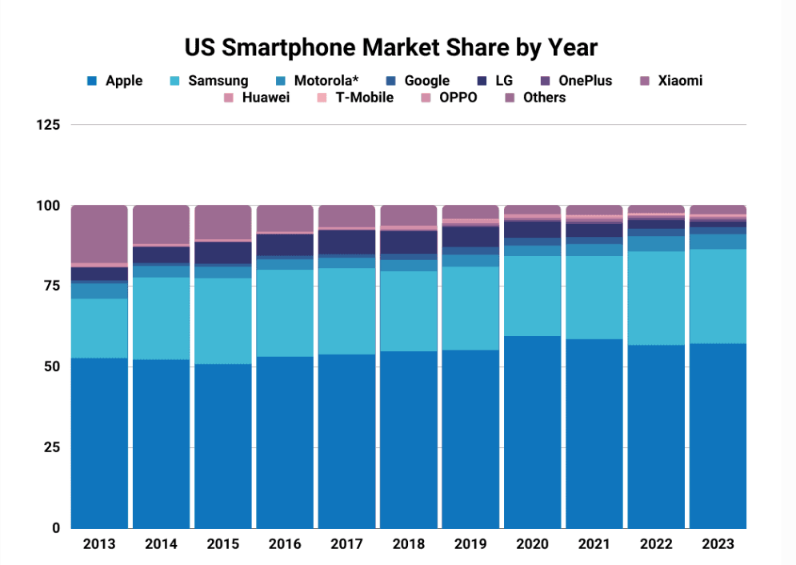
In particular, Apple presented not only an updated design and improved device ergonomics but also an enhanced iOS operating system. Consequently, the strong growth of smartphone sales until 2017 was driven by innovation and significant technological progress. It is essential to note that Apple has consistently created trends that have been followed to varying degrees by other market players, such as Samsung and Google (Zhao et al., 2020). This means that when assessing changes in Apple Inc.’s profits, it is possible to conclude that the development of smartphone sales is, in general. After the flow of significant innovations decreased after 2017 and was replaced by incremental improvements to existing features, such as the camera and smartphone battery, manufacturers’ profits stabilized.
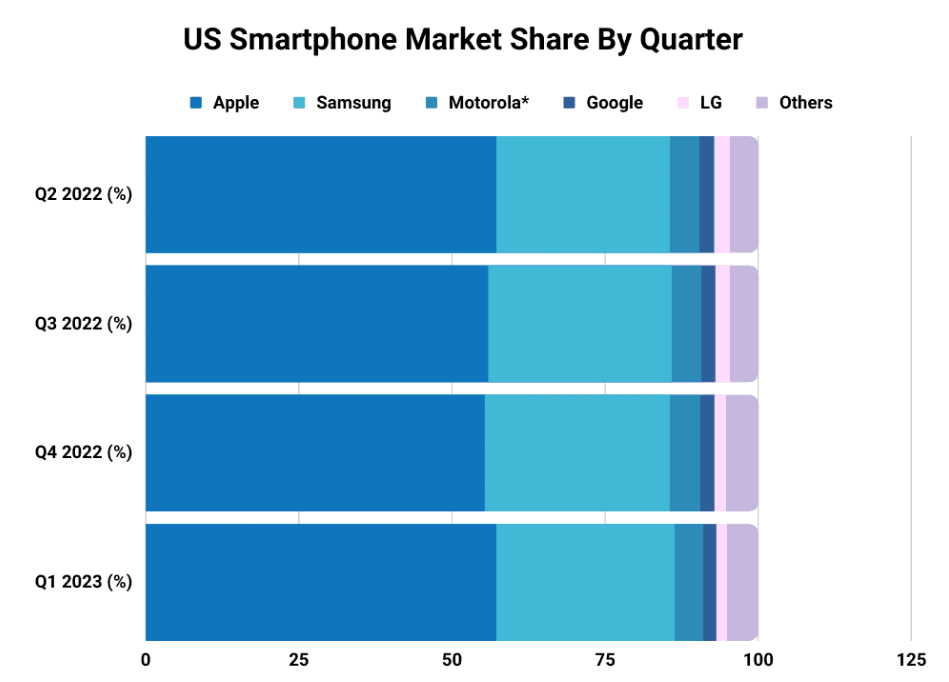
The following graph shows the market share of smartphone companies. When assessing the shares of major market players, Apple and Samsung, it is essential to note that Apple is gradually increasing its profit, as shown in the percentage graph. While in the third and fourth quarters of 2022, the company’s profit share in the US market was declining, in the first quarter of 2023, it grew significantly (Figure 2).
Considering this trend relative to Apple’s success, it is worth comparing the diversity factor of the company’s products and such concepts as product differentiation. Having assessed the products produced by the company as of 2017, it is possible to notice that the primary investments were directed to one product of the company, the iPhone (iPhone, n. d.). Apple then began to differentiate not only the characteristics of a particular product, such as an iPhone with different memory and screen sizes, but also paid more attention to other products. In particular, new technologies, such as the Apple Watch, AirPods, and others (iPhone, n. d.). It allowed Apple to become more competitive and increase investment, particularly for the iPhone.
As in previous years, Apple and Samsung were the market leaders in 2018. Nevertheless, Samsung and Apple sold fewer phones in 2018 than in 2017. Other brands like LG, Motorola, and Google also posted good sales results. Interestingly, the US smartphone market was down about 0.5 percent in 2018 compared to 2017, indicating a saturated market and less inclination for consumers to upgrade their devices. As in previous years, US smartphone sales remained strong in 2019. However, given the global economic situation and growing geopolitical risks, demand for smartphones in the US has become less robust than before.
In 2020, smartphone sales in the US declined, and the reason for the decline in sales is the worsening economic situation due to the COVID-19 pandemic and the market saturation with smartphones. Despite this, online sales increased due to increased demand for remote work and training. Nevertheless, the most popular brands, such as Apple, Samsung, and LG, continue to dominate the market, representing more than 70% of all sales in 2020. Demand for smartphones continues to grow in the US in 2021 and 2022, as most people use them daily and access the Internet via mobile devices. In addition, smartphones have become an integral part of our lives, so consumers are constantly looking for new models.
As the graphics show a specific trend of growth of profits from sales of smartphones in the US market, it can be concluded that companies, notably Apple, have made significant progress in specific problem areas. As stated in the literature review, a significant number of factors affect the sales of smartphones. These include privacy of the customers’ data, comfort and ergonomics, age of the customers, and others. It is important to stress that when considering Apple’s strategy, one can trace its efforts to satisfy each factor. For example, technologies such as FaceID help improve user privacy.
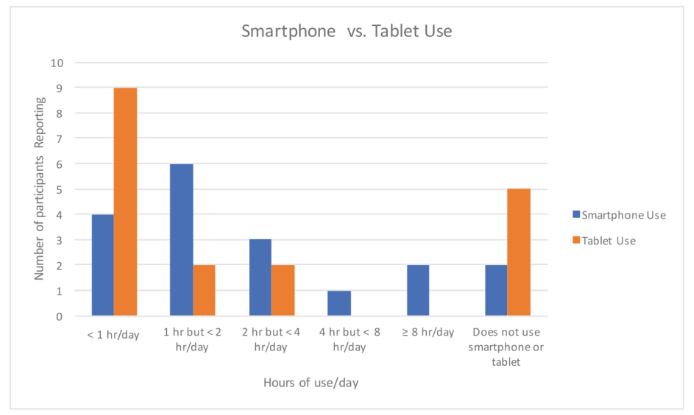
On the other hand, the benefits for older people when buying a smartphone are directly related to improving their health. In particular, Apple Watch allows you to measure the pulse and other essential body data, which are then passed to the doctor for analysis (iPhone, n. d.). In addition, the company improved the comfort of using smartphones for an average time of 1-2 hours for aged people (Figure 3). These factors directly affect such components as price elasticity and income elasticity, as they allow companies to understand the demands of consumers better and adjust their actions to them (Campbell & Singh, 2019). It can be concluded that the growth of smartphone sales in the United States and the improvement in the economic condition of manufacturers are due to their competent and rational strategy and marketing. Overall, smartphone sales in the US remain strong and are expected to grow soon, especially with increased interest in 5G-enabled smartphones.
Summary
The research has addressed the main objective of exploring the situation of smartphone sales in the US for the period from 2017 to 2022. The findings highlight the presence of various factors that directly influence sales and the economic state of manufacturers. As a result, the growing smartphone sales are caused by product differentiation, strategic vision, and price elasticity. The data obtained by researching the abovementioned objective also allows one to answer the research question. Notably, specific data mentioned in charts, other research, internet sites, and books demonstrated that Apple Inc. has a unique economic and marketing approach to researching and satisfying customers’ needs, allowing the company to increase its smartphone sales dramatically.
Conclusion
In summary, it is crucial to emphasize the value of understanding and responding to customer needs within the smartphone market. The graphs show that the company that does it most successfully and rationally will significantly increase its sales and profit. Companies like Apple and Samsung are examples of economic growth from unique approaches and product diversification. The obtained data showed particular tendencies and approaches influencing smartphone sales in the US smartphone market. However, further research should be conducted to better understand the peculiarities of the customers’ needs, which directly influence sales, as well as companies’ methods to address them.
References
Arezes, P.M.F.M. (2018). Advances in safety management and human factors: proceedings of the the 2018 international conference on safety management and human factors, July… in intelligent systems and computing, 791) (1st ed.). Springer.
Bauer, M., Geddes, J., Glenn, T. Gitlin M., Grof P., Kessing L.V., Monteith S., Faurholt-Jepsen M., Severus E., & Whybrow P. C. (2020). Smartphones in mental health: a critical review of background issues, current status, and future concerns. International Journal of Bipolar Disorders volume, 8(2). Web.
Campbell, D., & Singh, C. B. (2019). Differentiating Price Sales Promotion and Non-Price Sales Promotion in Affecting Customers Behavior at Smartphone Retail Outlets. An Empirical Study. International Journal of Advanced Scientific Research and Management, 4(4), 418-424. Web.
Fan, Y., & Yang, C. (2020). Competition, product proliferation, and welfare: A study of the US smartphone market. American Economic Journal: Microeconomics, 12(2), 99-134. Web.
Guo, Y., Xin, F., & Li, X. (2020). The market impacts of sharing economy entrants: evidence from USA and China. Electronic Commerce Research, 20, 629-649. Web.
iPhone. (n. d.). Apple. Web.
Smartphone sales forecasts in the United States from 2005 to 2022. (2022). Statista. Web.
US Smartphone Market Share (2023). BankmyCell, Web.
Warmington-Lundstrom, J., & Laurenti, R. (2020). Reviewing circular economy rebound effects: The case of online peer-to-peer boat sharing. Resources, Conservation & Recycling: X, 5. Web.
Yang, D., Sonmez, M., Gonzalez, M., Liu, Y., & Yoder, C. Y. (2019). Consumer-based brand equity and consumer-based brand performance: evidence from smartphone brands in the USA. Journal of Brand Management, 26, 717-732. Web.
Zhao, W., Tian, S., Huang, L., Liu, K., Dong, L., & Guo, J. (2020). A smartphone-based biomedical sensory system. Analyst, 145(8), 2873-2891. Web.
Zhao, Z., Li, S., Ramos, J., Luo, Z., Jiang, Z., Dey, A. K., & Pan, G. (2019). User profiling from their use of smartphone applications: A survey. Pervasive and Mobile Computing, 59. Web.