Abstract
The research focused on analyzing mental health and social media use among people. The findings indicate that younger people tend to be more vulnerable to social media’s mental health implications due to higher use rates. The sample was comprised of 30 people (n=30) divided into two groups: Group A and Group B. The former comprised younger adults and adolescents, whereas the latter included older adults. The literature supports the results, and the specific emphasis was placed on depression and anxiety since they are the main mental health manifestations of social media.
Introduction
It is important to note that with the rise of the Internet, social media platforms have exploded in popularity and use across all nations, ages, and other demographics. Social media mimics and enhances human connectivity by making communication instantaneous and enabling sharing options, such as images, audio, videos, or written text. The study is important because human development and well-being are intricate and delicate processes that are designed and evolved to proceed properly in a specific environment. Hypothesis: Social media disrupts such a healthy condition by expanding the range of socialization opportunities available for people, causing harm in the form of mental health issues, with children and adolescents being the most vulnerable.
Literature Review
Impact of Social Media on Children and Adolescents
One should be aware that the negative impact of social media on people’s well-being is multifactorial and multifaceted, which implies that it is severely dangerous and risky. “Personal safety risks, identity theft, privacy issues, access to inappropriate and upsetting content, social isolation, and mental health issues are among the dangers,” the study said. (Dyer, 2018, p. 1). These include problems “like depression, anxiety, and poor sleep” in the latter situation. Additionally, there is a considerable chance that kids will become the victims of sexting or cyberbullying. (Dyer, 2018, p. 1). In other words, there is an array of problems caused by social media with respect to people.
These effects can be even more detrimental among younger children and teens, which is why people should be concerned about allowing a child to use these platforms. One should know that his or her involvement, supervision, and monitoring of the use of social media can greatly reduce these risks (Dyer, 2018). Therefore, social media poses a serious risk to children and teenagers when used without appropriate and careful monitoring of dosage, exposure, and usage.
Due to their delicate developmental stage, adolescents are among the most vulnerable members of society and are most affected by the detrimental impacts of social media on their developing brains. There’s a strong association between depression in adolescents and the use of social media (Wongkoblap et al., 2017). In other words, interactions with social media and the Internet are not one-way inputs because the described tools also affect the human brain. Since teenagers are still in their formative years, accurate knowledge and a supportive social environment are essential to their complete growth (Davis & Shlafer, 2017).
However, social media ‘hacks’ the core social elements, making them more exposed and vulnerable to a wide range of negative forces. Social media filters, for example, might exaggerate one’s appearance to an unattainable level, giving the impression that beauty standards are unachievable. The social approval elements of such platforms make adolescents vulnerable to shallow online provision of attention, and examples include likes, emojis, or even comments.
Social Media Effects On Adults
It is crucial to remember that adults are also susceptible to the negative effects of communication technology on the human brain, thus its effects are not just felt by teenagers. When it comes to adults, social media can cause depression, anxiety, and a host of other mental health problems. According to a study, “research indicates that restricting daily social media use to around 30 minutes may result in a notable enhancement of wellbeing” (Hunt et al., 2018, p. 751).
In other words, abstaining from or limiting the use of social media brings many benefits to a person’s mental health, which indicates negative implications and effects of the information overload of these instruments (Chancellor & Choudhury, 2020; James & Williams, 2017). Another study shows that depending on “time spent, activity, investment, and addiction. All domains correlated with depression, anxiety, and psychological distress” (Keles et al., 2020, p. 79). Thus, it is critical for a person to be conscious and aware of how much time one spends on social media in order to prevent depressive symptoms.
Method
The research methodology is based on a quantitative design to assess whether or not mental health metrics are impacted by the use of social media. It is imperative to emphasize that the statistical significance of the correlation will be determined. The instrument will be a scored questionnaire aimed at a sample size of 30 participants. They will be divided into two groups called Groups A and B, where the former will include young adults and teenagers less than 21 years of age. Group B will be comprised of mature adults more than 21 years of age.
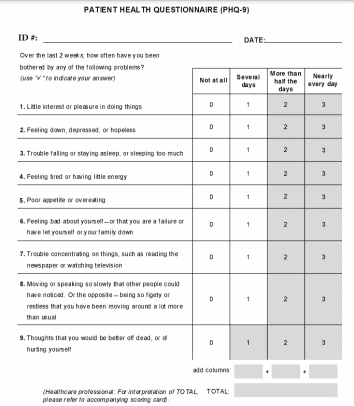
The statistical instrument will be a t-test with an independent variable being the time of social media use daily and a dependent variable being the mental health test score. The focus will be put on depression and anxiety since these issues tend to be the most common mental health problems associated with social media (Keles et al., 2020). The data collection material will be the Patient Health Questionnaire (PHQ-9) shown in Figure 2 of the Appendix. It was developed by the American Psychological Association (APA) and copyrighted by Pfizer, which is commonly used in the US (Pfizer, 2022). Procedurally, both groups will be given the test, and their scores will be assessed for statistical significance using a t-test. The next step will be observing the findings in light of the literature and the effects of social media. The final step is to analyze a wide range of limitations of the study to identify the direction for future research.
Results
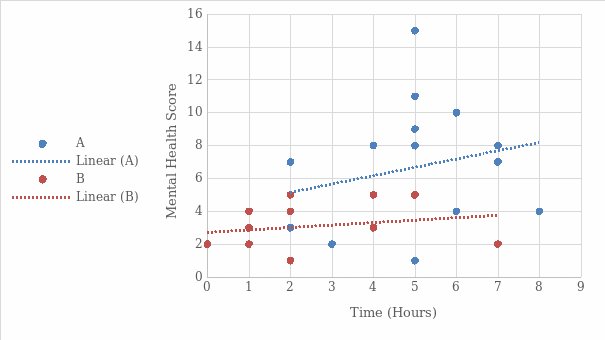
The data collected is shown in Table 1 below. The t-test showed a significant statistical difference between the use of social media between adults (B) and the younger group (A). The two-tailed P value equals 0.0031, t = 3.2338, df = 28, and the standard error of difference = 1.072. The time spent on social media was statistically significant, with the two-tailed P value equal to 0.0061. The intermediate values were t = 2.9634, df = 28, and standard error of difference = 0.697. Figure 1 shows the visual graph of comparison between the two groups.
Table 1. Data Collected
Discussion
The outcome supports the thesis that younger people tend to be more vulnerable to mental health issues due to higher social media use. People younger than 21 years old used spent more time on social media than people older than 21. The depression and anxiety scores were higher for the younger groups than for the older ones. The literature supports the results since adolescents tend to be more vulnerable to the effects of social media than adults (Morgan-Mullane, 2017; Myers & DeWall, 2020). The limitation of the study is that the analysis does not provide causational findings but only correlational ones. Therefore, a more in-depth assessment is necessary with a larger and properly sampled participant size.
Conclusion
In conclusion, social media affects the human brain both in the developmental stage and the developed stage, which leads to a reciprocal reinforcement of the perpetual cycle of negative interdependence. Repetitive usage of social media alters the human brain. The social environment of today encourages technology rather than shielding people from its harmful effects. Further utilization is made possible by the human brain’s reciprocal transformation into a computer-like thought pattern.
References
Chancellor, S., & Choudhury, M. D. (2020). Methods in predictive techniques for mental health status on social media: A critical review. Digital Medicine, 43, 1-12. Web.
Davis, L., & Shlafer, R. J. (2017). Mental health of adolescents with currently and formerly incarcerated parents. Journal of Adolescence, 54, 120-134. Web.
Dyer, T. (2018). The effects of social media on children. Dalhousie Journal of Interdisciplinary Management, 14, 1-16. Web.
Hunt, M. G., Marx, R., Lipson, C., & Young, J. (2018). No more FOMO: Limiting social media decreases loneliness and depression. Journal of Social and Clinical Psychology, 37(10), 751–768. Web.
James, J. K., & Williams, T. (2017). School-based experiential outdoor education: A neglected necessity. Journal of Experiential Education, 40(1), 58–71. Web.
Keles, B., & McCrae, N., & Grealish, A. (2020). A systematic review: The influence of social media on depression, anxiety and psychological distress in adolescents. International Journal of Adolescence and Youth, 25(1), 79-93. Web.
Morgan-Mullane, A. (2017). Trauma focused cognitive behavioral therapy with children of incarcerated parents. Clinical Social Work Journal, 46, 200-209. Web.
Myers, D. G., & DeWall, C. N. (2020). Psychology (13th ed.). Worth Publishers.
Pfizer. (2022). Patient health questionnaire (PHQ-9). Web.
Wongkoblap, A., Vadillo, M. A., & Curcin, V. (2017). Researching mental health disorders in the era of social media: Systematic review. Journal of Medical Internet Research, 19(6), e228. Web.
Appendix