
Strategic Management
Strategic management is a set of measures a corporation takes to achieve long-term goals that enable it to survive in competition and prosper in any environment. Moreover, the more unstable the situation in this environment, the more critical it is to have a clear approach. Strategic management, also known as strategic management, oversees the company’s overall management throughout strategy execution. It also refers to a wide range of operations required for the company’s proper functioning, including planning, environmental analysis, resource accounting, control, and regulation. Even if China’s zero-COVID policy has ended, e-commerce technology growth will accelerate.
The establishment of the digital yuan demonstrates the government’s intention to establish China as a global leader in e-commerce infrastructure. The relaxation of rules in the traditionally strictly controlled technology sector has already led to a boom in investment in big tech. The Chinese market will have a high demand for technology items, including hardware and software (Han et al., 2022). Domestic and foreign firms supplying luxury and premium items might expect success if their products are distinctive, of high quality, and highly localized for the Chinese market, for example, bioactive honey or products with a well-established name in China.
This is why Tesla must develop localized branding, communication, e-commerce, and conventional distribution methods before entering the Chinese market. This will need a thorough grasp of Chinese customer behavior and characteristics, as well as expertise in local marketing and operational technologies. Another part of strategic management is establishing a strong digital footprint (Guo et al., 2022).
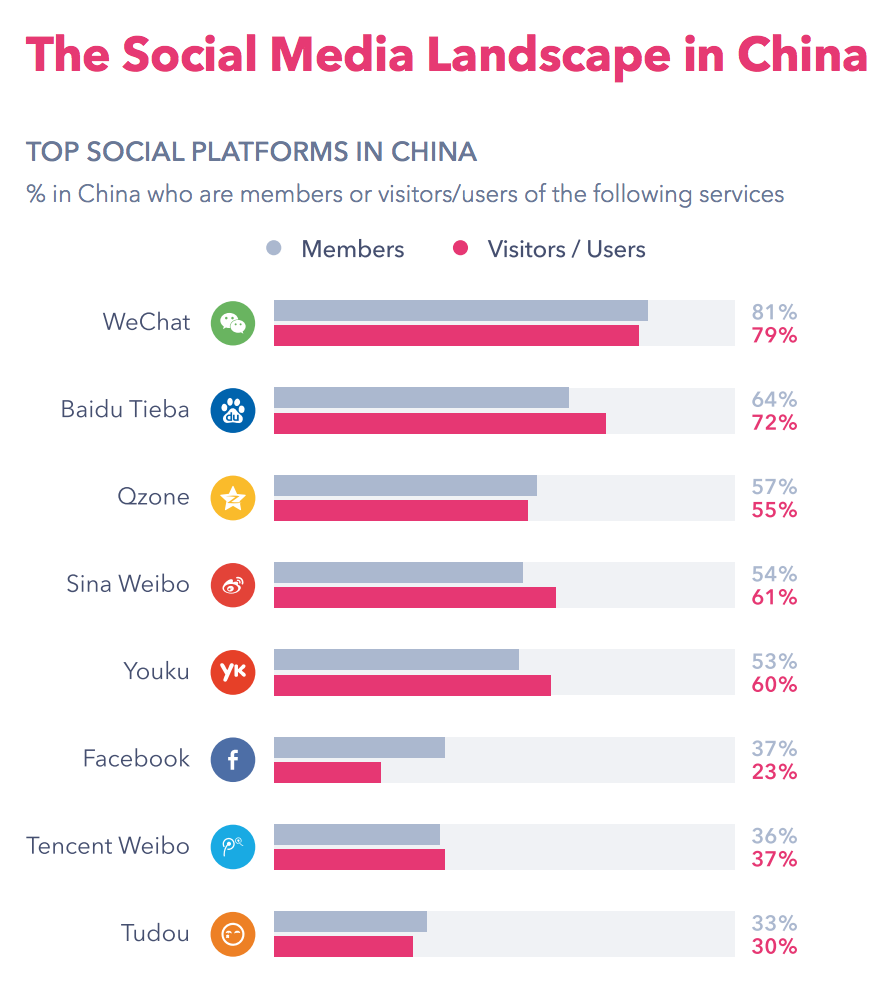
The company must ensure that its website is localized, meaning it is fully translated into Chinese, including metadata and tags, hosted on a local domain, and optimized for mobile devices. Due to China’s Great Firewall, reaching Chinese viewers requires a strong digital presence on domestic Chinese social media platforms. This is why Tesla needs to research the demographics of major platforms like Baibu Tieba, Ozone, WeChat, Sina Weibo, Youku, and Facebook before tailoring its marketing and advertising to each one. Figure 1 presents statistics on visits to various social networking sites in China.
Organizational Structure
At some point in a company’s development, it becomes necessary to assign all team functions explicitly. In this situation, the corporation opens branches and starts to grow. When new jobs develop, it is necessary to hire additional personnel and organize their work. An organizational structure is established to maintain control over the team’s actions.
The organizational structure is vital for all firm personnel, as it serves as a link between team members and organizes their work (Deresky & Miller, 2021). To ensure the strategy’s replication and maintenance, the distribution of tasks across departments and officials, as well as the allocation of power and responsibility, must stay consistent throughout time. As a result, the structure establishes the static systemic characteristics of corporate management.
Reorganization occurs when the strategy changes or the structure is found to be unsuccessful in achieving strategy objectives or economic efficiency. Reorganization can alter the concept of structural design and have a global impact on the organization, while also addressing local challenges across various subdivisions and their relationships. Any rearrangement should help to improve the structure’s order and efficiency. Unfortunately, this is not always the case. The most appropriate organizational structure for Tesla is the divisional structure.
A divisional management structure is a corporate organizational structure in which management tasks are assigned to specific regions, products, or services offered by the firm. The divisional system’s principal goal is to separate the operational level of management from the strategic level by dispersing two components of management content: responsibility and authority. Divisions are given economic and operational independence for this reason, and they are responsible for product manufacturing and marketing.
Responsibility and power under the divisional system are moved from the leaders of the organization’s centralized functional units to the heads of divisions, freeing up top management to focus on strategic duties. Each division has the right to make its own decisions within its area of jurisdiction. The head of the subdivision coordinates with the company’s senior management on issues affecting the entire firm (Deresky & Miller, 2021).
This management structure has the following benefits: it allows for quick responses to changes in the marketing environment, clearly defines the areas of responsibility at the enterprise level, and improves coordination across all divisions of the company, given their autonomy on the one hand and central management on the other. It also boosts the company’s competitiveness, delegates some work to senior management, and streamlines communication among the company’s departments.
Control and Monitoring Systems
The larger a company grows, the more difficult it is to manage. If the owner or director can keep everything under control at first, it becomes increasingly difficult to organize operations effectively under a single person’s leadership as the organization grows. In this book, we will discuss what should be done at the organization and where the emphasis should be focused on control procedures.
Preventive measures are a key part of the enterprise’s information turnover control system. Such safeguards might include developing confidentiality rules, making all workers aware of them, and drafting confidentiality agreements with specific obligations to track the consequences of information disclosure.
Also significant will be the use of licensed software for operational business tasks, as well as the development of techniques for storing operational documents in cloud infrastructure (Alawaqleh, 2021). Real-time plant status tracking and effective control of plant equipment, based on trustworthy information, can be difficult, especially as production becomes more complex. As a result, optimized process control systems and process visualization and monitoring technologies in the control room will be employed.
Staffing and Compensation
Before beginning to recruit new personnel, the company’s owner must have a comprehensive understanding of the quantity of work to be completed and the vacancy to be filled. Personnel selection should be handled professionally to minimize ongoing turnover in the workplace (Deresky & Miller, 2021). Vacancies will be advertised on career websites, job search sites, social media, and other job-search channels.
We will also conduct a check of our own candidate databases to ensure they align with current demand, selecting from previously saved prospects. A basic pay package will be adopted, which is a set amount of money that an employee receives in return for working a specific number of hours. Financial bonuses will be added to incentivize personnel.
It is worth noting that new Tesla information security staff will need to go through training. A complete cybersecurity awareness program should include defining cybersecurity rules and procedures, as well as developing incident response plans. It also includes conducting awareness training programs and vulnerability testing, creating password management guidelines, providing social engineering training and testing, and other activities. The purpose is to train staff to recognize and respond to any cyberattacks properly.
References
Alawaqleh, Q. A. (2021). The effect of internal control on employee performance of small and medium-sized enterprises in Jordan: The role of accounting information system. The Journal of Asian Finance, Economics and Business, 8(3), 855-863.
Deresky, H. & Miller, S. R. (2021). International management: Managing across borders and cultures (10th ed.). Pearson.
Digital Marketing Community. (2019). The social media landscape in China, 2018.
Guo, J., Jin, S., Zhao, J., Wang, H., & Zhao, F. (2022). Has COVID-19 accelerated the E-commerce of agricultural products? Evidence from sales data of E-stores in China. Food Policy, 112.
Han, B. R., Sun, T., Chu, L. Y., & Wu, L. (2022). COVID-19 and E-commerce Operations: Evidence from Alibaba. Manufacturing & Service Operations Management, 24(3), 1388-1405.