
Introduction
Innovation is vital for success in highly competitive sectors, such as the airline industry. Emirates Airlines, which has its headquarters in Dubai, United Arab Emirates, is a global airline that operates passenger and cargo flights to over 100 destinations (Al-Nakeeb, Darwish, and Alhajri, 2023). The iconic status that is characteristic of Emirates Airlines has guided its success since its founding in 1985 (Al Saed, Upadhya and Abu Saleh, 2020). It is the direct result of the increasing emphasis on tourism as a driver of Dubai’s economic growth (Al Saed, Upadhya and Abu Saleh, 2020). As of June 2016, the size of the fleet had risen from two leased aircraft to 236 operational wide-bodied aircraft and approximately 250 on order (Al Saed, Upadhya and Abu Saleh, 2020). It has been argued that the airline’s enhanced transportation has propelled Dubai’s evolution as a popular tourist and business destination.
Assessing Emirates’ Environment
There have been some innovative strategies that the company has adopted in its quest to maintain its market leadership position. Some of the improvements made by the corporation to expand its product offerings include installing audio systems and communication devices to increase comfort and persuade customers to choose their services (Al-Nakeeb, Darwish, and Alhajri, 2023). Specific aspects that require a comprehensive assessment are the external environment through a PESTEL analysis and competitive advantage through a VRIO framework.
PESTEL Analysis
Political factors have a significant impact on players in the aviation sector. It is worth noting that regulations in the United Arab Emirates, particularly in Dubai, often result in high tariffs that are likely to impact performance. However, the open policy that characterizes the region’s political framework provides a suitable environment for the company to grow.
Economic factors, such as the high rate of growth experienced in the UAE, are ideal for the company. The high flow of tourists and business people means that the carrier has a ready market (Al Saed, Upadhya and Abu Saleh, 2020). However, the COVID-19 pandemic and the associated travel restrictions have had a deleterious impact on the airline’s ability to expand its range of services.
Specific sociocultural factors impact Emirates Airlines’ operation as an international carrier. The fact that the organization is willing to embrace diversity and adapt its operations to cultural elements in different regions is central to its success. However, coping with the complexity of social norms and traditions is challenging and may significantly raise operational costs. Emirates has established itself as a high-end brand.
The manner in which different cultures view luxury and what constitutes good service is not always the same. Sustaining its brand image may be difficult because it requires meeting or exceeding these standards. Technology is an important driver of innovation in any business. Digital boarding cards, smartphone check-in, online reservations, and other digital services are now standardized in the airline industry. Improving the digital platform user experience is essential for airlines such as Emirates to sustain their customer base.
The aviation sector has been put in the spotlight for contributing significantly to the world’s carbon emissions. Airlines are under increasing pressure to lower their carbon footprint, either by implementing fuel-efficient aircraft or by exploring alternative, sustainable fuel sources. Finally, legal factors play a critical role in organizational performance. Air service agreements are bilateral agreements that specify the number, type, and frequency of aircraft that airlines are permitted to use on routes connecting specific countries. The activities of Emirates Airlines may be directly impacted by modifications or renegotiations under these agreements.
VRIO
Table 1 – VRIO Analysis
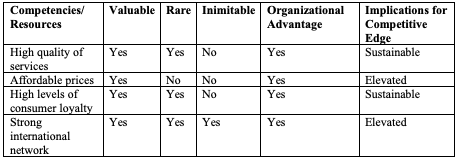
Based on the VRIO study shown above, it can be concluded that Emirates has unique resources and skills that it can leverage to provide high-quality services at a reasonable cost. It is worth noting that such actions foster consumer loyalty. Airline companies also gain a competitive edge from their robust networks in vibrant international markets. It is evident from the VRIO analysis that Emirates Airlines has maintained its position in the market by leveraging internal resources to compete with its main rivals. Therefore, the application of innovative solutions is possible and necessary.
Implementation Strategy
Adopting a strategy to address some of the airline’s innovation challenges is essential. The McKinsey 7S framework is a vital tool for implementing the overall strategy. It prioritizes the contextualization of an organization’s multidimensionality by considering the team, the level of organization, and individual factors (Chmielewska et al., 2022).
The first vital step is to make employees aware of the strategy and the need for change. It mainly entails outlining the necessary changes and informing the personnel that certain modifications must be made. For example, Al-Nakeeb, Darwish, and Alhajri (2023) point out that the industry used to rely on real-time route information and historical records. However, the adoption of big data has allowed companies such as Emirates to employ current route technologies.
The second important step is to ensure that the change aligns with the company’s systems. Specific procedures and workflows must be considered when crafting an innovative solution to the Emirates’ challenges.
The third aspect to consider is the organization’s structure and divisional makeup. The assessment of how specific functions and operations interconnect is critical. The McKinsey 7S framework proposes analyzing shared values, or institutional standards, that influence overall behavior. The utilization of various methods or instruments for communication to help the team comprehend the necessary adjustments and recognize the potential advantages of the proposed changes is vital (Al-Nakeeb, Darwish, and Alhajri, 2023).
A review of existing skills at Emirates is necessary before implementing changes. It is vital to note that one way to reduce resistance is to appeal to the younger, more tech-savvy early adopters (Al-Nakeeb, Darwish, and Alhajri, 2023). These staff members often have no trouble using the latest digital technology. More workers will become familiar with and proficient in using the new innovative technologies with their assistance.
An effective style must be applied to lead the organization towards the attainment of its goals. For instance, it is paramount that all communication channels remain open to ensure that helpful feedback is directed to the relevant departments. The organization’s managers should be able to access varying views from their staff on the proposed changes after announcing the adjustments via various communication platforms (Al-Nakeeb, Darwish, and Alhajri, 2023). Given that participants have diverse backgrounds, social skills, and persuasiveness, these factors play a crucial role in helping leaders establish rapport and build valuable networks.
The final component to consider is the staff. It is critical to educate staff members and reach out to early adopters to help the organization implement change. It is vital to demonstrate leadership and ensure that each step required to implement innovative solutions is followed.
Marketing Campaign
Emirates should commit to lowering its carbon footprint by initiating a variety of environmentally beneficial projects. Several procedures can be fit to the Emirates system to craft innovative solutions. For instance, the company should launch a marketing campaign that invests in carbon capture technology and uses sustainable aviation fuel.
The use of data-driven personalization measures that highlight a traveler’s decreasing carbon footprint, as well as a frequent-flyer program that prioritizes sustainability, is essential. The campaign should run for a month, with advertisements on social media and leading media outlets at an estimated budget of USD $100 million. By demonstrating its dedication to the environment, Emirates will distinguish itself from its rivals and draw in eco-conscious passengers.
Recommendations
The PESTEL and VRIO analyses reveal that the Emirates’ external and internal environments are supportive of the adoption of innovative strategies. Improvements in aviation engineering and design have led to the development of more fuel-efficient aircraft, which can lower operating expenses and reduce environmental impact. It is recommended that the airline invests in newer, more efficient aircraft models to increase the brand’s desirability to consumers. It is also recommended that the company adopt predictive maintenance technologies that leverage AI and IoT to identify problems before they impede operations.
Conclusion
Emirates Airlines is a market leader in the aviation industry. It has maintained its position by adapting to market changes and leveraging specific forces in its external and internal environments. The Emirates has specific, inimitable, and valuable features that allow it to succeed in the aviation industry. The conditions are favorable for adopting innovations to increase efficiency, enhance consumer convenience, and provide a luxury flight experience to destinations around the world.
Reference List
Al-Nakeeb, A., Darwish, H. Bin and Alhajri, R. (2023) ‘Leading technological change – case study of Emirates Airlines‘, International Journal of Technology and Systems, 8(1), pp. 58–68.
Al Saed, R., Upadhya, A. and Abu Saleh, M. (2020) ‘Role of airline promotion activities in destination branding: case of Dubai vis-à-vis Emirates Airline’, European Research on Management and Business Economics, 26(3), pp. 121–126.
Chmielewska, M. et al. (2022) ‘Evaluating organizational performance of public hospitals using the McKinsey 7-s framework‘, BMC Health Services Research, 22(1), pp. 1–12.