
Introduction
Supply chain management is a crucial function of companies that enables them to provide various services and goods promptly and efficiently. Thus, the company’s profit and customer satisfaction depend on how well the supply chains are planned. Reports provided by the Business Continuity Institute detail the root causes of supply chain disruptions and their consequences. Additionally, these documents provide the necessary information regarding failures and their trends from 2011 to 2022.
Thus, business trends are currently evolving with a strong focus on delivering various goods, which underscores the importance of reliable logistics systems. The causes of unforeseen risks in this structure can include the onset of climate disasters, military conflicts, epidemics, and cyberattacks. These factors need to be analyzed and taken into account to develop strategies aimed at mitigating adverse consequences.
Summary of Key Findings from the Reports
During the analyzed period from 2011 to 2022, numerous significant changes occurred in business, economics, and politics, which had a substantial impact on the risks to which supply chains are exposed. This results in significant losses for companies worldwide and may impact their operations in the long term. One of the leading causes of failures is adverse weather conditions, such as fires, hurricanes, and flooding (BCI, 2011; BCI, 2012). They significantly complicate the transportation of goods and interfere with the work of people.
Another critical failure is the occurrence of failures in IT/telecom systems. They cause significant damage to the planning and prevention of other risks, as they disrupt the entire system’s performance and jeopardize the possibility of cargo transportation. Cyber attacks have also been at the top of threat lists for a long time, while increasing the risk to supply chains over time (BCI, 2014). In recent years, this threat has become more pronounced, potentially leading to data theft and supply disruptions for extended periods.
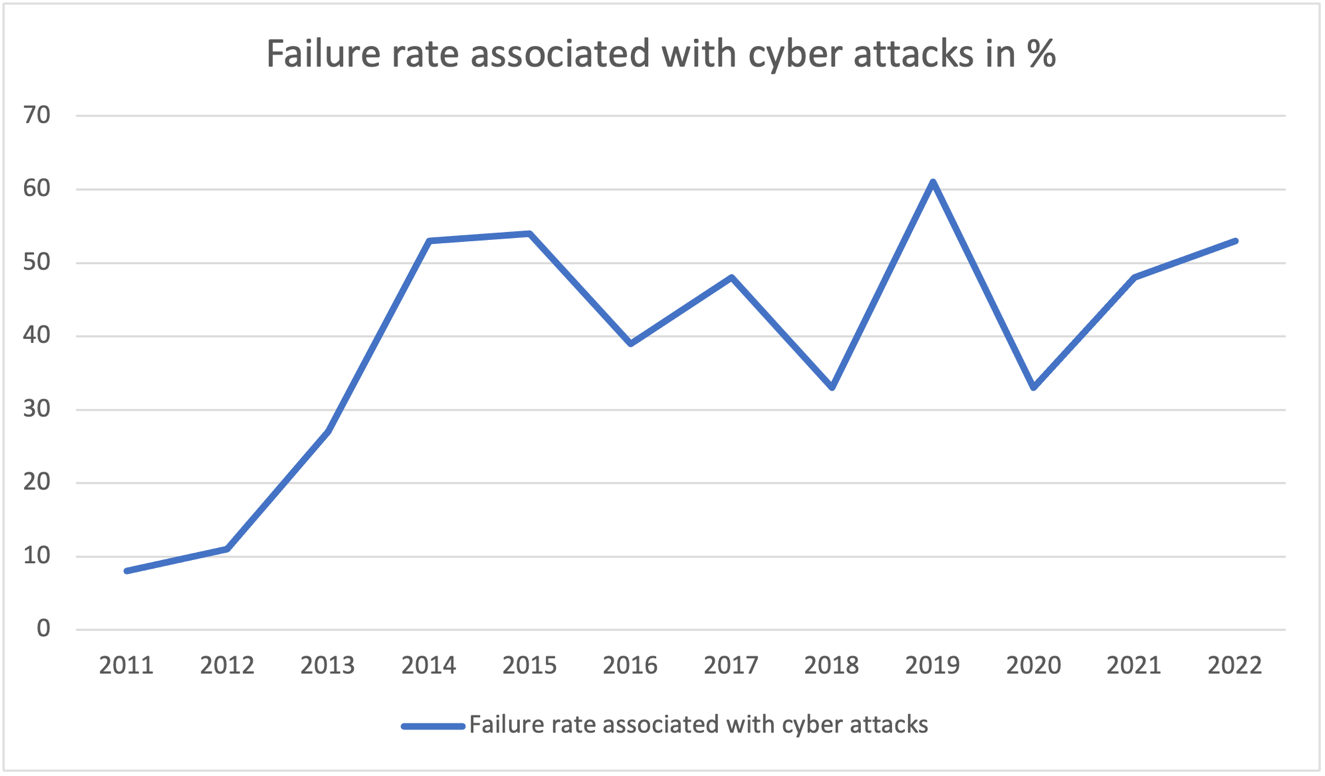
It is a remarkable fact that fears of cyberattacks have increased substantially over the years. Thus, in 2011, such cases were not given significant importance since they were few in number and could not pose a substantial threat to the health of supply chains (BCI, 2011). However, over the next decade, a growing trend emerged in reports regarding this threat. This is because the number and severity of cyber attacks have increased significantly, resulting in substantial losses associated with data theft, product redirection, and the creation of unsuitable and challenging working conditions for many organizations.
Trend Analysis (2011-2022)
The supply chain disruption trends from 2011 to 2022 have undergone significant changes. The most significant initial problems were inappropriate and hazardous weather conditions, IT/telecom disruptions, and transportation disruptions. These sources of threats pose a constant threat to organizations; however, some of them, such as transportation problems, have acquired solutions that have allowed them to mitigate the issues and make them less significant.
However, instead, the risks of computer failures and cyber attacks appeared in the failure trends, which began to increase every year and pose a significant threat to companies (Chart 1). The analyzed reports show how different threats change their situation. For example, you can compare the position of cyber threats that rapidly gained seriousness and then began to fluctuate. These fluctuations were marked by countermeasures that were taken in the supply chains. Digital supply chains are particularly vulnerable to such risks and can be shut down following a cyberattack.
The consequences of failure risks have remained relatively unchanged over the past decade. The primary consequence of disruptions in supply chains is a significant loss of productivity, which subsequently impacts the company’s overall operations (BCI, 2019). This can result in the organization suffering significant losses that will be difficult to recover from.
In addition, the trends of consequences in recent years have begun to approach the risk to human health and life due to the coronavirus pandemic and the war in Ukraine. The consequences of such events were outlined in a crisis that reduced financial performance and significantly increased the cost of reorganizing supply chains for organizations. The lack of an adequate response to emerging risks in supply chains can also negatively impact a company’s reputation.
Consequences in Business
The reports provided reveal a significant number of consequences resulting from disruptions in supply chains. The most serious consequence is the loss of productivity, which compromises the company’s integrity and its ability to continue meeting its obligations. This can often manifest due to delivery delays caused by unforeseen circumstances. Additionally, a significant consequence is the increase in costs resulting from inflation and the global economic downturn (BCI, 2013). Thus, this risk leaves a significant imprint on the working capacity and efficiency of organizations as they face a financial crisis and a decrease in opportunities.
Customer complaints are also a significant consequence for companies that have experienced some shock or breakdown. Massive negative reviews can significantly undermine an organization’s performance and stability by eroding employee morale and confidence. This can also be reflected in a drop in productivity as a side effect that has developed due to a lack of awareness among employees of the importance of their work (BCI, 2021). Such violations can lead to the following consequences: damage to the brand’s reputation due to negative reviews and poor handling of disadvantageous situations. This consequence may also occur due to failures that result in a loss of product quality, late delivery, or a violation of ethical considerations (BCI, 2015). Another critical impact is the delay in cash flows due to delayed orders and lower sales. This consequence can also include cyber attacks that contribute to the theft of funds.
Supply chains have been significantly affected by the COVID-19 pandemic in recent years. This disease, due to its novelty, led to a large number of lockdowns around the world, which significantly complicated the work of transport hubs and made the work of vehicles and couriers much more challenging. The scale of this disruption has swept the world, causing quarantine measures, labor shortages, and border closures that have created bottlenecks in supply chain strategies and led to cargo delays (BCI, 2020).
The pandemic has also affected demand volatility due to changing consumer behavioral patterns. Some industries, such as food service and clothing stores, have experienced solid and sustained declines in demand, while others, like pharmaceuticals, have gained many new customers. Many organizations heavily depend on suppliers and products to generate timely profits and ensure the delivery of services to their customers (BCI, 2022). Thus, another consequence was operational resilience, which was reflected in the fact that enterprises with a low level of preparedness and risk response were on the verge of bankruptcy. The coronavirus has also led to a global reorganization of supply chains to achieve greater flexibility and resilience, which can be beneficial for organizations in future crises.
General Mitigation Strategies
Multiple disruptions in supply chains have necessitated that companies develop and implement specific strategies to improve overall productivity and increase turnover. The first strategy companies have resorted to is diversifying suppliers and services. During the pandemic, many companies experienced significant overload and stress, which can make it dangerous to rely solely on intermediaries (BCI, 2022). The advantage of this method for reducing risks is that if one of the companies fails to fulfill its obligations, then the client organization will not lose the entire volume of goods (Um & Han, 2021). To mitigate the effects of the coronavirus pandemic, such actions are helpful as they provide for the absence of severe problems with obtaining goods.
In a supply chain, effective inventory management can be an essential strategy to mitigate excessive losses resulting from unforeseen risks. Building reserves for emergencies, such as the coronavirus pandemic, can be a proven way to help a company navigate a crisis more effectively and safely. It can also have an impact on supply shortages, which could cause the chain to collapse (BCI, 2012). The advantage of this strategy is that it reduces risks by creating additional resilience, which helps the organization better manage its assets. Accordingly, to mitigate the effects of the pandemic, which has dramatically reduced the productivity of many companies, this strategy may work as the reserve will provide stability.
Risk assessment is another strategy aimed at mitigating the negative impact of the coronavirus pandemic. Creating a company action plan for high-risk cases, such as a pandemic, can increase the chances of saving supply chains. Thus, consumers will be satisfied, and the company will not lose a significant part of the profits from existing supply chains. The advantage and usefulness of this strategy lie in the fact that it provides preventive action (Um & Han, 2021). Thus, supply chains can be preserved because the company can adjust its strategy regarding them promptly. This strategy can help mitigate the effects of COVID-19 as risk avoidance helps preserve existing profits.
A helpful strategy can also be considered digital transformation, which can provide better movement along the supply chain. Moreover, the active introduction of technologies can contribute to the improvement of the organization’s logistics and better meet customer needs (BCI, 2019). Thus, digital transformation may be a suitable strategy to mitigate the risks of supply chain disruptions by streamlining product paths more effectively.
Technology will allow for the receipt of a large amount of data in real-time. They can help read product information and adjust strategies as needed. The usefulness of this strategy in the context of COVID-19 lies in its ability to identify transport hubs with exceptional congestion more quickly.
Supplier relationship management can also be an essential strategy to facilitate joint strategic decision-making and strengthen supply chains coherently. Closer relationships with stakeholders can lead to better results in the final work. In this way, companies can reach joint agreements that strengthen their interaction throughout the supply chain (BCI, 2018). This strategy will enable organizations to perceive the situation more accurately and rely on their partners. Good cooperation can provide additional support in the event of supply disruptions.
Another advantage of applying this strategy is the sharing of resources that can make both firms stronger in the long run. To counter the coronavirus, the described strategy may be suitable, as coordinated actions are more effective in situations with border closures. Another important aspect is that the relationship, if improved, will continue to work in the future, leading to more profitable contracts.
Some ad hoc strategies can be adapted to mitigate the impact of COVID-19-related supply chain disruptions. One of them can be considered to increase the stability of the company. This category is one of the proven methods, as organizations with a developed element of resilience fared much better in dealing with the damage from the coronavirus (Um & Han, 2021). To implement this strategy, it will be necessary to accumulate additional resources that could help the firm survive and overcome problems when they arise.
The implementation of flexible supply controls is also necessary to enhance sustainability. Increasing the resilience of companies can have a positive impact on making the organization stronger and better equipped to compete in times of crisis. When there are fewer incumbents left during intense market turmoil, they will be able to capture more market share. However, the weakness of this method is that the increase in stability will be contrary to the flexibility that, in this case, cannot develop quickly enough.
Another way to adapt a particular strategy is to change the sources of supply to those that are closer. Geographic adaptation can help organizations redistribute workloads during times of crisis. The use of local suppliers can be a crucial aspect that facilitates delivery and strategic planning (Um & Han, 2021).
Thus, it will be possible for firms to organize supply chains that connect the closest points, thereby minimizing the waste of additional resources. This will also make it easier to monitor suppliers as they are easily accessible for inspections. These procedures, in turn, will enable the assessment of the reliability of partners for building supply chains. The weakness of this strategy is that being tied to the location significantly narrows the choice of suppliers.
Discussion and Conclusion
During the analysis of reports covering the period from 2011 to 2022, a substantial amount of valuable data was obtained that can be used to identify the most effective strategies for addressing supply chain disruptions. Over the past decade, the analyzed data reveal a significant shift towards cybersecurity, which has become a primary sector of concern in the context of disruptions. It can result in a significant loss of information, leading to reputational and financial costs for companies.
Failures in the supply chains of companies lead to severe consequences, the main of which are the loss of productivity and customer complaints. These aspects can have a profound impact on the organization, making it quite challenging to restore previous levels of income. Analyzing report data is beneficial for businesses, as it helps identify general trends and specific trends in the context of supply chain threats. In this way, organizations can more easily calculate the direction of their supply chains and understand the consequences of potential failures within them.
This study has some significant limitations to consider. One of them is the volume of data, which covers only the period from 2011 to 2022. The limited time frame does not allow for a full appreciation of how disruption trends have changed over time. In addition, it imposes certain restrictions on the flow of information. The analysis also fails to fully account for the variability of external factors necessary to develop an effective intervention strategy to improve the supply chain situation.
References
Business Continuity Institute. (2011). Supply Chain Resilience 2011.
Business Continuity Institute. (2012). Supply Chain Resilience 2012.
Business Continuity Institute. (2013). Supply Chain Resilience 2013.
Business Continuity Institute. (2014). Supply Chain Resilience 2014.
Business Continuity Institute. (2015). Supply Chain ResilienceReport 2015.
Business Continuity Institute. (2016). Supply Chain ResilienceReport 2016.
Business Continuity Institute. (2017). Supply Chain ResilienceReport 2017.
Business Continuity Institute. (2018). Supply Chain ResilienceReport 2018.
Business Continuity Institute. (2019). Supply Chain ResilienceReport 2019.
Business Continuity Institute. (2021). Supply Chain ResilienceReport 2021.
Business Continuity Institute. (2022). BCI Supply Chain Resilience Report 2023.
Um, J., & Han, N. (2021). Understanding the relationships between global supply chain risk and supply chain resilience: the role of mitigating strategies. Supply Chain Management: An International Journal, 26(2), 240-255.