Introduction
The Taj Mahal is described as an architectural marvel of the world, constructed in 1632 by the Mughal emperor, Shah Jahan, as a symbol of his love and to remember his dead wife, Mumtaz Mahal. It is situated on the Piedras River in Agra, near the south bank of the Yamuna River. It is the crowning glory of Mughal architecture and is one of the splendid Islamic buildings. The Taj perfectly synthesizes Persian, Central Asian, and Indian architectural styles. The focal point of this site is the fascinating marble-domed mausoleum, decorated with a distinctive Persian double-shell motif and typical Islamic architectural elements, including Pishtaq arcuations.
Historical Overview of the Taj Mahal in Agra, India
In 1628, Shah Jahan came to the throne through a bloody war of succession with his brothers. His rule marked the beginning of the most flourishing period in the history of the Mughal Empire, during which arts, architecture, and culture reached their peak. It was in 1631 that his wife Mumtaz Mahal died during childbirth, which broke the heart of the emperor. The Taj Mahal complex was conceptualized as a massive funerary garden with the royal tomb to be placed in the center of her memory (Asadi, 2023.
At the beginning of 1632, 20,000 workers were from all parts of the empire: Persia, the Ottoman Empire, and Europe. The leader architect was Ahmad Lahauri, but historical sources did not reach a final decision. More than 1000 elephants were used to lug building materials over long distances. The mausoleum sat atop a square base, divided into four quadrants by intercrossing waterways and pathways that skirted the surrounding greenery and floral areas. The mausoleum is a beautiful domed building with a marble exterior adorned with Quranic verses written in calligraphy and inlaid with precious gems.
The central tomb chamber contained the cenotaphs of Mumtaz Mahal and, after him, Shah Jahan. Its interior is lavishly rich with winding vines, flowers, calligraphy, and semiprecious stones such as jasper, jade, and lapis lazuli, inlaid into the white marble. The layout of the Taj Mahal complex follows the classical Charbagh model, with four intersecting waterways and gardens subdivided into sixteen parterres or planters. At every angle, there are similar red sandstone structures, two of which were used as mosques.
The raised marble water tank, placed directly in front of the mausoleum, reflects its image, giving the impression that it is floating on water. In total, the project spanned over 20 years, and a whopping 32 million rupees were spent from the royal treasury to complete the complex (Asadi, 2023). Finished in 1643, it was the last Mughal architectural masterpiece. This happened since the empire started to flounder at the beginning of Shah Jahan’s reign.
Architectural Design
The exteriors of the mausoleum are professionally decorated with intricately carved jali screens of naturalistic vines and floral arabesques that bear calligraphic inscriptions from the Quran- a بسمال feasible illustration of the Mughal blending of religious Islamic art with naturalistic aesthetics. This extraordinary marble surface adornment required the unmatched skills of Mughal lapidaries and carvers who created miraculous geometrical designs of unequaled complexity.
The massive pishtaq arches, with distinctive arched entranceways, show how Mughal architects were drawn to the large, monumental designs that became prominent in medieval Persia (Green, 2020). These arches are accentuated by carved jaali screens enhanced with calligraphy inlay, setting the stage for the playfulness of vibrant light and shadows combined with the splendid artwork.
The internal part of the sarcophagus is an outstanding artistic achievement, with every surface richly decorated in the valuable pietra dura technique of inlaying stone. Floral arabesques, calligraphic inscriptions, and borders of scrolling vines are meticulously created through the delicate inlay of semiprecious stones, such as lapis lazuli, jasper, and jade, into pure white marble. This lavish architectural style and decoration reflect the peak of Mughal aesthetic taste, combining Persian textile and miniature painting motifs with lapidary artwork.
The garden scheme in the Taj complex is quadrilateral. It follows the Central Asian traditional char bagh pattern, with waterways dividing the area into 16 parterres or planters that represent the earthly paradise (Green, 2020). It merges geometry, water features, colorful foliage, and cleverly placed cypress trees into a magical confluence of nature and architecture.
The Taj Mahal Artwork by William Hodges
The most prominent feature of the artwork is the marble mausoleum’s tall domes and minarets. The domes and minarets make the Taj Mahal look royal (Kleiner, 2015). The bridge’s reflection in the river at the front of the painting is a mirror image. The piece’s warm hues and atmospheric lighting draw the viewer to the monument. It depicts the Romantic style, which was commonplace in the second half of the 18th and the beginning of the 19th centuries, when this artwork was created.
Romanticism is characterized by an atmospheric mistiness with soft edges, muted hue, and a preference for mood lighting over exact detail. The free, expressionistic brushstrokes represent the setting’s surreal, almost ethereal atmosphere. The mist stands as a symbol of beautiful dreams tinged with sadness. The river evokes themes of duality and alignment with the flow of life. The painting elicits a deep sense of wonder, calm, and nostalgic longing. Hodges’ favorite form of poetic rendering combines architectural grandeur and an emotional beauty experience.
Night Intaj Mahal by Yoshida Hiroshi
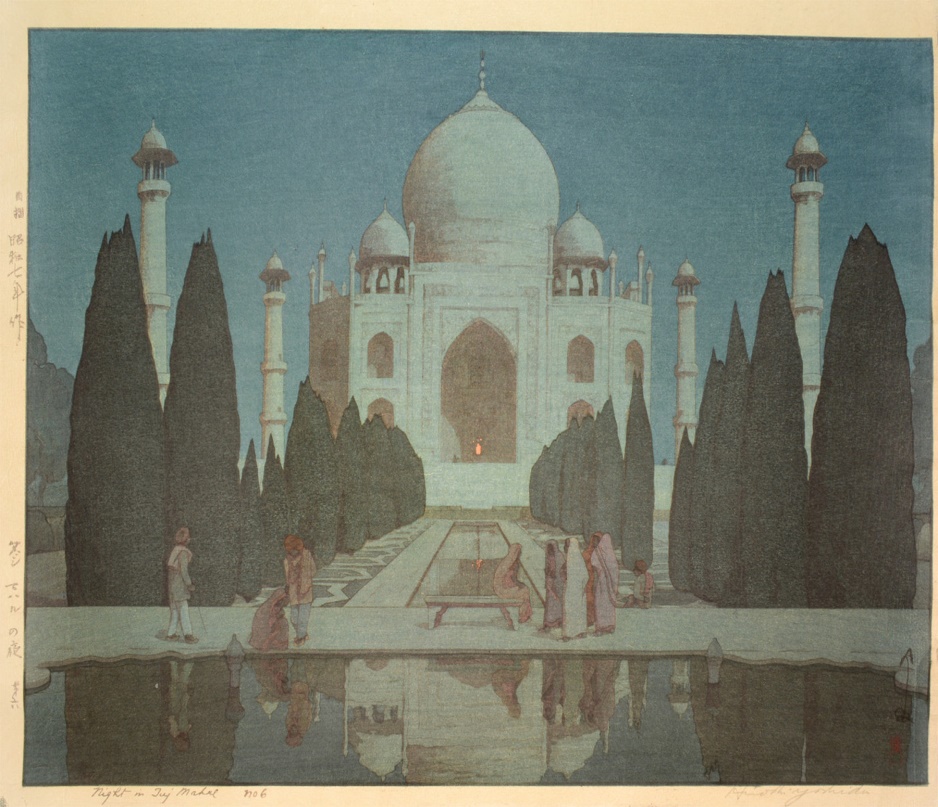
The marble dome stands out in the front, and a soft, mysterious glow lights up the minarets with arches. The Taj Mahal, as the main feature, glows against the muted blue-gray backdrop of the night sky. Cypress trees form a frame around the picture, thus providing depth and scale. The entire area is dotted with tiny human figures that give the work a form of life and atmosphere. Hiroshi applies a Japanese woodblock printing technique characterized by flat areas of color, bold outlines, and stylized forms.
The muted color palette, with shades of blue, gray, and sepia, creates a serene, nocturnal mood. The night scene and warm lighting convey a sense of timelessness, tranquility, and reverence. The artist’s interpretation of the Taj Mahal at night brilliantly portrays serenity, meditation, and ecstasy (Kleiner, 2016). The soft light and subdued colors establish a dreamy, ethereal ambiance where one can relax and contemplate. Humans give the monument a sense of scale and proportion, enabling viewers to imagine the memorial in person and fostering wonder and admiration for the masterpiece.
The Taj Mahal by Edwin Lord Weeks
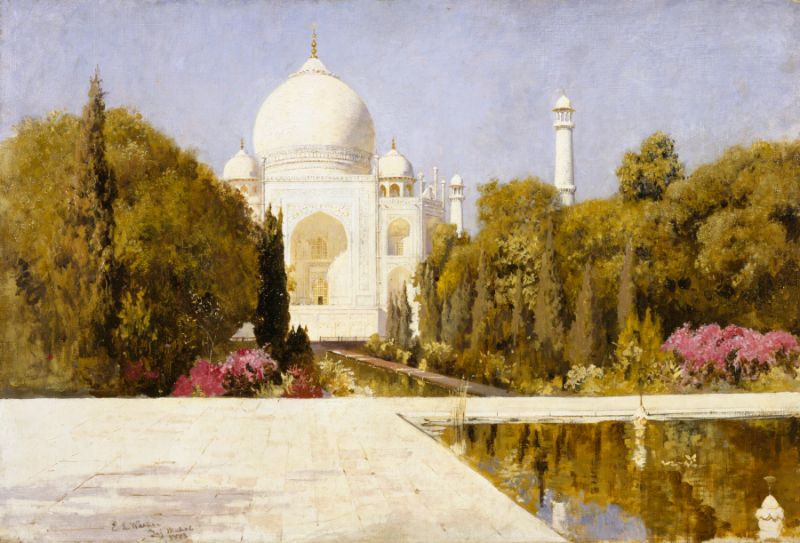
The main subject of the painting is the magnificent marble-domed structure with its minarets. It is set against the bright sky and lush surrounding gardens. However, the Taj Mahal is not in the center; it is slightly off-center. The first plan features a reflecting pool in the foreground that mirrors the monument, creating a visually pleasing symmetry. Flower beds and cypress trees define the borders, look natural, and complement each other. Some figures have been added to the gardens, giving a sense of scale and human presence.
The painting by Weeks employs a realistic, detailed style, capturing architectural details and natural elements with great accuracy. The light-and-shade technique adds depth and mood to the scene. The color scheme is warm and shining, with the white marble standing magnificently against the thick vegetation and the flourishing flowers. In his depiction of the Taj Mahal, Weeks suggests a paradise-like atmosphere, reflecting Islamic texts’ descriptions of the gardens of paradise on Earth (Asadi, 2023). The soft lighting creates a serene, lovely atmosphere.
Conclusion
The Taj Mahal, a monumental tomb built by the emperor Shah Jahan as a tribute to his beloved wife, Mumtaz Mahal, epitomizes Mughal art. This edifice was created over 20 years ago using the sweat and labor of many people. Its magnificent marble-domed structure was embellished with calligraphy and floral patterns borrowing from the Persian, Central Asian, and Indian styles, creating a harmonious blend.
Artistic depictions by William Hodges, Hiroshi Yoshida, and Edwin Lord Weeks define the beautiful landscape’s timeless beauty and romantic illusion. By bringing together a collection of works spanning centuries and mediums, viewers encounter a sense of awe and reverence. They can experience the Taj Mahal’s lasting legacy as a symbol of love, cultural heritage, and artistic mastery.
References
Asadi, S. (2023). The Taj Mahal is the crystallization of Iranian architecture and a symbol of God’s throne on earth. The Academic Research Community Publication, 7(3), 34–47.
Green, S. (2020). Taj Mahal, The. Bellwether Media.
Kleiner, F. S. (2015). Gardner’s art through the ages. Book F, Non-Western art since 1300. Wadsworth.
Kleiner, F. S. (2016). Gardner’s art through the ages. Book C, Non-Western art to 1300. Cengage Learning.
Images