
Introduction to the Landfill Directive
One of the main international documents regulating the circulation of food and biodegradable waste is the Landfill Directive. The overall objective of the Directive is to prevent or reduce, as far as possible, negative impacts on the environment, in particular pollution of surface water, groundwater, soil, and air, as well as on the global environment, including the greenhouse effect, and any resulting risks to human health due to waste disposal throughout the life cycle of the landfill.
The Directive establishes minimum standards for the location, design, construction, and operation of landfills, targets for the disposal of biodegradable waste, characteristics of waste accepted for disposal, etc. According to the Directive, it was necessary to reduce the amount of biodegradable waste disposed of by weight from the amount produced in 1995: by 2010 to 75% of the 1995 level; by 2013 to 50% of the 1995 level; by 2020 to 35% of the 1995 level (Grosso & Falasconi, 2018). It seems appropriate to consider the current results of implementing the food waste management directive in the example of a high-income country – the United States. The discussion below aims to prove the severity of the food-waste issue in the US and provide possible solutions and recommendations to address the problem.
Background
Food that is safe for eating but is knowingly thrown out during the sale or consumption stages is what food waste refers to. Today, more than one-third of the food produced in the United States is never eaten, resulting in a waste of the resources used to produce it and a host of negative environmental impacts. Food waste is the most common material landfilled and incinerated in the United States and accounts for about 24% of landfilled and incinerated waste levels in the United States. Reducing food waste provides opportunities to improve food security, increase productivity and economic efficiency, promote resource and energy conservation, and address climate change.
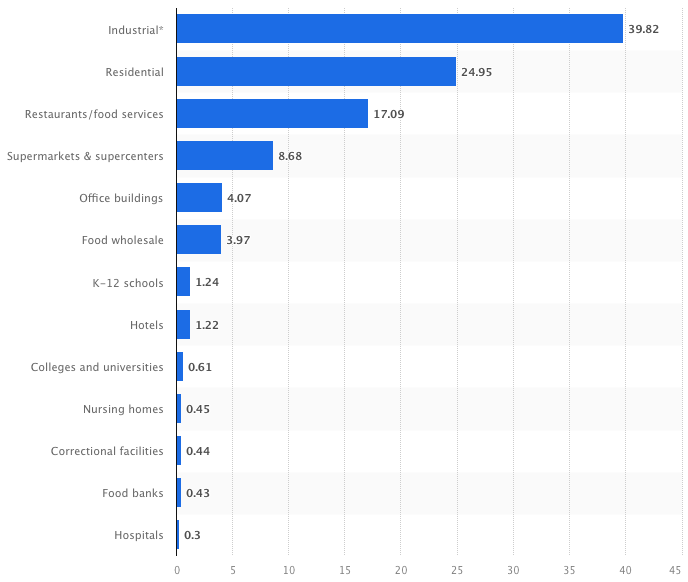
As the United States strives to meet the Paris Agreement’s goal of limiting global temperature rise to 1.5 degrees above pre-industrial levels, there is a need for change in the food system and food waste management (Grosso & Falasconi, 2018). Even if fossil fuel emissions were reduced, current trends in the food system would prevent this goal from being achieved. Globally, food waste accounts for 8% of anthropogenic greenhouse gas emissions (4.4 gigatonnes of CO2e/year) and is a priority for significant reductions. It should be noted that industrial and residential sectors are the main contributors to overall food waste in the US (Figure 1). Residential Reducing food waste can also help address food insecurity as the world’s population grows.
The United Nations (UN) predicts the world population will reach 9.3 billion by 2050. This increase in population will require more than a 50 percent increase in food production compared to 2010 levels (Lehtokunnas et al., 2022). Reducing consumption can reduce the need for new food production and reduce projected deforestation, biodiversity loss, greenhouse gas emissions, and water pollution. In 2015, the United States announced a goal to halve food waste and food waste in the United States by 2030, but to date, the country has not yet made significant progress.
Given the size and complexity of the US food system, there is no single agreed-upon estimate of total food waste. Estimates that include loss or waste of food at all stages of the food supply chain (from primary production to consumption) range from 73 to 152 million per year, or from 223 to 468 kg per person per year, which is approximately 35% US food supply (Conrad et al., 2018). Approximately half of the food is wasted at the consumption stage, where fruits, vegetables, dairy products, and eggs are the most frequently wasted foods. This uneaten food leads to a “waste” of resources, including agricultural land, water, pesticides, fertilizers, energy, and environmental impacts. These influences include greenhouse gas emissions and climate change, consumption and degradation of freshwater resources, loss of biodiversity and ecosystem services, and degradation of soil and air quality.
Global Context
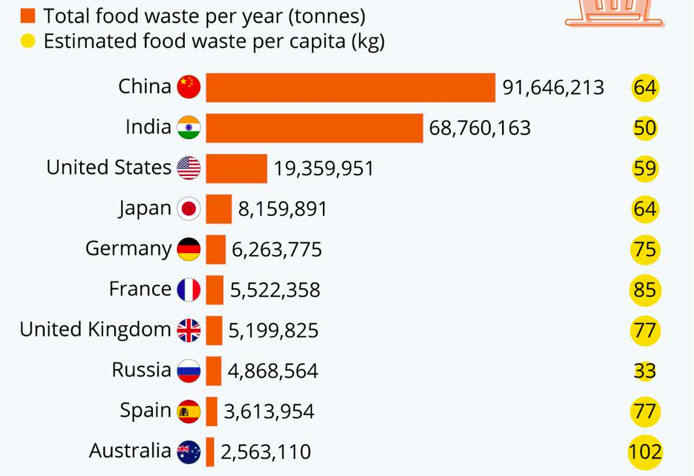
As populations grow, as does food production, reducing the environmental impact of agriculture will become increasingly important to the planet’s sustainability. Eliminating crop shortages and increasing productivity will probably not be enough to prevent further deforestation and environmental degradation. Even with the most positive projections, increasing crop yields by 2050 will require 20 percent more land. In 2007, the US accounted for roughly 10 percent of the world’s food waste (by weight) but less than five percent of the world’s population (Conrad et al., 2018). In 2021, the United States ranked third in absolute food waste by weight (68 million tons per year) among all countries, second only to China and India, and the share of US food waste in the global structure is about 10% (Figure 2).
The Food and Agriculture Organization (FAO) estimated that in 2007, approximately one-third of food by weight was lost or wasted worldwide. Using FAO regional data, the World Resources Institute (WRI) calculated that in 2009, the average share of total food loss or waste was relatively the same in all seven major geographic regions of the world, with an average of 34% to 36% of food loss in all regions except South and Southeast Asia. Most recently, experts estimated that 29% of all food was lost or wasted worldwide in 2017 (Baron et al., 2018). According to the most comprehensive estimates, between 35% and 36% of food was lost or wasted in the United States (Baron et al., 2018). Although the proportion of food stocks (by weight) that are lost or wasted may be the same in many regions of the world, the size of food stocks in each region varies greatly (even per person), which limits the representativeness of this indicator.
A comparative analysis of the potential for reducing food waste showed that the greatest potential exists in regions where there is no shortage of food, in contrast to regions where there is a lack of food supply. For example, as of 2009, Europe could reduce food waste by 63% compared to Africa, which could only reduce waste by 3% in the short term (Lehtokunnas et al., 2022). It is necessary to consider the main similarities and differences in the formation of food waste in different countries and regions, as well as to characterize individual approaches to assessing the impact of waste generation on the environment. Namely, when and for what categories of food losses occur (at what stage of the value chain).
The FAO estimates that in low-income countries, approximately 40% of food waste comes from production and processing, while in middle- and high-income countries, approximately 40% of waste comes from retail and consumption. It is possible to outline the structure of food waste generation in the context of product life stages for each region (Lehtokunnas et al., 2022). The stages of production, processing, and storage make a significant contribution to waste generation for less developed regions, such as Africa, while at the consumption stage, the largest share of food loss occurs in more developed regions.
Globally, fruits and vegetables account for the largest share of food waste, and fish and seafood for the smallest. One of the key differences in the indicators considered between European countries and other countries is the waste of animal products, including meat, milk, and eggs. Both categories account for a larger share of waste in Europe than in any other region (Baron et al., 2018). According to experts, the US wastes 7.5 times more dairy, 3.5 times more meat, and two times more fruits and vegetables than the world average.
The United States is one of many countries that have adopted a national goal to halve per person food waste at the retail and consumer stages by 2030, similar to UN Sustainable Development Goal 12 (Target 12.3). So far, the US has not made progress on this front, but several countries have reported significant reductions in food waste. For example, the United Kingdom reduced food waste per person by 27 percent and total waste per person by 21 percent between 2007 and 2018 (Cooremans & Geuens, 2019).
Between 2010 and 2019, the Netherlands reduced household food waste per person by 29 percent. Between 2010 and 2015, Norway reduced food waste per person in the industry, wholesale and retail, and households by 12 percent, including an 11 percent reduction in household waste per capita. Between 2011 and 2017, Denmark reduced household food waste per capita by 8% and by five percent overall. Japan reduced household waste generation by 13 percent between 2005 and 2009, with most of the reduction achieved in the first year (Cooremans & Geuens, 2019). These countries have taken a number of actions to achieve these reductions, including setting goals, developing national strategies with milestones, sponsoring educational campaigns, and developing partnerships with organizations and businesses within the food system. However, at the time of this writing, no country has declared the achievement of the UN Sustainable Development Goal (12.3).
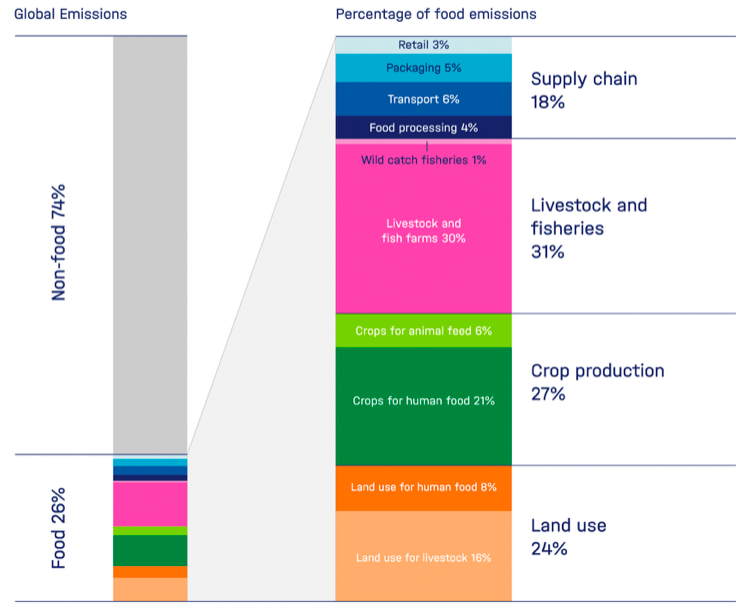
The global food supply chain is a major driver of environmental degradation and natural resource depletion. Globally, the food system uses 70% of all freshwater withdrawals, occupies about 40% of free land, generates 34% of anthropogenic greenhouse gas emissions (Figure 3), and is the largest contributor to biodiversity loss and water pollution associated with disturbances in nitrogen and phosphorus cycles (Conrad et al., 2018). The situation has worsened against the backdrop of recent events in the world, where supply chains have been significantly disrupted. As the population and per capita incomes grow, so does the diet. Looking ahead, demand for food is projected to grow by more than 50 percent between 2010 and 2050, and demand for more resource-intensive foods (i.e., animal products) will grow by nearly 70 percent over the same time period (Xue et al., 2017). Waste reduction is one way to a more sustainable agricultural system.
Current Approach to Addressing the Issue
At this point, it can be noted waste processing is an activity that consists of waste management in order to ensure the reuse (secondary) use of the obtained raw materials, energy, products, and materials in the national economy. The developed market for the recycling of secondary raw materials and the demand for it is one of the factors for increasing the country’s raw material base, reducing raw material and material losses, and improving the environmental situation (van der Werf et al., 2021). Although waste management does not provide quick results in terms of job creation, as might be expected in housing upgrades, this sector will be important for the green economy in the long term. The US government is encouraged to initiate legislation to include the cost of environmental damage in this area in the cost of products. This will help transform the waste management and recycling sector into a highly profitable, labor-intensive sector of the economy that provides reliable and skilled services and decent conditions for its workers.
The work of such a sector should include the safe and clean loading, removal, storage, and disposal of waste while respecting the three main rules: waste reduction, recycling, and reuse. When considering public financial support for renewable energy technologies, green transportation, and energy-efficient buildings, governments should encourage the use of materials and products made from waste or recycled materials (van der Werf et al., 2021). Their tax policy should be at least the same in relation to materials and products from primary and secondary raw materials.
Investing in waste management and recycling can make the waste problem economically viable. In the US, recycling generates $236 billion in revenue annually and employs 1 million people in 56,000 public and private enterprises (van der Werf et al., 2021). The national average recycling rate in the US is 30%, saving 10.7 million barrels of crude oil annually, which would be enough to fill 22 million cars each year. Every year, as a result of recycling, 256 billion barrels of oil are saved in the world, i.e., the amount of electricity produced by five nuclear power plants (van der Werf et al., 2021). Recycling also saves on the number of raw materials that could be loaded on 155,000 railcars annually. In 2000, the recycling sector in the member states of the European Union accounted for 4% of the region’s GDP. With rising commodity prices, this sector can be expected to grow rapidly.
Conclusions and Recommendations
Based on the analysis performed, the following statements can be made. The greatest environmental benefits can be achieved through the prevention rather than the reuse of waste. Considering that high costs and environmental impacts (land, water, pesticide and fertilizer use, and greenhouse gas emissions) associated with waste generation occur during primary production, the greatest benefit can be achieved by optimizing primary purchases from manufacturers and by improving company inventory management. Further, the greatest greenhouse gas emission benefits can be obtained by reducing waste generation at the consumption stage (households and restaurants). It is also worth saying that reducing consumption in institutional food service (e.g., schools or hospitals) or retail trade will produce minimal environmental results.
Focusing on reducing food waste of the most resource-intensive foods, such as animal products, fruits, and vegetables, can bring environmental benefits. These two categories invariably occupy leading positions in many environmental consequences. Animal products (especially beef) make a particularly significant contribution. Thus, reducing losses and waste in these food categories should have more significant environmental benefits than in the case of other food categories.
In recent years, many national and international initiatives to reduce food loss and waste have stimulated research into the study and reduction of waste. However, there are still gaps in statistics, and there are uncertainties associated with estimating the amount and characteristics of waste. For example, after analyzing the reporting, it was found that such an indicator as the loss and spoilage of food products, or its analog, has not been developed. Further research is needed to refine assessment methods and improve the availability, quality, consistency, and frequency of updates of the required data.
In addition, a better understanding of the interrelationships between stages of the supply chain can lead to more successful policy and program development. Analytical evidence for how to address these issues will improve government understanding and help tailor waste management strategies to achieve the goal of reducing food loss and waste with maximum environmental benefit.
Further Questions
Opportunities for further research can be formulated as follows. The first is improving US food waste data collection procedures (Xue et al., 2017). Research is needed to address gaps in statistics and understand key differences between institutions’ estimates of the amount, waste categories, and supply chain stages at which food is currently lost or wasted in the US. Regular collection, monitoring, and analysis of data are needed to obtain more accurate estimates of waste generation and losses from primary production (including fisheries) and the food industry.
The second is the development of methods and tools to track changes in food waste at appropriate intervals in the US. It is necessary to develop food loss factors for each food category in the country. Third, it is the analytical underpinning of the interactions between stages of the US food system supply chain in relation to waste. In general, the food system functions as a complex system of interdependencies and feedback that responds to a variety of economic, environmental, and social factors. Research is needed to assess how changes in demand affect production and supply initially.
Fourth, it is the analysis and identification of key factors in the formation of food waste in the United States. Identifying and studying the systemic or institutional players in the food waste management industry can lead to more successful solutions. Research is needed to investigate the causes of excess/deficit food supply. Finally, it is a systematic analysis of current trends in the US food system and their impact on waste generation and future environmental impacts. Further research is needed to predict the impact of such trends: the active development of the use of online grocery shopping and changes in household size; change in the amount and characteristics of food waste in the constituent entities of the US; dynamics of food waste formation in the context of industries and sectors of the economy.
References
Baron, S., Patterson, A., Maull, R., & Warnaby, G. (2018). Feed people first: A service ecosystem perspective on innovative food waste reduction. Journal of Service Research, 21(1), 135–150.
Conrad, Z., Niles, M. T., Neher, D. A., Roy, E. D., Tichenor, N. E., Jahns, L. (2018). Relationship between food waste, diet quality, and environmental sustainability. PLoS ONE 13(4): e0195405. Web.
Cooremans, K., & Geuens, M. (2019). Same but different: Using anthropomorphism in the battle against food waste. Journal of Public Policy & Marketing, 38(2), 232–245.
Grosso, M., & Falasconi, L. (2018). Addressing food wastage in the framework of the UN Sustainable Development Goals. Waste Management & Research. 36(2):97–98.
Helmholtz Climate Initiative. (n.d.). For the climate: Avoiding excessive food waste. Web.
Lehtokunnas, T., Mattila, M., Närvänen, E., & Mesiranta, N. (2022). Towards a circular economy in food consumption: Food waste reduction practices as ethical work. Journal of Consumer Culture, 22(1), 227–245.
McCarthy, N. (2021). The enormous scale of global food waste [infographic]. Forbes. Web.
Statista. (2022). Estimated volume of food waste generated in the United States in 2018, by sector (in million tons). Web.
van der Werf, P., Seabrook, J. A., & Gilliland, J. A. (2021). “Reduce food waste, save money”: Testing a novel intervention to reduce household food waste. Environment and Behavior, 53(2), 151–183.
Xue, L., Liu, G., Parfitt, J., Liu, X., Van Herpen, E., Stenmarck, A., O’Connor, C., Östergren, K., & Cheng, S. (2017). Missing food, missing data? A critical review of global food losses and food waste data. Environmental Science & Technology, 51(12), 6618–6633.