
Introduction
Milk is among the most naturally nutritious beverages, which is why it is regularly a popular drink for individuals of all ages and a staple in school lunches. For decades, nutrition guidelines have recommended low-fat dairy products for people aged 2 years or older (Sipple et al., 2020). Whole milk, also known as regular or full-fat milk, has its fat content unchanged, whereas skimmed milk is produced by removing fat from whole milk (Collard & McCormick, 2020).
In the United States, most children grow up consuming cow’s milk unless their families are vegetarians or have an allergy. Those who were brought up after the 1970s may have drunk skim milk due to growing concerns about research linking dietary fat to heart disease (Bhavadharini et al., 2020). Earlier, most folks drank regular milk with no worries about saturated fat, calories, or whether the milk was grass-fed. Thus, the debate between processed milk and full-fat milk has been an enduring one. The paper critically analyzes the differences between regular and skimmed milk and concludes which is better.
Whole Milk
Consumers are becoming more conscious of their health and dietary choices; therefore, it is essential to understand the nutritional differences between full-fat and skimmed milk alternatives. Skimmed milk boasts a lower fat content, while whole milk offers a creamy richness, but both have their benefits and shortcomings.
Whole milk is a form of dairy milk with the highest natural fat content. It is unprocessed and obtained from a cow, which implies it has not been passed through any fat alteration or removal process (Collard & McCormick, 2020). It contains all the elements of milk, including cream, giving it a rich, milky texture. It has a 3.5% fat content, making it denser and more indulgent than other forms of milk, and does not increase the risk of cardiovascular disease (CVD) (Torres-Gonzalez & Rice Bradley, 2023). Hence, it is mostly applied in baking, cooking, and standalone beverages.
Skimmed Milk
It has a lighter texture than full-fat milk. The milk still contains essential nutrients, such as calcium, protein, and vitamins, although with a lower fat content. It is favored by people looking to lower their fat and calorie intake, those with specific health objectives or dietary limitations, and those seeking to prevent cardiovascular disease in adults (Wang et al., 2021). It mixes more easily into recipes and smoothies because of its thinner consistency, but it lacks flavor.
Key Dissimilarities between Whole Milk and Skimmed Milk
Nutritional and Caloric Differences
The difference in fat content directly influences the nutritional and caloric profiles of skimmed and whole milk. Because fat is a concentrated source of calories, also known as kilocalories (kcals), whole milk appears to have higher energy than skimmed milk (Weaver, 2021). On the contrary, skimmed milk has considerably lower kcals due to its lower fat content.
Nonetheless, it is vital to note that the fat in whole milk provides essential fat-soluble vitamins, including D, A, K, and E. These vitamins are present in whole milk but are reduced or absent in skimmed milk. Regular milk contains healthier saturated fats, unlike those found in red meat (Astrup et al., 2020).
Further, grass-fed cows produce whole milk rich in more omega-3 fatty acids than skimmed milk. In addition, whole milk increases high-density lipoprotein (HDL), but skimmed milk does not affect HDL or good cholesterol, which prevents CVD (Collard & McCormick, 2020). Therefore, whole milk provides a more detailed nutrient profile, with higher levels of fat-soluble vitamins, and improves HDL and fat levels than skimmed milk.
Fat Content
The most apparent difference between skimmed milk and whole milk is their fat content. Whole milk has the greatest fat content among other types of milk, with approximately 3.5% fat (Yang et al., 2020). The fat is attributed to the rich flavor and creamy texture of this milk. However, skimmed milk undergoes a process in which most of its fat, particularly the cream, is removed. In addition, this extends the shelf life of the milk while retaining bioactive proteins. Hence, it has an insignificant fat content, often below 0.5% (Zhang et al., 2021). This elimination of fat gives skimmed milk a lighter texture and a thinner consistency. Thus, it is easier to use in baking and cooking than whole milk.
Protein and Calcium Content
Both skimmed and whole milk are excellent sources of calcium, an essential mineral for strong teeth and bones. Its content in both forms of milk remains constant, regardless of the fat content. On the contrary, because skimmed milk has a lower fat content, it can have slightly higher levels per serving than whole milk (Huppertz & Lambers, 2020). In addition, milk is a good source of protein; however, its content is consistent across these two types of milk. Milk provides essential amino acids and amino groups for the biosynthesis of non-essential amino acids, and, in surplus, provides energy to the body (Akkerman et al., 2020). Thus, drinking skimmed milk will provide more calcium than drinking whole milk.
Culinary Applications
Whole milk has a high fat content, which gives it a creamy, rich texture and flavor. This makes it a preferred alternative for persons who enjoy a full mouthfeel in their cereals, beverages, or recipes (Cardello et al., 2022). However, the low fat content in skimmed milk gives it a less creamy taste and a lighter mouthfeel. Thus, it is generally regarded as a healthier option for individuals aiming to reduce their fat and calorie intake while still benefiting from milk’s essential nutrients (Zhang et al., 2020). Skimmed milk is typically used in cooking and baking, and as a base for protein shakes or smoothies, where its thinner consistency can be beneficial.
Dietary Considerations
A decision on either drinking skimmed milk or whole milk often relies on a person’s health goals, nutritional preferences, and nutritional needs. High in fat, whole milk is appropriate for those who need more calories, such as athletes, growing children, or those looking to gain weight. In addition, whole milk may be enjoyed in moderate portions as part of a balanced diet for those without specific nutritional limitations (Poppitt, 2020).
On the contrary, skimmed milk has a lower energy content and minimal fat, making it often preferred by the population to manage body mass and reduce fat intake, or to follow recommended healthy low-fat intake guidelines. A sensible strategy is to select a milk type based on one’s body composition goals, body mass, and existing health risks and status (Richards, 2021). Therefore, the decision to drink whole milk or skimmed milk depends on the individual’s preferences. Table 1 below reveals that whole milk has more kcals, fat, saturated fat, and iodine than skim milk and less-fat milk. However, skimmed milk has more protein, carbohydrates, calcium, vitamin D, and A than Whole milk.
Table 1. Detailed nutrients per 246 grams of various forms of milk
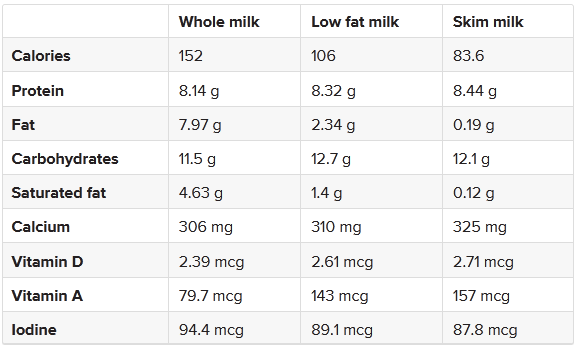
(Richards, 2021)
Which Milk Is Better?
Both full-fat milk and skimmed milk provide the same minerals and vitamins. They have vitamins A and D, although nutrients in skimmed milk are added back as they are lost during the fat removal. Whole milk is regularly reinvigorated with additional vitamin D and is better than skimmed milk for its rich taste and creamy feel. It is still the best source of protein, fats, and micronutrients (Collard & McCormick, 2020).
A study by White et al. (2020) found that children aged 2 to 20 years who were obese or overweight were less likely to have drunk whole milk and more likely to have drunk fat-free milk than children of a healthy weight. They concluded that individuals who drink whole milk are less likely to become overweight or obese (White et al., 2020). Nutrition guidelines typically recommend avoiding whole milk due to its saturated fat content.
Further, nutritional recommendations advise restricting fat intake, as it may raise cholesterol levels, which are associated with the risk of heart disease. The dramatic increase in non-communicable disease rates is related to overweight and obesity, namely CVD (Bhavadharini et al., 2020). Saturated fat may contribute to elevated low-density lipoprotein (LDL) cholesterol percentages, and increased plasma cholesterol is correlated with risk factors for CVD. However, the relationship does not assign an action.
The American Heart Association’s (AHA) position on the strength of the evidence supporting the recommendation to restrict saturated fat for CVD prevention may be overstated. It could be re-evaluated (Heileson, 2019). Conversely, whole milk can raise HDL (good cholesterol), which reduces the risk of CVD. In addition, fats in whole milk control one’s appetite by inducing the release of cholecystokinin hormone, which leads to fullness. Fat slows sugar release into one’s bloodstream, decreasing the amount that may be stored as fat in the body (Collard & McCormick, 2020). Hence, consuming whole milk may aid in weight management for people who want to lose weight.
Additionally, low-fat milk does not trim a person’s gut and can make them fatter than when they consume whole milk. There is a significant and positive relationship between the consumption of highly processed food, such as skimmed milk, and the escalated risk of developing hypertension, low HDL cholesterol levels, obesity, and diabetes (Vitale et al., 2023). Further, whole milk assists in the absorption of fat-soluble vitamins, such as Vitamins K, A, E, and D.
On the contrary, those who drink skimmed milk could have problems with absorbing these vitamins that are in the milk if they fail to eat sufficient healthy fats, such as salmon, olive oil, and avocado. Those who drink skimmed milk feel hungry sooner because the fat in milk may help them feel full, reducing continuous eating and, hence, leading to weight gain (Collard & McCormick, 2020). Skimmed milk may contribute to overconsumption because it lacks the satiety factor.
Whole milk contains high levels of natural fat, protein, and calcium, making it safer to consume. In addition, skim milk has more added sugar than whole milk, which is not healthy for the body (Mahato et al., 2020). Hence, consumption of skimmed milk can increase the risk of being overweight and obese, leading to heart disease. It implies that whole milk is not essentially bad for one’s cholesterol and heart.
Conclusion
The main difference between skimmed milk and regular milk is in their fat ratio. Whole milk has a higher fat content of 3.5%, leading to a creamy texture and taste; skimmed milk has less than 0.5% fat, resulting in a thinner consistency. The milk types’ disproportions extend to the nutrient component, caloric content, and culinary applications. However, the decision between skimmed and regular milk is based on a person’s preferences, health goals, and nutritional needs, allowing individuals to choose the milk that best suits their needs.
The better type of milk is regular milk. It can be consumed by growing children, athletes, and adults because it is rich in nutrients, has a creamy taste, and contains fats. Whole milk provides several health advantages, including helping regulate blood sugar and appetite, aiding in the absorption of fat-soluble vitamins, and boosting HDL cholesterol. However, before switching to whole milk, a person with a heart condition should consult a doctor. Skimmed milk is recommended as part of a healthy diet and requires supplementation with healthy fats to avoid the problem of fat-soluble vitamins in milk.
References
Akkerman, M., Johansen, L. B., Rauh, V., Sørensen, J., Larsen, L. B., & Poulsen, N. A. (2020). Relationship between casein micelle size, protein composition and stability of UHT milk. International Dairy Journal, 112.
Astrup, A., Magkos, F., Bier, D. M., Brenna, J. T., de Oliveira Otto, M. C., Hill, J. O., King, J. C., Mente, A., Ordovas, J. M., Volek, J. S., Yusuf, S., & Krauss, R. M. (2020). Saturated fats and health: A reassessment and proposal for food-based recommendations: JACC state-of -the-art review. Journal of the American College of Cardiology, 76(7), 844-857.
Bhavadharini, B., Dehghan, M., Mente, A., Rangarajan, S., Sheridan, P., Mohan, V., Iqbal, R., Gupta, R., Lear, S., Wentzel-Viljoen, E., Avezum, A., Lopez-Jaramillo, P., Mony, P., Varma, R. P., Kumar, R., Chifamba, J., Alhabib, K. F., Mohammadifard, N., Oguz, A., & Lanas, F. (2020). Association of dairy consumption with metabolic syndrome, hypertension and diabetes in 147 812 individuals from 21 countries. BMJ Open Diabetes Research & Care, 8(1).
Cardello, A. V., Llobell, F., Giacalone, D., Roigard, C. M., & Jaeger, S. R. (2022). Plant-based alternatives vs. dairy milk: Consumer segments and their sensory, emotional, cognitive and situational use responses to tasted products. Food Quality and Preference, 100.
Collard, K. M., & McCormick, D. P. (2020). A nutritional comparison of cow’s milk and alternative milk products. Academic Pediatrics, 21(6), 1067-1069.
Heileson, J. L. (2019). Dietary saturated fat and heart disease: A narrative review. Nutrition Reviews, 78(6), 474–485.
Huppertz, T., & Lambers, T. T. (2020). Influence of micellar calcium phosphate on in vitro gastric coagulation and digestion of milk proteins in infant formula model systems. International Dairy Journal, 107.
Mahato, D. K., Keast, R., Liem, D. G., Russell, C. G., Cicerale, S., & Gamlath, S. (2020). Sugar reduction in dairy food: An overview with flavored milk as an example. Foods, 9(10).
Poppitt, S. D. (2020). Cow’s Milk and dairy consumption: Is there now consensus for cardiometabolic health? Frontiers in Nutrition, 7.
Richards, L. (2021). Which type of cow’s milk is the healthiest?
Sipple, L. R., Barbano, D. M., & Drake, M. (2020). Invited review: Maintaining and growing fluid milk consumption by children in school lunch programs in the United States. Journal of Dairy Science, 103(9), 7639–7654.
Torres-Gonzalez, M., & Rice Bradley, B. H. (2023). Whole-milk dairy foods: biological mechanisms underlying beneficial effects on risk markers for cardiometabolic health. Advances in Nutrition, 14(6) 1523-1537.
Vitale, M., Costabile, G., Testa, R., D’Abbronzo, G., Nettore, I. C., Macchia, P. E., & Giacco, R. (2023). Ultra-processed foods and human health: A systematic review and meta-analysis of prospective cohort studies. Advances in Nutrition.
Wang, S., Liu, Y., Cai, H., Li, Y., Zhang, X., Liu, J., Sun, R., Fang, S., & Yu, B. (2021). Decreased risk of all-cause and heart-specific mortality is associated with low-fat or skimmed milk consumption compared with whole milk intake. Clinical Nutrition, 40(11) 5568-5575.
Weaver, C. M. (2021). Dairy matrix: is the whole greater than the sum of the parts? Nutrition Reviews, 79(Supplement_2), 4–15.
White, M. J., Armstrong, S. C., Kay, M. C., Perrin, E. M., & Skinner, A. (2020). Associations between milk fat content and obesity, 1999 to 2016. Pediatric Obesity. 15(5).
Yang, S., Liu, G., Munk, D. M. E., Qin, Z., Petersen, M. A., Cardoso, D. R., Otte, J., & Ahrné, L. (2020). Cycled high hydrostatic pressure processing of whole and skimmed milk: Effects on physicochemical properties. Innovative Food Science & Emerging Technologies, 63.
Zhang, W., Liu, Y., Li, Z., Xu, S., Zhang, J., Hettinga, K., & Zhou, P. (2021). Effects of micro-filtration combined with ultrasonication on shelf life and bioactive protein of skim milk. Ultrasonics Sonochemistry, 77.
Zhang, X., Ai, N., Chen, L., & Sun, B. (2020). Lipase-catalyzed modification of structural properties and sensory profile of recombined skim milk: From a non-volatile perspective. LWT, 118.