Executive Summary
This paper presents an innovative approach to managing personal finances using financial technology (FinTech). An automated system for providing individualized financial advice based on personal banking and investment preferences. This invention seeks to democratize financial knowledge by leveraging artificial intelligence (AI) and machine learning (ML), enabling everyone to make confident financial decisions. The paper reveals the rationale for the innovation, outlines a thorough strategy for its implementation, and evaluates the leadership attributes required to advance this creative endeavor.
Description and Rationale for the Proposed Innovation
There are so many challenges that block people without strong investment backgrounds from successfully navigating the financial services sector. The financial sector has so many complex tools, investment choices, and market trends that are not easy to apply, analyze, or use to make the right decisions (Ashta and Herrmann, 2021). This leaves those without proper financial training in limbo when navigating such areas. Even though the traditional resource management systems have given personalized assistance before, they are quite costly for the average individual who needs the service (Sattar, Toseef, and Sattar, 2020).
According to Yang, Liu, and Wang (2023), existing personal budgeting and investment planning systems overlook the unique nature of personal financial needs. Traditional budget plans are rigid and fail to adapt to unexpected changes in income or expenses (Ashta and Herrmann, 2021). This inflexibility frequently leads to frustration and abandonment of budgeting efforts altogether. Additionally, many budgeting tools offer limited financial insights (Fox and Bartholomae, 2020). This leaves users in the dark about potential savings or ways to optimize their spending habits.
The Investment and Budgeting Assistant (IBA) is proposed to resolve the limitations of the traditional financial management systems. At the heart of IBA is a sophisticated AI system capable of securely and comprehensively analyzing users’ financial data in depth. The AI engine operates as follows. Firstly, it ensures secure data retrieval by allowing users to link their financial accounts, such as bank accounts and credit cards, to the IBA platform via Open Banking APIs. This ensures data confidentiality while eliminating manual data entry errors (Javaid et al., 2022).
Secondly, it incorporates an income and expenditure analysis, employing advanced algorithms to examine income sources and spending patterns. This helps identify recurring expenses, categorize income streams, and highlight potential savings opportunities (Haleem et al., 2022). By visualizing cash inflows and outflows, IBA helps users better understand their financial status and make informed decisions about their spending patterns.
Thirdly, the system has a risk assessment feature that adopts a comprehensive strategy to evaluate an individual’s risk tolerance by combining questionnaires with, where applicable, an analysis of existing investment behaviors and financial information. Understanding risk tolerance is essential for formulating suitable investment suggestions (Padmanaban, 2024a). Fourth, it includes features for goal setting and financial strategy. Acting as a virtual financial advisor, IBA assists users in setting goals via interactive prompts and questionnaires.
Users can define short- or long-term objectives, such as saving for a down payment on a home, planning for retirement, or funding educational expenses. Laying down clear goals provides essential guidance for crafting investment strategies (Susanto, Mardhiah, and Susanto, 2022). It also generates tailored solutions by drawing on personalized investment advice and adaptive budget planning from extensive data analysis, while considering user-defined objectives.
IBA formulates bespoke solutions tailored according to each individual’s unique fiscal circumstances. Leveraging its AI capabilities, IBA offers customized portfolio recommendations that align with users’ risk tolerance levels, investment timelines, and objectives. Instead of directly managing investments, suggesting diversified asset portfolios that match users’ risk profiles empowers them to participate in investments without financial managers (Brown, Hu, and Kuhn, 2020; Baloyi and Lotter, 2024).
Typically, static budgets struggle to handle unpredictable aspects of personal finance (De Zarzà et al., 2023). IBA creates dynamic budget plans that adapt to real-time fluctuations in income and expenditures, continuously monitor cash flow trends, and enable timely adjustments, ensuring users remain aligned with their fiscal aspirations and fostering flexible, responsible financial practices.
Rationale: Aligning with Key FinTech Trends and User Needs
In terms of aligning with current FinTech trends and meeting user needs, the proposed IBA stands out by blending with various key advancements in the FinTech domain. Firstly, it provides AI-driven financial services that serve as a potent tool for tailoring financial advice and suggestions. Unlike conventional wealth management services, the IBA leverages AI to democratize access to investment insights, rendering financial literacy reachable to a broader audience (Agrawal, Rose, and PrabhuSahai, 2024).
Secondly, facilitates open banking since the revolutionary impact of Open Banking APIs on financial data access is noteworthy. By securely linking with user accounts, manual data entry is eradicated, enhancing analysis accuracy and delivering a seamless user experience (Kanaparthi, 2024). Furthermore, it focuses on user experience by emphasizing design principles centered on user needs and crafting a seamless experience.
Thirdly, it is an intuitive, user-friendly interface tailored for individuals with varying levels of financial literacy. Clear explanations of financial concepts and easy-to-understand visualizations ensure users can confidently navigate through the platform (Odeyemi et al., 2024). Interactive dashboards offer real-time insights into financial performance, helping users track progress towards their objectives (Nadj, Maedche, and Schieder, 2020). Additionally, beyond presenting data, the IBA’s ability to transform intricate financial details into actionable insights and recommendations lies.
Such a system clearly guides users on areas for potential savings, offers suggestions for enhancing spending habits, and provides personalized investment strategies aligned with their aspirations (Shubho et al., 2022). This approach empowers users to seize control over their financial future. Furthermore, acknowledging that sound decision-making stems from a solid financial literacy knowledge base (Odeyemi et al., 2024). Users can access these resources at their own pace, facilitating better comprehension of personal finance and investment strategies.
Lastly, the IBA system recognizes individual differences in needs and preferences, allowing users room to customize their experience. Users can define preferred budgeting categories, establish goal-specific alerts or notifications, and adjust the level of detail shown in financial reports. This element grants users the autonomy to adapt the IBA to their unique financial management style (Javaid et al., 2022).
Furthermore, given paramount security concerns in the finance sector, trustworthiness is upheld by adherence to strict security standards that safeguard user data integrity. This ensures that the utmost security measures are maintained by maintaining transparent practices regarding data usage norms and providing clear explanations of how information shapes recommendations (Jarvis and Han, 2021). Robust encryption protocols are employed alongside secure access channels to connect to financial accounts.
High-Level Plan for Innovation and Change
The successful creation and introduction of the Investment and Budgeting Assistant (IBA) requires a meticulously crafted strategy that fosters teamwork, creativity, and continuous improvement. This section presents a strategic overview for the IBA. It is segmented into three pivotal phases: Development and Testing (Lasting 6 Months), Pilot Launch and Assessment (3 Months), and Market Rollout and Expansion (Continuous).
Phase 1: Development and Testing
This initial phase lays the foundation for the IBA by building a proficient team, establishing essential partnerships, and constructing a robust platform.
Team Establishment (Month 1): The formation of an adept team is a linchpin of the IBA’s prosperity. The key team members include AI/ML engineers, a Data Security Specialist, Financial Services Experts, a User-Experience (UX) Designer, and a Project Manager, as shown in Appendix 1.
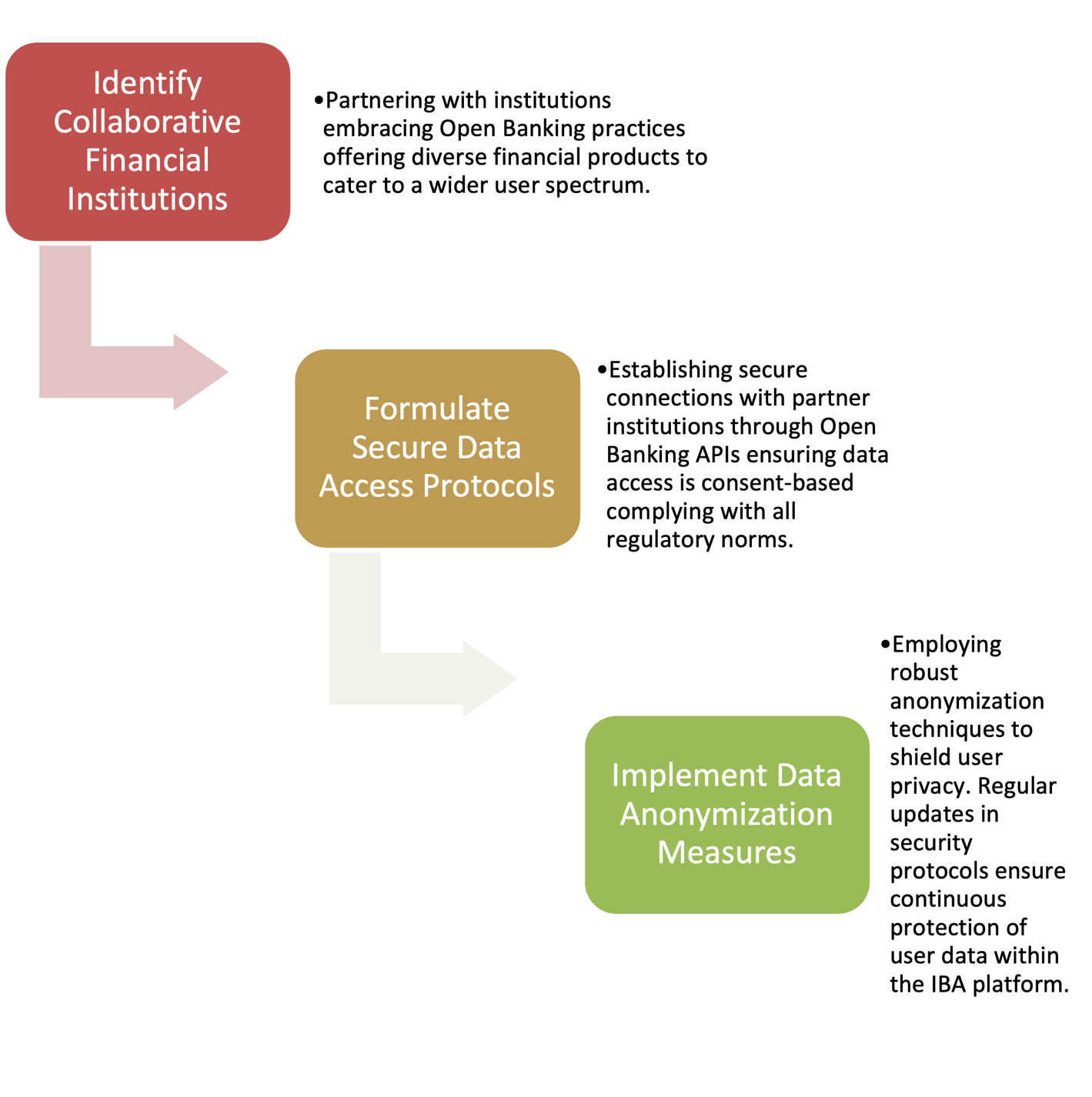
The functionality of the IBA hinges on secure access to user financial data. This stage focuses on the objectives outlined in Appendix 2. There will also be an educational phase in which a range of materials, such as articles, videos, and interactive tutorials, will be used to elucidate financial concepts lucidly and captivatingly. For users seeking a personalized touch, providing customization options is key. This includes granting them the ability to tailor their experience through setting budget categories, configuring goal-specific alerts, and fine-tuning the level of detail showcased in reports.
Phase 2: Pilot Launch and Evaluation
Once the IBA platform has been successfully developed and tested, a meticulously planned pilot launch is initiated to allow for real-world user testing and gather valuable feedback before a full-scale market release. This phase focuses on collecting user insights and enhancing the IBA based on users’ experiences. In Month 7, the focus shifts towards recruiting Beta Testers. It’s essential to identify a diverse group of testers to obtain comprehensive feedback.
The strategy includes targeting individuals who represent the intended user base for the IBA, such as young professionals, retirees, or first-time investors. Ensuring diversity in financial backgrounds by including participants with varying levels of financial literacy and investment experience will help tailor the IBA to a broad audience. Offering incentives such as access to premium features or early access to future functionalities can motivate user participation during the pilot program.
During Months 7-8, gathering user feedback becomes paramount in refining the IBA for its successful market launch. Various methods were employed, including surveys and questionnaires to collect opinions on aspects such as the user interface, functionality, value proposition, and overall experience; integrating feedback mechanisms within the platform itself for immediate analysis; and conducting focus groups and in-depth interviews with a small group of testers to gain deeper insights.
Moving into Months 8-9 involves refining and improving based on the feedback collected. This includes addressing usability issues identified during the pilot launch by analyzing interface feedback, enhancing the recommendation algorithms that generate investment suggestions, optimizing or expanding educational resources based on feedback, and implementing security enhancements informed by any security-related input received during testing.
This three-month pilot phase plays a critical role in actively engaging users to gather feedback-driven refinements that prepare the IBA platform for a successful market launch and increased user adoption rates. Phase 3 focuses on Market Launch and Growth, which involves marketing strategies to reach target audiences through channels such as social media campaigns, developing partnerships with financial institutions, and continuously monitoring post-launch data to further refine recommendation algorithms based on user behavior patterns.
Leadership Strengths
The journey of spearheading the creation and introduction of the Investment and Budgeting Assistant (IBA) calls for a diverse leadership style. This segment explores my leadership strengths in critical areas pivotal to this project’s success. First, having a robust grasp of Artificial Intelligence (AI) and Machine Learning (ML) principles is key to steering the IBA initiative. This technical foundation is of immense importance for several reasons. It ensures proper algorithm design and choices for efficient financial data analysis, risk evaluation, and tailored suggestions (Rizinski et al., 2022).
Understanding of AI and ML enables the effective selection and engagement of AI/ML experts within a team (Larson and DeChurch, 2020). This is in line with Path-goal leadership theory, which emphasizes that a leader must understand the project and provide a path to achieve the set goals (Bans-Akutey, 2021). It also ensures AI algorithm assessment by pinpointing the areas that need evaluation.
My technical know-how enables me to interpret data generated by these algorithms, assess their precision, and communicate effectively with our AI/ML squad about necessary tweaks. Moreover, it keeps abreast of progress since AI and ML are ever-evolving. Embracing continuous learning helps me stay abreast with cutting-edge advancements in these domains (Padmanaban, 2024b). This equips me to explore incorporating new algorithms or features into IBA as it evolves.
Second, orchestrating the successful development and debut of IBA necessitates a methodical project management approach. Project management ensures meticulous project planning, as steering the development crew requires a well-defined project blueprint outlining objectives, timelines, and milestones (Doherty and Stephens, 2023). Leveraging my project management background lets me segment the development process into manageable stages, allocate resources efficiently, and track progress. This is in line with the Transformational Leadership Theory, which emphasizes that a leader must motivate and inspire their team effectively (Asbari, Santoso, and Prasetya, 2020).
Furthermore, every project faces potential hurdles along its path (Doherty and Stephens, 2023). My experience enables me to anticipate obstacles and craft fallback strategies to mitigate them, ensuring smooth progress. Additionally, effective communication is the bedrock of successful project management. Cultivating transparent communication channels within our team fosters collaboration and ensures clear, concise interactions with stakeholders, bridging gaps between technical squads and user experience designers.
Thirdly, there is a need for strong teamwork skills to ensure collaboration with other key stakeholders and successfully sail a crew with diverse skills and backgrounds. Team-building skills help build strong teams and acquire relevant talent (Doherty and Stephens, 2023; Krauter, 2022). Gathering a crew with the right skills is the first step to triumph. I can use my experience to seek out and bring on board skilled hands for the AI/ML, data security, financial services, and UX design aspects of our quest. It also helps create a unified work environment, which is vital for team spirit and productivity.
I can craft an environment where my shipmates feel appreciated, their voices are heard, and they work together across different domains. Furthermore, it ensures efficient delegation and empowerment as sharing tasks wisely lets a crew shine bright in their roles (Doherty and Stephens, 2023). I can assign duties with clear guidance and support, empowering my teammates to take charge of their missions and instilling a sense of responsibility.
Lastly, vision and strategic thinking will be crucial to navigating this innovative voyage. It is important in several areas, such as painting. Casting a clear vision for the journey is key to rallying support from all quarters and inspiring the crew (Putri and Fontana, 2022). I can paint a vivid picture of how the IBA could transform financial literacy, empowering folks to make savvy money choices. It also supports strategic planning, as the course demands careful prioritization (Putri and Fontana, 2022).
I can mark out crucial milestones, prioritize features based on user needs and market trends, ensuring our path aligns with our grand business strategy. It also ensures flexibility and growth, as the financial services landscape is ever-changing. A dedication to constant improvement helps the team stay nimble, seizing chances to add new elements or features that enhance the value of its treasure map over time.
Reference List
Agrawal, S.S., Rose, N. and PrabhuSahai, K. (2024) ‘The fintech revolution: ai’s role in disrupting traditional banking and financial services’, Decision Making: Applications in Management and Engineering, 7(1), pp.243-256.
Asbari, M., Santoso, P.B. and Prasetya, A.B. (2020) ‘Elitical and antidemocratic transformational leadership critics: is it still relevant?’. International Journal of Social, Policy and Law, 1(1), pp.12-16.
Ashta, A. and Herrmann, H. (2021) ‘Artificial intelligence and fintech: an overview of opportunities and risks for banking, investments, and microfinance’, Strategic Change, 30(3), pp.211-222.
Baloyi, S. and Lotter, M. (2024) ‘Suitability of risk assessment tools used during the portfolio recommendation process‘, Journal of Economic and Financial Sciences, 17(1).
Bans-Akutey, A., 2021. The path-goal theory of leadership. Academia Letters, 2.
Brown, G., Hu, W. and Kuhn, B.K. (2020) ‘Private investments in diversified portfolios‘, Unpublished working paper. University of North Carolina (UNC) at Chapel Hill.
De Zarzà, I. et al. (2023) ‘Optimized financial planning: integrating individual and cooperative budgeting models with llm recommendations’, AI, 5(1), pp.91-114.
Doherty, O. and Stephens, S. (2023) ‘Hard and soft skill needs: higher education and the Fintech sector’, Journal of Education and Work, 36(3), pp.186-201.
Fox, J. and Bartholomae, S. (2020) ‘Household finances, financial planning, and COVID‐19‘, Financial Planning Review, 3(4).
Haleem, A. et al. (2022) ‘Artificial intelligence (AI) applications for marketing: a literature-based study’, International Journal of Intelligent Networks, 3, pp.119-132.
Jarvis, R. and Han, H. (2021) ‘FinTech innovation: review and future research directions’, International Journal of Banking, Finance and Insurance Technologies, 1(1), pp.79-102.
Javaid, M. et al. (2022) ‘A review of Blockchain Technology applications for financial services‘, BenchCouncil Transactions on Benchmarks, Standards and Evaluations, 2(3).
Kanaparthi, V. (2024) ‘Exploring the impact of Blockchain, AI, and ML on financial accounting efficiency and transformation‘, arXiv preprint arXiv.
Krauter, J. (2022) ‘A team-based leadership framework—The interplay of leadership self-efficacy, power, collaboration and teamwork processes influencing team performance’, Open Journal of Leadership, 11(2), pp.146-193.
Larson, L. and DeChurch, L.A. (2020) ‘Leading teams in the digital age: four perspectives on technology and what they mean for leading teams’, The Leadership Quarterly, 31(1).
Nadj, M., Maedche, A. and Schieder, C. (2020) ‘The effect of interactive analytical dashboard features on situation awareness and task performance‘, Decision Support Systems, 135.
Odeyemi, O. et al. (2024) ‘Integrating AI with blockchain for enhanced financial services security‘, Finance & Accounting Research Journal, 6(3), pp.271-287.
Padmanaban, H. (2024a) ‘Navigating the role of reference data in financial data analysis: addressing challenges and seizing opportunities’, Journal of Artificial Intelligence General Science (JAIGS) ISSN: 3006-4023, 2(1), pp.69-78.
Padmanaban, H. (2024b) ‘Quantum Computing and AI in the Cloud’, Journal of Computational Intelligence and Robotics, 4(1), pp.14-32.
Putri, S.R.R. and Fontana, A. (2022) ‘July. Surviving digital transformation era through strategic entrepreneurship with collaborative innovation between bank and fintech’, Family Business and Entrepreneurship (Vol. 3, No. 1).
Rizinski, M. et al. (2022) ‘Ethically responsible machine learning in fintech‘, IEEE Access, 10.
Sattar, M.A., Toseef, M. and Sattar, M.F. (2020) ‘Behavioral finance biases in investment decision making‘, International Journal of Accounting, Finance and Risk Management, 5(2), p.69.
Shubho, O.Q. et al. (2022) ‘Real-time data visualization using business intelligence techniques in small and medium enterprises for making a faster decision on sales data‘, Decision Intelligence Analytics and the Implementation of Strategic Business Management, pp.189-198.
Susanto, H., Mardhiah, N. and Susanto, A.K.S. (2022) ‘Crafting strategies of security breaches: how financial technology business models work in data-centric approaches’, In FinTech Development for Financial Inclusiveness (pp. 214-234). IGI Global.
Yang, H., Liu, X.Y. and Wang, C.D. (2023) ‘FinGPT: open-source financial large language models‘, arXiv preprint arXiv.
Appendices
Appendix 1: Team Members and Their Roles
Appendix 2: Data Acquisition Steps