
Introduction
Commodity pricing strategies differ from one market structure to another. According to Francis (2020), a market structure is the fundamental element of a system for exchanging goods and services. Besides, the existence of a market depends on the availability of potential customers and sellers, goods or services, rivalry among suppliers, product differentiation, and the ability to enter or leave the market relatively quickly.
In light of this notion, (Hemsley, Morais, and Di Iulio, 2020) point out that market structures are distinct elements that affect buyer and seller actions. However, the number of competing businesses in a given market determines the market’s nature, as do the pricing mechanisms. As such, the nature of the market conditions deeply affects manufacturers’ operations. This affects the pricing of a given product or service (Manral, 2010).
Additionally, the market environment influences the availability of goods and establishes entry obstacles. Companies can employ the most productive and efficient pricing methods in their particular market structures since market structures specify the nature of the market in which they participate (Sjøvaag, 2022). Therewithal, the pricing techniques of some of the most well-known market structures are analyzed, and practical examples are provided.
In other words, a market structure is a foundation upon which a marketplace for exchanging goods and services rests (Hemsley et al., 2020). It is generally accepted that a market can be considered to exist when there are sellers, buyers, competitors, products, product differentiation, and freedom of entry. This paper looks at several prevalent market structures and analyzes how they’re priced in practice.
Perfect Competition
Description
This indicates a company that needs to follow someone’s pricing strategy. Companies using this market structure are thus required to follow the pricing set by the market conditions, like demand and supply for goods and services (Hemsley et al., 2020). A company can now freely advertise its wares to the public.
There are abundant suppliers in a market characterized by perfect competition. Since there are few or no obstacles to entry, many sellers are in a perfect competition market. Since no single company commands a sizable portion of this market, prices can only be set through the forces of supply and demand. In a call with perfect competition, the customer wins out over businesses. Because of the high number of sellers in a perfectly competitive market, firms must focus on reducing costs to differentiate themselves from the crowd.
Consumers can shop for better deals when sellers have no say in their market. A company could lose customers and market share if it charges excessive pricing in the competitive marketplace. A perfectly competitive market lacks a fixed price for a given quality or quantity of commodities (Hemsley et al., 2020).
Accordingly, it is up to the vendor to set the offering price and quantity. Since new vendors can enter the market at will, specific businesses have no say in supply and demand. Kessler (2013) suggests that typical rivals in a competitive market may not earn any profit, especially if pricing is the sole strategy. There are no entry or departure restrictions in such a market system, as pointed out by Srivastav and Vaidya (2022) because an infinite number of vendors and purchasers can participate. However, this benefits customers by leading to quality products at low prices.
When businesses mass-produce commodities that are uniform in appearance and function, an economic system known as “the commodity market” is created. This concept suggests that enterprises exclusively compete in pricing. Furthermore, customers are aware of the competitive pricing environment. As a result, everything for sale must be priced similarly in the market (Gasiorowska & Zaleskiewicz, 2021). Businesses and consumers occasionally check prices even if they cannot affect the market directly. As a result, businesses can either offer at the going rate or reduce prices to maintain customer satisfaction (Francis, 2020). Furthermore, enterprises operating in this market can sell a small percentage of their total output.
Pricing Strategies
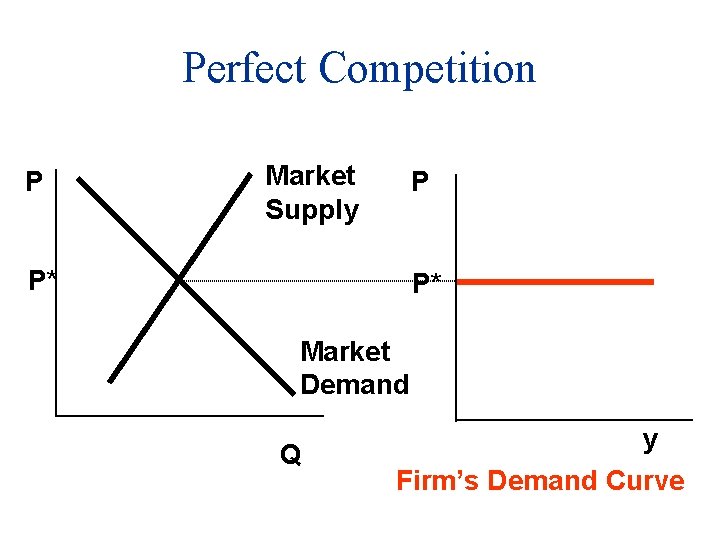
Supply and demand are the driving factors in setting prices in a perfectly competitive market. It is important to remember that in a perfectly competitive market, all companies make identical products, hence exact pricing mechanisms. The demand curves for all firms are wholly elastic and parallel to the price axis, as shown in Fig. 1 below (Srivastav & Vaidya, 2022). Due to the high number of rival sellers and readily available substitutes in a perfect competition market, businesses operating in such an environment are forced to accept whatever prices their customers are willing to pay passively.
When supply and demand are perfectly balanced at the same price, the market has reached the best price point, known as the equilibrium price. Therefore, the firm could only sell a fraction of its output at the current price. When prices go up, even slightly, customers leave in search of cheaper options elsewhere. All transactions in this market take place at the same price; the so-called “rule of one price” does not fluctuate (Sjøvaag, 2022).
Monopolistic Competition
Description
Firms in a monopolistic market structure do not consider the effects of other firms’ pricing policies when determining their own. Here, a variety of manufacturers provide variations on a single product. As a result, it encourages healthy rivalry among the member firms. Therewithal, monopolistic competitors use product differentiation to maintain a firm grip on prices without jeopardizing market share. It might be said that Monopolistic Competition is the natural progression of a market in which perfect competition exists. Under this market condition, a firm can change its capabilities into a competitive advantage by modifying its products to divert its prices from other suppliers.
Unlike perfect competition, which is highly elastic to price-to-demand factors, monopolistic markets tend to be inelastic to demand. This implies that competition in a monopolistic market structure takes a vertical form of a perfectly competitive market instead of the normal linear. Companies intentionally create product distinctions and competitive price points (Gasiorowska & Zaleskiewicz, 2021). A monopolistic market structure has no entry restrictions, although product differentiation is lacking in a perfect market.
Pricing Strategies
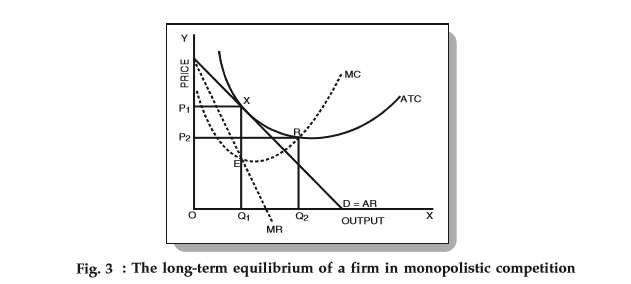
Firms differentiate themselves from rivals by charging different prices for similar products because of the differences in quality and quantity between the goods on offer. Companies in this context attempt to establish their brands by emphasizing the features that set their interests apart from competitors (Sjøvaag, 2022). In a monopolistic competition framework, corporations can differentiate their offerings so buyers can go deeper into their pockets to buy premium products. The hybrid structure known as monopolistic competition combines elements of monopoly and perfect match, as indicated in Fig. 2 below.
Depending on the situation, a company in this setup can act as either a price taker or a price maker. Pricing follows this model to reflect the degree to which its many product lines are differentiated. Besides, a firm uses the same pricing mechanisms in the short and long run, although it calls for advanced marketing campaigns to introduce differentiated products. One way manufacturers can charge premium pricing without risking their hold on the market is to differentiate their products from their rivals. The demand is elastic, so companies can raise prices whenever they like (Samuelson & Marks, 2006).
Oligopoly
Description
In an oligopoly market structure, a large portion of the market is occupied by at most three firms. Each firm strives to obtain maximum profit from their sales, hence the existence of a price war. When prices increase, the amount of product each firm sells is affected. For example, when one of the competing firms lowers its market price, customers will prefer their products over their competitors, affecting its sales (CFA Institution, 2022). Oligopolies can be compared to monopolies; however, their demand elasticity and market participation differ.
In this market structure, few firms control the market shares, and moderate to high market entry barriers exist. Due to its inelastic nature, firms operating as oligopolies tend to manage prices in the market. The correlation in this market structure directly affects other firms’ actions. The market price control, therefore, indicates that the producers must first consider the effects of decisions made on rising or lowering prices. According to Samuelson & Marks, some firms in the oligopoly market structure tend to be rivals; hence, conflicts may arise (2011).
Pricing Strategies
The price strategies of firms operating under an oligopoly market structure are interdependent on other firms’ actions in the market. This means oligopolies’ reactions are high on price changes, which has led to market manipulation, collaboration, and even end-game strategies. Product prices are decided after thorough consideration (Francis, 2020). Since independent actions performed by an oligopoly firm may result in competitively lower price strategies, leading to firms making losses and consumers benefiting, most firms, therefore, decide to adjust their prices frequently.
Before changing prices, these firms tend to understand their consumers’ behaviors. When an individual firm changes its price policy, the other firms are affected, leading to price rigidity elements that cause other firms to operate on non-price competition. This results in prices not being determined in terms of demand and supply. Despite prices in the market depending on the preference and taste of the consumer, the pricing strategies in oligopolies are always interdependent.
Monopoly
Description
In a monopoly market structure, single firms control the markets entirely. When a firm operates under a monopoly, it tends to be the only seller, producer, or supplier in the market. In this market structure, higher entry barriers exist. Pure monopolies only exist for a certain period until they are divided into various companies or decommissioned, an act of federal regulations. According to studies, monopolistic firms generate about 4 percent of the GDP in countries with developed economies, such as the United States and the United Kingdom. (Samuelson & Marks, 2011).
The high entry barriers to this market help prevent other companies from joining such markets, as this will affect their operations and profits. Consumers, therefore, lack options when it comes to products produced by these firms, so they have to purchase their products. Monopolies ensure that profits are maximized despite having a high inelastic supply and demand for their products. The maximization of profits is reached when marginal costs equal marginal revenues.
Pricing Strategies
In a monopoly price strategy, the prices of products produced are controlled by a single firm in the market. Most monopolistic firms adopt trial and error in setting prices for their commodities, and the demand for the product controls this. According to Wilkinson, monopolies also use profits and losses to determine prices for specific products (2005). By determining the highest price suitable for a product and ensuring all these products produced are sold, the firms tend to maximize their profits. Monopolies are price givers, and not price takes. This fortunate position has enabled them to produce products that are not easily substituted, hence an inelastic demand curve. Their price-giving opportunity also allows them to set a product price that will result in the marginal cost being equal to the revenue cost.
All marketing structures have pricing strategies that maximize profit, so understanding demand and its elasticity are essential. When an equilibrium level is reached, that is, the marginal revenues equate to marginal cost, monopoly firms tend to decide on the market price to be set. The maximum profit obtained is a result of the high prices set. A differentiation approach can also be used, which involves setting different prices for consumers in different regions and depending on demand elasticity. Monopolies also use dumping as a pricing strategy in which domestic markets offer high prices for products compared to international markets (Blesch, 2015).
Case Study Example
Since the 1980s, the personal computer industry has been among the most dynamic in the electronic industry. Their dynamism has impacted the computer industry and other logistics, manufacturing, and distribution industries. In 1981, the first personal computer was launched, and since then, revolutions and innovations have been made daily (Pasalic & Pavic, 2021). Today’s industry is distributed in all parts of the world, with large firms controlling their production. Many different producers, suppliers, and sellers exist in the personal computer market and are a shallow entry barrier.
The industry can be categorized as a perfect competition market. The industry has many firms producing and selling personal computers. The demand for these products by the consumers is also elastically high; hence, the producers are the price takers, and the consumers are somehow the price determiners. Different personal computer firms have different operating systems compared to one another. A Microsoft window is the main operating system, but other operating systems such as Linux and Apple IOS exist. Here, we can note two types of market structures: perfect competition, the personal computer hardware, and oligopoly market structure, the operating software. However, the personal computer industry contains an elasticity demand subset. On the one hand, the production of personal computers is highly elastic in terms of consumer demand.
On the other hand, the demand from the producer to the supplier of the software operating system is inelastic. Therefore, those selling personal computer windows tend to compete mainly among themselves. For this case, it is correct to say an Apple IOS or Linux personal computer is highly differentiated; hence, the firm moves from perfect to monopolistic competition (Hamilton, Senauer & Petrovic, 2011). They are, therefore, controlling the prices of their products rather than being a price taker. From this illustration, it is easily understood how Apple or Linux personal computers tend to have higher prices than Windows personal computers. In the industry of personal computers, monopolistic competition, oligopolies, and perfect competition may be demonstrated. Hence, prices set will depend on the market structure in which a firm operates.
In the cellular phone industry, there are multiple smartphone firms. For hardware manufacturers, there are many firms, which may indicate that this industry falls in a perfect market structure. However, smartphones require specific operating systems to perform their tasks correctly and as instructed. Three leading operating platforms exist for smartphones: Google Nexus, windows, and Apple’s IOS smartphone edition(Hamilton et al., 2011).
The two industries, personal computers and the smartphone industry, are not that different. The hardware parts in both industries are in perfect competition but differ when software is selected, shifting the product to another market structure: monopolistic competition. Despite the products being in a monopolistic competition market structure, the software producers belong to an oligopoly market structure since they manage almost eighty-five percent of the market activity within their industry. The personal computers’ pricing strategies are determined by the demand for the product’s elasticity within the different firms in the industry, and demand can be determined by looking at each operating firm’s market structure.
Conclusion
In conclusion, a firm’s market structure influences its pricing strategies. The four market structures, monopoly, oligopoly, perfect competition, and monopolistic competition, have different characteristics based on entry to the market barriers, price control, and the number of participants in the market. In a monopolistic and perfect completion market structure, there are many participants; hence, there are no barriers to entering the market. The sellers have the opportunity as price givers to set prices. The prices set are affected by the demand elasticity of the consumers.
In an oligopoly market structure, market competition exists among the few sellers, and economic factors such as customer preference determine the prices of the products besides demand and supply. In an oligopoly market structure, there are significant market barriers that are less prohibitive and rigidity in the prices of the products. In a monopoly market structure, single firms produce and determine product prices in the market. In this market, many barriers prevent other firms from entering. Therefore, the marketing strategies are different, and there is no substitute for the products; hence, consumers have no options.
Firms operating in a perfect competition market structure are price takers, and hence their control over the prices of their products is minimal because their demand curve is highly elastic. Monopolistic competition market structure has a less elastic demand since their products are highly differentiated; hence, they have more control over the prices of their products. Therefore, the pricing strategy for all market structures aims to maximize their profits.
References
Blesch Aron. (2015). Marketing in the 21st Century. ResearchGate | Find and share research. Web.
CFA Institute. (2022). The firm and market structures. Web.
Francis, A. (2020). Different market structures and pricing strategies. Web.
Gasiorowska, A., & Zaleskiewicz, T. (2021). Trading in search of structure: Market relationships as a compensatory control tool. Journal of Personality and Social Psychology, 120(2), 300-334. Web.
Hamilton, G. G., Senauer, B., & Petrovic, M. (2011). The market makers: How retailers are reshaping the global economy. Oxford University Press.291-310
Hemsley, P., Morais, R., & Di Iulio, K. (2020). Market structure and knowledge acquisition by firms. Journal of Economic Studies, 48(6), 1128-1144. Web.
Kessler, E. H. (2013). Encyclopedia of management theory. SAGE Publications.
Manral, L. (2010). Towards a theory of endogenous market structure in strategy: Exploring the endogeneity of demand-side determinants of firm investment strategy and market structure. Journal of Strategy and Management, 3(4), 352-373. Web.
Pasalic,N Ivana & Pavic Ivan. (2021). MARKET CONCENTRATION IN THE PERSONAL COMPUTER INDUSTRY. ResearchGate | Find and share research. Web.
Samuelson, W. F., & Marks, S. G. (2011). Managerial economics (7th ed.). Wiley.287-330.
Sjøvaag, H. (2022). The news markets: Enduring structures in the age of business model disruptions. Taylor & Francis.
Srivastav, A. K., & Vaidya, D. (2022). Difference between perfect and monopolistic competition. WallStreetMojo. Web.
Wilkinson, N. (2005). Managerial economics: A problem-solving approach. Cambridge University Press.