
Introduction
The Euro Disneyland case study focuses on the cultural problems the corporation faced after expanding to France. This paper discusses issues related to the cultural dimension and develops strategic recommendations to improve Euro Disneyland’s business performance. Because it could not attract guests, Euro Disney, a brand-new theme park in Paris, failed to generate revenue after opening. The tourists found it excessively costly, very crowded, and, most significantly, disrespectful of French culture (Luthans & Doh, 2021).
Subsequently, Euro Disney renamed the park to Disneyland Paris, altered its management strategy, and lowered pricing (Luthans & Doh, 2021). They strengthened their operations, made more loans and investments, and eventually attracted tourists, which significantly improved Euro Disneyland’s business performance (Luthans & Doh, 2021). The cultural aspect is critical to developing an effective strategy for the company.
Cultural Challenges
Euro Disney’s first experience in France was challenging since the company failed to consider essential cultural peculiarities. First, Walt Disney Company’s decision not to serve alcoholic drinks in its U.S. and Asian theme parks was unpopular in France. This presented a cultural issue for the company when it expanded into Europe (Williams, 2020). Implementing this American tactic in practice sparked public opposition in France, where having a glass of wine with lunch was customary, a variable that influenced the change.
The company overlooked the fact that alcohol is seen as a standard beverage with meals and a necessary component of daily existence (Williams, 2020). The importance score for this factor was 4, as shown in Table 1. The Walt Disney Company changed its policy and permitted wine and alcohol in its French division after reviewing the circumstances.
The type of breakfast available at the theme park was another cultural challenge, with a score of 3 in importance, as shown in Table 1. Disney assumed that French customers preferred their local French breakfast but wanted to buy an American meal in the Disney Park, which was the primary variable in this challenge (Williams, 2020). Another challenge was the price and promotion of Euro Disney, which were the main variables in this problem. Their importance score was 5, since clients paid the most attention to the theme park’s cost.
The American essence of the company was evident in its promotion campaign, and the prices were high in France. Disney’s approach was viewed by many French people as derogatory to local culture, leading to protests and low park attendance (Williams, 2020). Therefore, Disney’s first performance featured many cultural mistakes due to the company’s ignorance of French and European customs and preferences.
Table 1 – Weighted Decision Matrix
Hofstede’s Cultural Dimensions
Hofstede’s four cultural dimensions help managers assess the effectiveness of implementing specific initiatives. The dimensions include short- and long-term orientation, femininity vs. masculinity, the uncertainty avoidance index, and collectivism vs. individualism (Luthans & Doh, 2021). This paradigm can be used to explore the substantial cultural differences between France and the US.
For instance, the power distance measures how vulnerable people of a country’s institutions and organizations expect and accept that power is distributed unevenly (Sobanet & Sago, 2019). The essential American goals of equality and freedom for everyone are combined with the nation’s comparatively low power distance, making it the most individualized society in the world (Sobanet & Sago, 2019). France has a relatively high power distance score since parents are the primary source of emotional dependence for their children (Sobanet & Sago, 2019). Thus, it is a society where a certain amount of inequality is tolerated; not only is power concentrated in organizations and the government, but it is also concentrated geographically.
The primary issue in the collectivism vs. individualism debate is the level of interdependence within a community. In an individualist culture, people are expected to take care of themselves and their closest relatives. People in collective societies are members of their group that look out for them in return for unwavering allegiance.
Since Americans prioritize their own families, the US scores better on individualism. It also demonstrates that France is an individualist society. Parents help their children develop emotional independence about the organizations or social groups they are a part of (Forsdick & Launchbury, 2023). This implies that one should only focus on caring for themselves and their families.
A comparatively high masculine result on the feminine vs. masculinity component predicts that competition, achievement, and success will be the driving forces in society, with the victor defining success. A low result (feminine) in this category shows that quality of life and caring for others are the prevailing values in the community (Forsdick & Launchbury, 2023). In a feminine society, having a high quality of living is a sign of success, and being different from the crowd is not something to be proud of (Forsdick & Launchbury, 2023).
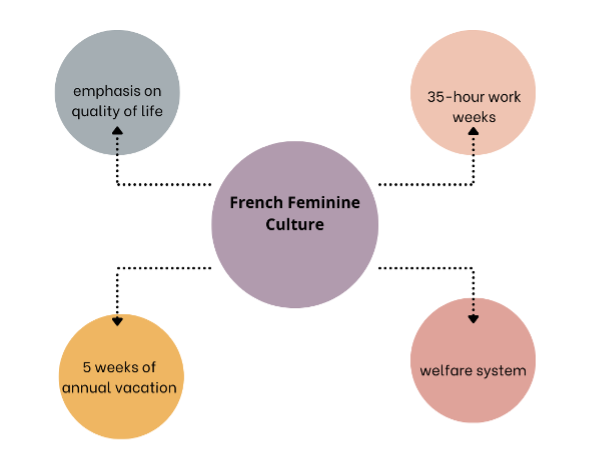
US masculinity scores are high, as seen by the country’s normal behavioral tendencies (Forsdick & Launchbury, 2023). France has a more feminine culture, as seen in its emphasis on quality of life, five weeks of annual vacation, 35-hour workweeks, and a welfare system (Forsdick & Launchbury, 2023; see Figure 1). The working class is more masculine, and the affluent class ranks feminine (Forsdick & Launchbury, 2023). It means there is a significant difference in this dimension across French society, depending on a person’s income level.
The way a community responds to the inability to know the future is the subject of the dimension of uncertainty avoidance. The question of whether humans should attempt to influence future events or allow things to unfold is debatable. This ambiguity causes unease, for which many cultures have evolved a wide range of coping strategies. Regarding uncertainty avoidance, the US does far worse than average.
Consequently, Americans’ behavior will be more influenced by the perceived situation they find themselves in than by the culture’s higher or lower score. French culture has a “high uncertainty avoidance score” because people in France dislike surprises (Forsdick & Launchbury, 2023, p. 35). Planning and organization are therefore necessary when working in France.
The pragmatic (long-term orientation) dimension explains how individuals in the past and present deal with the knowledge that much of what goes on in their environment is beyond explanation. In a normatively oriented society, most people are strongly urged to provide as much explanation as possible (Schröder et al., 2019). The majority of individuals in pragmatic civilizations do not believe it is necessary to explain everything, as they find it difficult to comprehend life’s complexity (Schröder et al., 2019).
Americans tend to investigate new information to make sure it is accurate (Schröder et al., 2019). Therefore, the majority of Americans are not made pragmatic by their culture. Yet, this should not be mistaken with an assumption that Americans are efficient. People in France are less sensitive and disagree that situation, context, and time all play a significant role in determining the truth (Schröder et al., 2019). They have a strong inclination to save and invest wisely, the ability to adapt traditions to changing circumstances quickly, and the tenacity to achieve goals.
Mistakes
Operational mistakes Disney made had a direct impact on their business. The first mistake was that Disney believed, in France, Mondays would be light days, and Fridays would be heavy days for guests, as it did in America (Hendrickson, 2020). However, the reality was that the opposite occurred, and Disney had to solve this issue quickly. The second mistake was connected with hiring and training. Disney had to introduce 12,000 new employees to the corporate culture and train them properly over 1 year (Hendrickson, 2020).
One of Disney’s most significant challenges was instilling the “have a nice day” mentality in European employees, who were instructed to wear the “Disney smile” throughout the day. Euro Disney found that Disney’s restrictive dress code, which forbade mustaches or beards, required colored hair to be dyed, and stipulated nail and jewelry sizes, was the primary source of staffing issues (Hendrickson, 2020). The European workers refused to adopt the American style since they felt it went against their sense of independence.
For Euro Disney, cultural and operational blunders became a third significant issue. They affected Disney’s attendance and performance. For instance, the absence of alcohol service startled French people, who often have a glass of wine with their lunch. Another error the company made was serving the wrong type of breakfast at the local hotels (Hendrickson, 2020). Disney reduced the number of restaurants because it assumed that Europeans skipped breakfast.
In reality, French visitors also had breakfast, and the main issue was that they wanted to try the American menu during their visit to the theme park (Hendrickson, 2020). It is essential to note that a visit to Disneyland is typically associated with exposure to American culture (Williams, 2020). As a result, people in Europe expect everything in Disneyland to be generally American. This assumption has sparked much controversy, as research shows, since there are variations in the typically American things French people expect to find in Disneyland.
Conclusion
Any business that wants to expand internationally should not do so without conducting a thorough, in-depth investigation of all relevant aspects of the target nation. It would increase the likelihood of success, and cautious, diplomatic planning that considers all of Hofstede’s cultural components would allow an organization to function well everywhere. There were other factors at play when Euro Disneyland failed. However, it had a significant impact, and Disney management needs to assume responsibility for this area going forward. Euro Disney’s first performance was a complete bust because of its ignorance of French and European cultures and preferences.
References
Forsdick, C., & Launchbury, C. (2023). Transnational French Studies. Liverpool University Press.
Hendrickson, B. (2020). Periphery and intimacy in anti-imperial culture and politics: From French others to othering Frenchness. French Politics, Culture & Society, 38(2), 105–125.
Luthans, F., & Doh, J. P. (2021). International management: Culture, strategy, and behavior (11th ed.) McGraw-Hill Education.
Schröder, A., Völker, N., Winkler, R. A., & Clucas, T. (2019). Futures worth preserving: Cultural constructions of nostalgia and sustainability. Verlag.
Sobanet, A., & Sago, K. (2019). Revisioning French culture. Liverpool University Press.
Williams, R. (2020). Theme park fandom: Spatial transmedia, materiality and participatory cultures. Amsterdam University Press.