
Introduction
In the market, the demand for products or services is influenced by a number of factors, such as consumer income, quality of service delivery, taste and preference, price of related products, and population. These aspects remain constant for almost all the businesses in any given industry that offer commodities and services. Any change in the above elements can make the need for the service or goods by the customers either increase or decrease, which will then determine the profitability of the business. This paper will analyze how changes in taste and preference, price of related products, income, quality, and population have affected the demand for services in the airline industry.
The airline industry is one of the most extensive performing businesses across the globe. They facilitate movement from different locations to various destinations. Most people prefer using planes as a means of transport to ferry their products or travel for long distances. Flight services are offered in almost all parts of the world by companies like Delta Airlines, Alaska Airlines, JetBlue, Frontier Airlines, Southwest Airlines, and China Southern Airlines. These firms provide services to consumers all over the world. Despite their effective operation in the market, the level of demand in the industry is affected by the following changes.
Factors Affecting Demand in Airline Industry
Consumer Preference
In the flight industry, clients have specific that attract their attention as well as satisfy their needs. Most customers would prefer to use planes that offer baggage allowance as this will cut the cost incurred. Other clients will go for airlines that have enough comfortable legroom to enhance their comfort during the flight. Furthermore, some will opt for planes that provide meal services during the journey. Currently, some of the firms have adopted the use of customized fares to enable customers to have their preferred service. For example, Vistara is using Vistara Freedom Fares, which has made it increase its demand in the market.
Customers Income
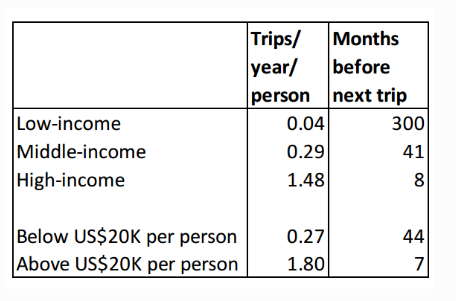
Another key aspect that determines the demand of travelers is the level of their income. Services offered by the airline industry are generally expensive. When customers’ level of income reduces, they will not be able to afford the tickets, therefore, lowering the demand. For example, during the COVID-19 pandemic, the industry experienced a decrease in sales since several clients got laid off from work, which affected their income; hence could not manage to pay for the services.
Price of Related Products
In the aviation industry, they face strong competition from other transport sectors like rail transport and road services. With the development in the railway transportation system in terms of speed ease of connection, and accessibility, most consumers evaluate the price difference and satisfaction they derive. Clients who are price-sensitive would use electronic railways instead of airlines to reach their destinations. Low prices offered by the other means of transport have made the flight companies have a reduction in the demand for their services.
Population
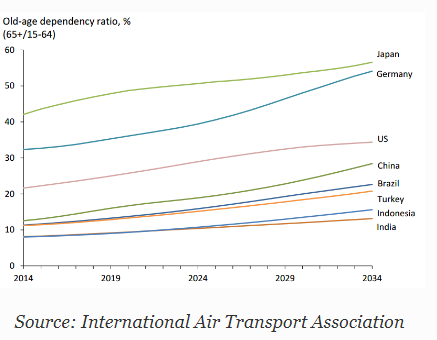
Population plays a vital in the airline industry; for example, a demography that consists mainly of the working class would mean that the rate of travel increases due to job-related issues. This will make the demand for air travel increase as more planes will be required to offer the services to accommodate the travellers. Furthermore, a population structure full of growing middle and working-class will have enough disposable income that would, in turn, influence their need to use the flight industry. For instance, in the US, people who commute to workplaces from the state are prompted to use the air services to catch up with time. This has made planes that operate domestically realize an increase in demand in the market. The figure below shows how population structure determines air travel.
Ticket Price
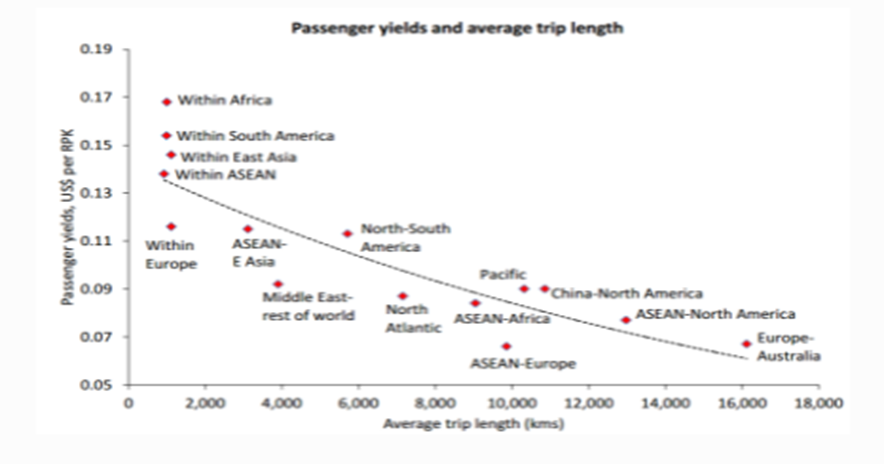
The cost of traveling is also an essential factor that determines the rate at which travelers use the services. Currently, the price of travel documents has declined, making the number of passengers capable of buying the tickets increase. Factors like increased competition, efficiency, and reduced fuel charges have made the cost of traveling by airlines reduce. When there are low airfares, customers’ needs to use the services increase, therefore raising the demand in the industry. The figure below shows the airfare trend in the industry.
Inflation
An increase in the cost of fuel products and other related services in the industry can make the price of tickets go higher. The firms tend to adjust the airfares to meet the cost incurred in offering the services. As inflation hits the market, the cost of travel increases, therefore making most people unable to purchase the tickets. This will, in turn, affect the rate of demand in the aviation sector. Low air travel needs can prompt companies to cancel some routes to remain operative in the market.
Conclusion
Just like other businesses, the aviation industry is also impacted by changes in factors like consumers’ level of income and preference. Furthermore, the aspect of population structure also plays a significant role in determining the rate of service demand in the industry. For effective and efficient operation in the airline sector, the firms have to adopt mechanisms that meet the client’s needs to attract more consumers, like free meals, comfortable space, and baggage-free services.
Works Cited
Addepalli, Sri, et al. “Socio-Economic and Demographic Factors That Contribute To The Growth of The Civil Aviation Industry.” Procedia Manufacturing 19, 2018, pp. 2-9. Web.
Becken, Susanne, and Fabrizio Carmignani. “Are The Current Expectations For Growing Air Travel Demand Realistic?.” Annals of Tourism Research 80, 2020, p. 102840. Web.
Chen, Zhen-Song, et al. “Identifying And Prioritizing Factors Affecting In-Cabin Passenger Comfort On High-Speed Rail In China: A Fuzzy-Based Linguistic Approach.” Applied Soft Computing 95, 2020, p. 106558. Web.