
Media Analysis: “For Women by Women” by Eekwol & T-Rhyme
In their song “For Women by Women,” Eekwol and T-Rhyme depict liberal feminism. This feminist theory is grounded in advocating for women’s freedom and emphasizes its importance. Proponents of the theory argue that freedom encompasses personal autonomy and freedom from coercion (Baehr, 2020). Liberal feminists hold freedom for women in high regard, categorizing them into two groups: egalitarian-liberal feminism and classic liberal feminism.
On the one hand, egalitarian-liberal feminism advocates for women’s autonomous political and personal choices. Contrarily, classic liberal feminist theory champions that legislation implemented does not treat men and women differently and grants each equal opportunity. They accomplish this by advocating for economic and social inclusivity, such as affirmative action, social welfare programs, and anti-discrimination laws (Baehr, 2020). The song For Women by women illustrates these forms of liberalism.
Eekwol and T-Rhyme’s advocacy for individuality and personal autonomy is evident in the song. Based on Egalitarian-liberal feminism, a woman can decide how she wants to live. T-Rhyme sings, “…Impress the boys, man that stuffs behind me…Not trying to be somebody’s trophy or wifey…” (T-Rhyme Music, 2018, 01:12 – 01:24). The artist speaks against androcentrism, which refers to a male-centered assessment of individuals and society’s values and norms (Parisi, 2017).
Androcentrism overtly disparages societal views about women and subtly presents itself in the form of sexism, misogyny, and patriarchal attitudes. T-Rhyme deviates from and criticizes the viewpoint that women’s sole purpose is to have a man. Women are encouraged to have autonomy in decision-making and not let social norms limit their success.
The song aims to recognize the abilities and achievements of women. Visual imagery illustrates a group of women who are liberated and free to be themselves. It depicts women of all sizes feeling confident in their skin and doing what they want – including skateboarding, dancing, and wearing traditional attire freely. The artists emphasize this liberalization and success by women as they sing, “…Unapologetic, powerful and poetic. You better believe that if I wanted to, I could get it…” (T-Rhyme Music, 2018, 0:49 – 00:54).
This motivates women to have ambition, be independent and assertive, and have self-confidence. In line with classic liberal feminism, the song portrays women and men as having equal opportunities in all aspects of life without interference (Baehr, 2020). The artists encourage listeners to defy stereotypes of women and men.
Society sets standards for women to look and behave a certain way. The song dismisses this by encouraging women to follow their passion and ignore patriarchal cultures. “…Focus on appearance not enough, pursue the dreams. Smash the patriarchy interfering with our means/needs…” (T-Rhyme Music, 2018, 02:13 – 02:18).
According to liberal feminism, freedom also includes political autonomy, which entails a woman has free will to determine how she lives, i.e., independent/democratic decision-making (Baehr, 2020). Barker (2017) posits that sovereignty and self-determination are core to promoting the development of women. The freedom to choose ensures socioeconomic parity in society. Proponents of this type of freedom often rally behind initiatives such as affirmative action and pro-choice legislation to ensure women can choose without any consequence.
Critical Analysis of Laboucan-Massimo’s “Violence Against the Earth…” Talk
In her talk, Melina Laboucan-Massimo highlights the challenges Indigenous communities are experiencing as a result of neo-colonialism in the form of resource extraction. One of the apparent theories highlighted is the Marxist feminist theory. The Marxist feminist theory posits that women’s oppression stems from a capitalist economic system (Armstrong, 2020).
Laboucan-Massimo stresses that the exploitation of natural resources has degraded and destroyed their land. She explains that women mainly experience the implications of this exploitation. She states, “Violence against the earth is violence against women…” (The Avatriix Network, 2016, 15:32 – 15:35). Laboucan-Massimo mentions that in a quest to maximize returns – a primary goal of a capitalistic system- industries exploit the land of the Indigenous people and women. The values of patriarchy and capitalism drive resource depletion and the oppression of women.
During the talk, Laboucan-Massimo highlights the initiatives her community is taking toward resisting the exploitation of their natural resources. The initiatives are a portrayal of liberal feminist theory, which values autonomy – personal and political (Baehr, 2020). Under the theory, liberalism entails being free from interference or coercion. Laboucan-Massimo mentions, “…in the fight to protect the land, and also we are fighting to protect our women…” (The Avatriix Network, 2016, 18:15 – 18:21).
She cites the steps taken by her community to resist outside influence. These steps include frontline community-based resistance, energy independence through solar panels, and food security. Barker (2017) emphasizes that solidarity and communities’ initiatives to seek environmental justice are vital to achieving sovereignty and self-determination of the Indigenous people. The initiatives aim to give the Indigenous people autonomy and equality with other communities.
Intersectionality highlighted in the speech explains the oppression of Indigenous women due to myriad factors. Intersectionality refers to the various factors about an individual or their environment that predispose them to prejudice and bias. These factors include race, gender, social class, or sexual orientation (Kelly et al., 2021).
Laboucan-Massimo emphasizes the role of these factors in her community’s subjection to social injustices. The Indigenous people of Canada are historically oppressed and marginalized. Laboucan-Massimo explains that they received prohibitions on practicing their culture in the past. She states, “…a lot of Canadians know that…our culture was prohibited…” (The Avatriix Network, 2016, 17:29 – 17:34). This demonstrates that some individuals within society undermine their culture and ethnicity.
Indigenous communities value the traditional lands that are connected to their traditions and livelihoods. Laboucan-Massimo explains that extracting raw materials leads to land loss and pollution, which in turn affects their way of life. The deforestation of forests results in the loss of natural medicines, upon which the community relies.
Another consequence is climate change and the loss of water sources (glaciers). Clearing forests has led to a decline in moose populations, negatively impacting hunters, and oil spills have resulted in tumors in fish (The Avatriix Network, 2016). These situations depict how industries exploit these Indigenous communities and deny them civil and political liberty. Marxist and liberal feminist theories highlight these issues. The United Nations developed the Declaration on the Rights of Indigenous Peoples to address and mitigate these injustices affecting these communities.
Additionally, Indigenous communities do not receive consultations before initiating projects on their land, resulting in the erosion of the culture of the Indigenous people. Over 4,000 Indigenous women missing and murdered have their cases open and unsolved. These are indications of discrimination they face due to social class, gender, and race.
Laboucan-Massimo’s position is that environmental and cultural genocide continues to occur, making reconciliation improbable. Further, she asserts that ethnicity and social identity aggravate injustices (The Avatriix Network, 2016). The result is the displacement of Indigenous communities, pollution or degradation of their ancestral lands, and erosion of culture and traditions.
Critical Connections with “What Activism Really Means” by Khan
The talk, titled “What Activism Really Means,” given by Khan, highlights the actual definition of activism. They start by narrating their experience on a plane where the adjacent passenger was racist. Based on this encounter, they argue that departing from the ideologies we are born into is critical.
Khan explains that as an activist, it is crucial to free oneself from incorrect views about the world one acquires over time. Khan tells the audience, “…the work of activism is. It’s about seeing the world as it is, not as others perceive…” (BoF, 2021, 05:41-05:50). The main argument of the talk is to resist compliance with societal views and opinions, which is a critical element of activism.
The ideas presented about activism are fundamental in feminist advocacy. One key point is that activism requires the freeing of the mind. Liberal thinking is essential in feminist movements as it requires individuals to disregard societal views and opinions about femininity. According to this proposal, we should view the feminist lobby as a human rights issue. To be a free thinker, they state that “…we need to see each other as we are, not as others perceive we are…” (BoF, 2021, 11:14 – 11:16). This implies that we view each other as equals, which builds the argument for feminism. Without the work of activism, women and minority groups would grapple with political and socioeconomic inequalities.
Undoubtedly, the propositions highlighted support feminist theories. Khan posits that individuals should step out of their comfort zones and engage in activism to support those who are oppressed. Liberal feminism is rooted in fighting for women’s political and legal rights and individual autonomy.
As portrayed by Khan, an activist does not need to be extraordinary to be in the fight for freedom and justice. They must only step out of their comfort zones (BoF, 2021). Khan calls to action every individual, regardless of their status, gender, religion, or ethnicity. In the fight for women’s liberation from capitalist systems (Marxist feminism) and the pursuit of individual autonomy (Liberal feminism), activist efforts are essential.
Khan highlights that the realities we were born into require some defiance. They resist the notion that activism requires extraordinary individuals. Khan dares the audience to step out, pay attention, and find something they care about than others. They criticize the prevalence of ideas and opinions due to social media, challenge the audience to see the world differently, and support those who need it.
Khan proposes that individuals should seek the truth and advocate for it. They say that seeking the truth will only be possible if we see the world differently from the one we live in (BoF, 2021). The video “What Activism Means” portrays the prevalence of injustices when individuals live by norms and ideas they are born into and fail to defy. We should ensure that injustices such as gender inequality do not thrive. Change begins from within when individuals dare to imagine differently and promote that change.
Visual Analysis of Odile Brée’s Illustration for Axelle Magazine
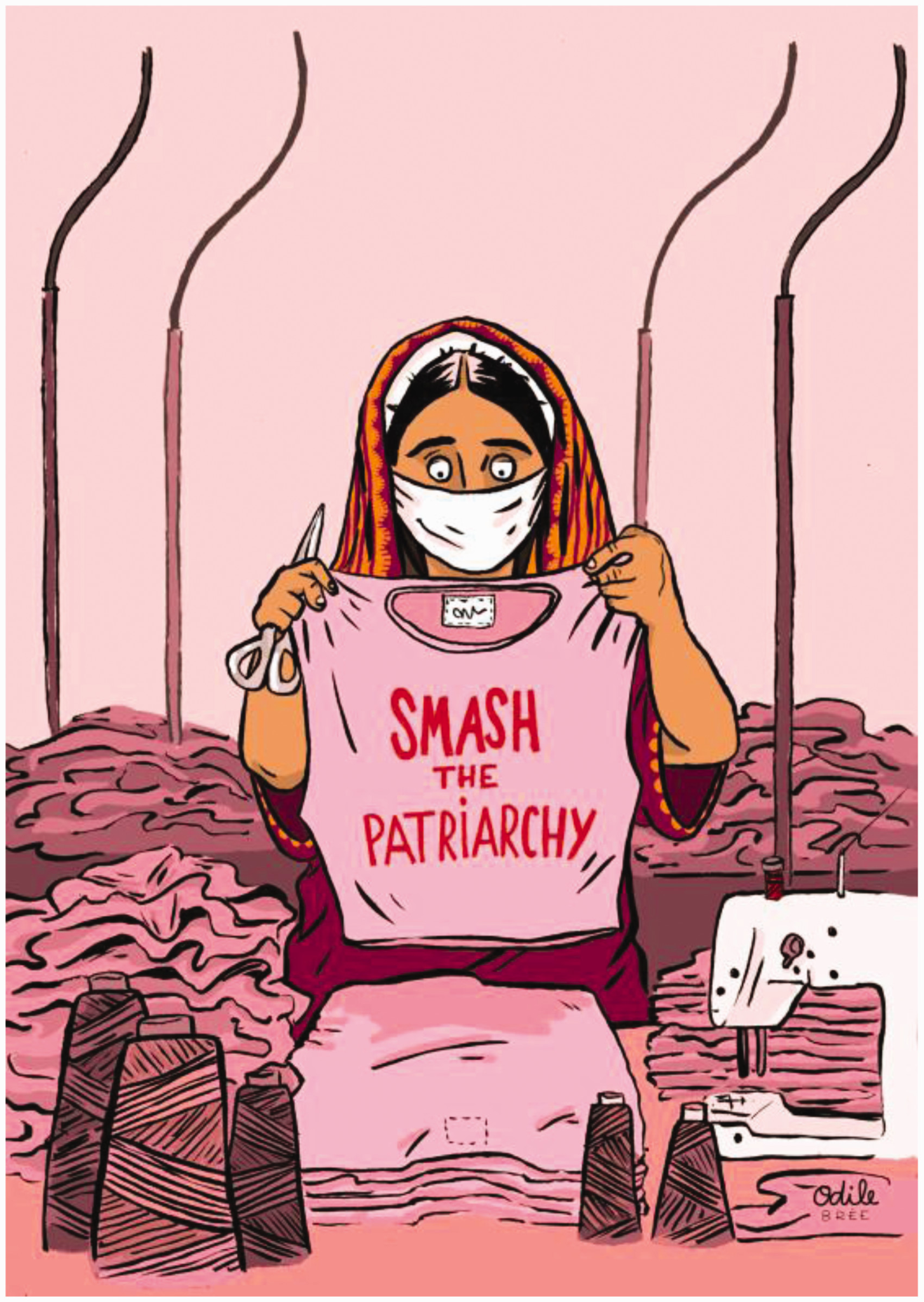
‘Smash the Patriarchy’ is a common phrase by modern-day feminists. Patriarchy does not simply mean men; it refers to a system in a society where there is an unfair granting of power, disproportionately benefiting men (Parisi, 2017). The image depicts a pink shirt with the words ‘Smash the Patriarchy’ and heaps of similar shirts in the background.
It emphasizes the point of challenging societal systems that enhance the existing patriarchy. The color of the shirt (pink) represents a traditionally feminine color, thus reiterating the point that it is all about women. The heap of similar shirts in the background accentuates the magnitude of the feminist movement.
The shirt displays a powerful message conveyed by feminists: we deserve equal rights and opportunities. Visual culture seeks to convey a message to a bigger audience. The shirt aims to influence the viewer to favor the message on display. Proponents of the message detest masculine hegemony (patriarchy) and call for gender equality regardless of race, sexuality, or religion.
Smashing the patriarchy implies the destruction of the androcentric systems of society. In turn, they give women autonomy and self-determination (liberal feminism) or liberate women from capitalistic systems that exploit them (Marxist feminism) (Parisi, 2017). The shirt champions giving women equal rights and sovereignty to be their true selves.
References
Armstrong, E. (2020). Marxist and socialist feminism (pp. 1–24). Study of Women and Gender: Faculty Publications, Smith College.
Baehr, A. R. (2020). Liberal feminism. The Stanford Encyclopedia of Philosophy, Spring 2021 Edition. SEP. Web.
Barker, J. (2017). Critically Sovereign: Indigenous gender, sexuality, and feminist studies. Duke University Press.
BoF (The Business of Fashion). (2021). Janaya future Khan: “What activism really means” | BoFVOICES 2021. [Video]. YouTube. Web.
Kelly, C., Kasperavicius, D., Duncan, D., Etherington, C., Giangregorio, L., Presseau, J., Sibley, K. M., & Straus, S. (2021). “Doing” or “using” intersectionality? Opportunities and challenges in incorporating intersectionality into knowledge translation theory and practice. International Journal for Equity in Health, 20(1). Web.
Parisi, L. (2017). Feminist perspectives on human rights. Oxford Research Encyclopedia of International Studies, 1(1). Web.
The Avatriix Network. (2016). REDx talks – Melina Laboucan-Massimo: “Violence against the earth is violence against women.” [Video]. Vimeo. Web.
T-Rhyme Music. (2018). For women by women – Eekwol & T-Rhyme. [Video]. YouTube. Web.