
Introduction
In recent years, food insecurity has become a global phenomenon expected to persist as progress is made in addressing its contributing factors. Since 2020, factors such as climate change, COVID-19, inflation, lower economic growth, rising poverty, and the war in Ukraine have combined to worsen global food insecurity. Globally, the number of people suffering from food insecurity increased from 135 million in 2019 to 345 million in 2022 (Bozsik et al., 2022).
Although climate change is the primary factor, supply chain disruptions from COVID-19 and the Ukraine-Russia conflict have driven food prices to record highs. Approximately 80% of the global population, mainly affected by food insecurity, is from Sub-Saharan Africa and Southeast and South Asia, where farming families are vulnerable and poor (Pawlak & Kołodziejczak, 2020). Furthermore, a severe weather pattern can push the Vietnamese and the Philippines, already living at the edge of poverty, to acute food insecurity and hunger. The global food production system, which primarily relies on greenhouses, has contributed significantly to a warmer world and increased drought. The Ukraine War has driven up fuel prices and disrupted food supplies, leading to demand and supply issues.
This paper examines the contributions of various elements to food insecurity in developing nations. Food insecurity is likely to worsen as the world continues to warm and other factors come into play. Therefore, unless climate change and other factors, such as inflation, lower economic growth, rising poverty, the effects of COVID-19, and the Ukraine War, are addressed, food insecurity will remain a demand-and-supply issue and grow into a chronic phenomenon in developing nations.
COVID-19
Measures taken to mitigate or control the COVID-19 outbreak severely affected global food supply chains, particularly in developing nations. When the global health crisis emerged, the world was already grappling with food insecurity exacerbated by climate change (Barman et al., 2021). Controlling COVID-19 required nations and states to collaborate in developing the most effective strategies. Unfortunately, some mitigating measures, such as food supply, are subject to restrictions (Workie et al., 2020).
Border restrictions and regional lockdowns prevented the movement of food transportation from one point to another. According to Barman et al. (2021), major disruptions to the food supply chain, caused by restricted movement, affected food quality, pricing, and availability. The closure of hotels and restaurants led to a significant decline in demand for perishable goods, including fresh fruits, vegetables, dairy products, and meat (Barman et al., 2021).
Between March and May 2020, many countries reported food items being thrown away or plowed back to the farms due to a lack of demand (Barman et al., 2021). The restriction on movement made it difficult for fresh and long-life food to reach markets. Consequently, farmers without long-term storage had food that they could neither sell nor use.
Food movement through international channels was explicitly affected by lockdown measures. Most developing countries that rely on imported food have experienced reduced food supplies because nations have had to impose export restrictions to mitigate the impact of COVID-19 (Bozsik et al., 2022). As borders closed, demand for specific foods declined, leading to a corresponding drop in supply (Barman et al., 2021). Most African countries rely on imported staple foods, such as wheat and rice, and export restrictions only make consumers hungrier (Bozsik et al., 2022).
With reduced supply, the prices of locally available food items increased, making them less affordable for people experiencing poverty (Barman et al., 2021). The COVID-19 lockdown slowed local food production, negatively affecting the livelihoods of harvesters and consumers. When yields are slow, the local food supply is disrupted, leading to hunger among immediate food consumers (Barman et al., 2021). Food insecurity worsened after the lockdown because delayed harvests led to food spoilage on farms. Consequently, the starving third-world nations could not find enough supplies from trusted international suppliers.
The COVID-19 outbreak also affected food production systems when workers fell ill. When the illness invaded food processing industries, most workers got ill, forcing the systems to shut down (Barman et al., 2021). Labor-intensive food sectors, which heavily depend on immigrant labor on open farms, were also affected (Bozsik et al., 2022). Many immigrants were unable to travel due to movement restrictions, forcing production firms to shut down indefinitely (Barman et al., 2021). Such conditions disrupted the food supply and further reduced the already limited supply. The prices of these essential items increased, and some low-income earners were unable to afford them.
Lower Economic Growth
When COVID-19 reached various parts of third-world countries, it slowed the already sluggish economy. A nation’s population depends on its economy to achieve food security. Low economic growth leads to minimal cash flow, unemployment, increased poverty, and low wages (Pawlak & Kołodziejczak, 2020). The coronavirus pandemic caused a global economic recession, exacerbating severe consequences in the poorest countries (Workie et al., 2020).
Developing nations are composed of low-income earners who struggle to buy essential food items. In the households of low-income earners, food consumption accounts for 45% of their daily spending (Pawlak & Kołodziejczak, 2020). Lower economic growth reduces the chances of salary or wage increments. Therefore, these earners must divide their small salaries to accommodate all their spending.
Following the global recession, food prices have risen, making it challenging to afford. According to Bozsik et al. (2022), two in five households in Africa and South Asia cannot afford three meals a day. Following low income, households are forced to consume one or two meals daily to survive. These practices lead to starvation and poor health, resulting in deficiencies in essential nutrients.
Lower economic growth also affects farming and food production practices. With limited cash flow, farmers cannot afford fertilizers or field preparation practices. In developing countries, farmers cannot purchase high-priced fertilizers (Erokhin & Gao, 2020). Large-scale farming requires significant investment in plowing, sowing, planting, and land preparation. Large-scale farming ensures high food production and security (Bozsik et al., 2022). Therefore, farmers who cannot afford farming costs produce less and suffer from long-term food insecurity (Erokhin & Gao, 2020).
Low-income nations cannot ensure food security for their population. National food banks do not store food for long because the government is required to release stored food to feed the hungry (Erokhin & Gao, 2020). Low food production from a national perspective means that the government will be liable for feeding the largest population. A low-income, struggling nation also strives to adequately provide for its starving population, thereby worsening food insecurity.
Climate Change
Climate change is a primary driver of global food insecurity, driven by shifting weather patterns. Climate change causes extreme weather patterns, leading to floods and droughts. Climate change is a worldwide problem attributed to the increased emission of carbon gases into the atmosphere (Nyiwul, 2021).
Carbon emissions contribute to global warming, which raises temperatures above normal levels. An increase in atmospheric temperatures changes the frequency and intensity of precipitation. Warmer oceans release more water into the atmosphere, and the moisture-laden air moves over land to form a storm that produces intense rainfall (Nyiwul, 2021). The high-intensity rains fall for a shorter time than expected, resulting in insufficient water for crop growth (Bozsik et al., 2021).
Extreme rainfall also triggers increased flooding, especially in poorly structured cities in developing nations (Nyiwul, 2021). Floods affect farms, destroying crops and making it challenging to grow crops in flooded areas. According to Nyiwul (2021), reduced rainfall levels lead to severe droughts that cause the extinction of plants and animals. The effects of these droughts trigger shortages in animal-based food such as milk and meat. Warmer oceans cause the deaths of sea animals, thus reducing the supply of seafood.
The greenhouse food production system significantly contributes to increased carbon dioxide emissions and climate change. According to Nyiwul (2021), the global food production system is the primary source of biodiversity loss and methane emissions. In other words, greenhouse gases increase the likelihood of global climate change (Bozsik et al., 2022). Unfortunately, the population that contributes the least to gas emissions is the most affected by climate change. Developing nations mainly rely on natural field farming rather than greenhouse irrigation (Nyiwul, 2021).
Furthermore, these nations that already experience high temperatures are affected by worsening weather patterns. To a certain extent, rising temperatures and carbon dioxide levels benefit semi-arid crop growth. However, the crops still need enough water to grow food adequately (Nyiwul, 2021). Henceforth, as temperatures rise, rainfall declines, and droughts persist, developing nations suffer the most from the effects of climate change on food security.
Prolonged droughts cause harvest failures, declines in water availability, livestock losses, and deteriorating pasture conditions. Short-term rainfall does not allow farmers to harvest enough food (Pawlak & Kołodziejczak, 2020). In most cases, farmers who rely exclusively on rain to grow crops typically have enough food only before harvest.
Food security also encompasses the availability of clean drinking water. Consequently, insufficient rains reduce water storage, while floods contaminate drinking water. In dry parts of Africa, livestock die from a lack of pasture and drinking water (Pawlak & Kołodziejczak, 2020).
Such circumstances make it difficult for pastoral farming in pastoral-dependent communities. Furthermore, the loss of livestock reduces the production of dairy products, including meat, eggs, and milk (Pawlak & Kołodziejczak, 2020). In the long term, drought renders local food production unsustainable, necessitating expensive imports (Nyiwul, 2021). Poor people, especially in areas heavily affected by drought, cannot afford costly food, leading to starvation and malnutrition-related health conditions.
Rising Poverty
The rising poverty level in developing nations is closely linked to low economic growth and food insecurity. Low income, unemployment, climate change, COVID-19, and other factors contribute to food insecurity in developing countries. According to the United Nations Children’s Fund (UNICEF) (2022), more than 700,000 children in northern Kenya suffer from malnutrition-related diseases. At least 1.5 million children under five years are currently facing starvation in arid parts of the country (UNICEF, 2022).
The regional government can no longer provide food for the starving and is now seeking urgent food aid. This is among multiple cases of rising poverty in developing countries (UNICEF, 2022). In areas with reduced rainfall and prolonged drought, the population most dependent on buying food in the market is the largest. However, increasing poverty levels make these populations starve and sometimes die of hunger.
The effects of COVID-19 on the economy have made nations with high populations more vulnerable to poverty. As of 2022, at least 648 million people worldwide lived in poverty, spending less than $2.15 per day (UNICEF, 2022). In Africa, countries with the most significant shares of globally extreme poverty are Nigeria (11.9%), the Democratic Republic of Congo (11.3%), Tanzania (4.3%), and Madagascar (2.8%) (World Food Program, 2022).
By the end of 2022, 12% of the Nigerian population lived in extreme poverty, with a daily expenditure threshold of $1.90 (World Food Program, 2022). The health crisis has exacerbated poverty and hunger worldwide, but more in India. According to the World Food Program (2022), approximately 83 million Indians live in poverty, spending less than $2 a day. The pandemic has widened the gap between the rich and the poor, making the poor more vulnerable to food insecurity.
Unemployment has proven to be the primary cause of rising poverty in India. By May 2021, rural unemployment had spiraled to 14.3%, while urban unemployment stood at 14.71%. The majority of the Indian population works in the informal sector. When COVID-19 struck the nation, the largest population either lost their jobs or had their wages significantly reduced. During the lockdown, street vendors, construction workers, domestic workers, and other daily wagers were adversely affected (UNICEF, 2022).
The consequent loss of livelihood exacerbated poverty and hindered the ability to purchase food in the market. The report indicates that among the 73 million poor Indians, three-quarters require urgent food donations from global food donors (World Food Program, 2022). The pandemic, prolonged drought, low-income, and poor farming practices have boosted the increasing poverty level.
Inflation
Inflation hikes the prices of food products, reducing the purchasing power of low-income consumers. According to Arnd et al. (2023), low-income earners are the most affected by inflation because they spend a significant portion of their income on food. Inflation measures the increase in the cost of goods and services over time. When inflation is high, the prices of goods and services spike (Arnd et al., 2023).
When food prices rise, food becomes inaccessible and unaffordable for economically struggling populations, pushing many individuals into poverty. Arnd et al. (2023) state that other challenges, such as food fraud, accompany inflation. Food fraud involves deliberate business activities aimed at deceiving consumers about the integrity of food for personal gain. Developing nations are prone to food fraud, including the sale of fake products and incorrect food measurements.
African nations, including Kenya, Nigeria, and India, have evidence of food fraud. For example, Kenyans have had experiences of plastic rice sold to people experiencing poverty. Nigeria has also fallen victim to palm oil fraud, in which fake oil is produced with red coloring agents to make it appear genuine (Arnd et al., 2023). In India, phony milk is made with detergents, paints, or even wheat and sold to those who cannot afford packaged milk (Arnd et al., 2023). Fake products are often sold at slightly lower prices, and the poor fight to buy them.
Inflation increases currency supply, particularly in foreign exchange markets, thereby reducing a country’s currency’s value (Workie et al., 2020). The currencies of underdeveloped nations are already weak compared to the US dollar. Therefore, the ongoing global inflation only makes their currencies more vulnerable. A weak currency makes it difficult to import goods at favorable prices (Baptista et al., 2022). These import-dependent nations are now purchasing food items at higher prices and selling them at extreme prices, making them unaffordable for low-income earners.
High inflation reflects increased costs of agricultural inputs, such as labor, seeds, and fertilizers. When these inputs are unaffordable, farmers in the countryside, who rely solely on farming for their income, may struggle to afford them. Consequently, they produce reduced crops, record lower harvests, and experience food shortages. Inflation spikes labor and fertilizer costs, making large-scale farmers incur higher production costs. Increased food production pushes the prices of distribution, wholesale, and retail (Baptista et al., 2022). Farmers are forced to increase labor wages or experience labor shortages.
Ukraine War
The Ukraine-Russia War has caused global food insecurity and hunger in developing nations. The blockade of Ukrainian exports to various countries triggered record food and energy prices. Ukraine supplies energy and food commodities, such as wheat and rice, to developing nations in Africa and Asia (Arndt et al., 2023). When the prices of Ukrainian grains increased, some countries imposed export restrictions, exacerbating market shocks and slowing operations, thereby causing global supply unpredictability (Bozsik et al., 2022).
As the war escalates between Russia and Ukraine, Russia has been using food insecurity to threaten the nations dependent on Ukraine for supplies. Since February 2022, food insecurity has been a priority in international political agendas (Arndt et al., 2023). As the UN gathered to find a way out of the food insecurity caused by the war, Russia strategized to block the Ukraine grain exports.
Russia has been using military forces to block and unblock Ukraine’s grain exports at the Black Sea. In February 2022, Russia sent its military to stop Ukrainian ships from leaving the Black Sea. This blockage lasted for four months, causing supply disruptions and shock in African and Asian countries. These nations are forced to rely on small local supplies or seek alternative, higher-priced sources. In July 2022, Russia entered into an international agreement to facilitate Ukraine’s grain exports (Arndt et al., 2023).
However, by October 30, Russia withdrew from the global deal and resumed Ukraine’s grain blockade at the Black Sea. Ukraine reported that 218 ships were blocked on the day: 22 were in loading docks, 95 were stuck awaiting departure, and 101 were awaiting inspections. Although without proof, Russia broke the UN agreement, accusing Ukraine of staging a drone attack on its fleet in the Black Sea (Arndt et al., 2023). The resumption of blockades only means that African and Asian nations will have to purchase wheat and rice at higher prices or go hungry.
Temporary or a Chronic Phenomenon
After analyzing each factor causing food insecurity in underdeveloped countries, the next question to answer is whether food insecurity is a temporary or chronic phenomenon. The six factors, COVID-19, climate change, lower economic growth, rising poverty, inflation, and the Ukraine War, have deteriorated food insecurity in these nations. The most crucial issue is that the Ukrainian war has been ongoing for a year already, and although the two countries are rumored to be planning negotiations, it remains unclear when the war will end (Arndt et al., 2023).
Therefore, it is impossible to correctly predict when the food insecurity caused by the war will end. Many nations are slowly recovering from the effects of COVID-19, but are still dragged down by global inflation. Currently, the continuation of the Ukraine War is likely to exacerbate the state of inflation. All other factors can be easily reversed, except for climate change, which farming significantly exacerbates. Since 1970, carbon emissions have increased by 90%, with agriculture, forestry, and other land-use activities being the second-largest emitters.
The figure below shows that electricity and heat production account for 25%, while agriculture and land-related uses account for 24%. The main proposal to ensure food security in all nations is to increase land use (Baptista et al., 2022). The safest way to farm depends on the natural rainwater (Nyiwul, 2021). However, with changing weather patterns caused by global warming, farmers can no longer rely on rainfall. Consequently, they must depend on irrigation and greenhouse farming, thus releasing more gases.
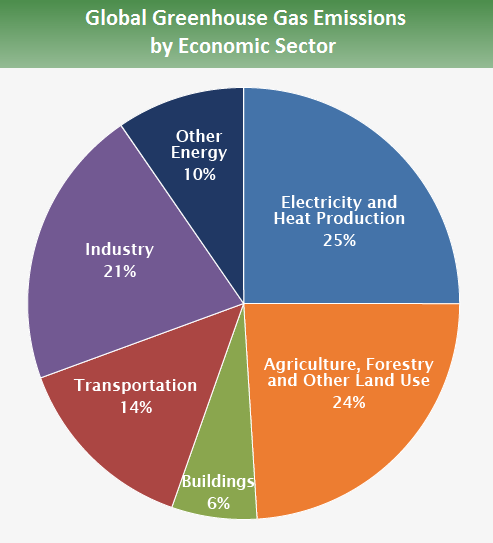
Deforestation is a land-use issue that emits carbon, especially in developing nations where people with low incomes depend on charcoal and firewood for their livelihood. People experiencing poverty, especially in Africa, cannot afford cooking gas; hence, they use firewood and charcoal (Nyiwul, 2021). They also burn and sell charcoal to earn a living. Therefore, deforestation will continue to be a problem in developing regions.
According to Baptista et al. (2022), when deforestation occurs, the cut trees release all the carbon-stored gases they contain into the atmosphere. When trees absorb carbon dioxide from the air, they store it in their trunks, leaves, and roots, and when the trees are cut, more carbon is released into the air (Nyiwul, 2021). In other words, carbon emissions will continue in developing nations.
Developing nations suffer most from climate change despite contributing less to the crisis. According to Nyiwul (2021), Africa contributes only 2% to 3% of global carbon emissions. Ironically, the region is one of the most affected by climate change. Africa and Asia already experience high temperatures, and global warming exacerbates them (Nyiwul, 2021). Therefore, as long as these nations continue to suffer from climate crises caused by the rest of the world, food insecurity will persist as an issue. Climate change is the primary cause of food insecurity, and unless carbon emissions decrease, which is almost impossible in developing nations, food insecurity will remain a chronic phenomenon.
Conclusion
The worsening of major factors contributing to food insecurity will make food shortages a chronic phenomenon. Climate change stems from food insecurity, and following the contribution of carbon emissions by the global farming system, developing nations are unlikely to achieve food security anytime soon. The uncertainty of the Ukraine War makes predicting declining inflation unpredictable, and highly affected nations will continue to suffer from rising poverty and lower economic growth.
Although all countries are slowly recovering from COVID-19, climate change remains a disturbing reality that cannot be ignored. African and Asian nations are highly affected by climate change, where floods, droughts, and farm destruction lead to food shortages. The recent blockade of Ukraine’s grain exports has already caused inflation in import-dependent countries and will likely worsen as long as short rainfall is recorded. Whether food insecurity in these regions is a temporary or chronic issue is not easily answered. Considering that climate change is not expected to end soon, developing nations will continue to experience short-term rainfall fluctuations, and with other factors, food insecurity will remain a chronic phenomenon.
References
Arndt, C., Diao, X., Dorosh, P., Pauw, K., & Thurlow, J. (2023). The Ukraine war and rising commodity prices: Implications for developing countries. Global Food Security, 36, 100680.
Baptista, D. M. S., Farid, M. M., Fayad, D., Kemoe, L., Lanci, L. S., Mitra, M. P., & Unsal, M. F. D. (2022). Climate change and chronic food insecurity in sub-Saharan Africa. International Monetary Fund.
Barman, A., Das, R., & De, P. K. (2021). Impact of COVID-19 in food supply chain: Disruptions and recovery strategy. Current Research in Behavioral Sciences, 2, 100017.
Bozsik, N., Cubillos T, J. P., Stalbek, B., Vasa, L., & Magda, R. (2022). Food security management in developing countries: Influence of economic factors on their food availability and access. Plos One, 17(7), 271696.
Erokhin, V., & Gao, T. (2020). Impacts of COVID-19 on trade and economic aspects of food security: Evidence from 45 developing countries. International journal of environmental research and public health, 17(16), 5775.
Nyiwul, L. (2021). Climate change adaptation and inequality in Africa: Case of water, energy and food insecurity. Journal of Cleaner Production, 278, 123393.
Pawlak, K., & Kołodziejczak, M. (2020). The role of agriculture in ensuring food security in developing countries: Considerations in the context of the problem of sustainable food production. Sustainability, 12(13), 5488.
United Nations Children’s Fund. (2022, July 6). The state of food security and nutrition in the world 2022.
Workie, E., Mackolil, J., Nyika, J., & Ramadas, S. (2020). Deciphering the impact of COVID-19 pandemic on food security, agriculture, and livelihoods: A review of the evidence from developing countries. Current Research in Environmental Sustainability, 2, 100014.
World Food Program. (2022). A global food crisis.