
Introduction
Race is a multidisciplinary concept that has a profound and overarching impact on global civilization. Consequently, the concept has been defined in modern society as a social construct integrating people with common historical, ancestral, and linguistic backgrounds and physical characteristics (Messer & Gonzalez, 2021). Bulatao (2004) identified that such classifications include the main attribute of skin color.
In America, the central themes of race have been construed to group people as either white, black, native American, or Pacific Islanders. With these groupings, there are global social constructs of identity based on color. Prominent in modern political activism and discussions, the phrase “people of color” has become a common term, representing individuals who are not of European descent (Bulatao, 2004). Accordingly, the perpetuated generational trends vilify the white race of society based on the historic impact they symbolize.
Historical Roots of Race and Racism
Anthropological research centers its focus on the matter of racism as an integral component of racial differentiations. Historically, the attribute of racism was most applicable to the trends of slavery that existed globally against the black people in civilization, the majority of whom were African men, women, and children who were enslaved and were being sold by traders at the auction blocks (Waxman, 2019). The visual analysis focuses on the Colston Statue being taken down, and the image of a circa 1830 auction of slaves is a fundamental illustration that represents the history of the origin of race as a global phenomenon that sparked turmoil with an overarching impact on this generation. Thus, the analysis will compare the modern and historic perpetuations of race and racism.
Figure 1 represents significant symbolism of racism in the seventeenth century tied to New Year’s Eve and the auction block. Firstly, New Year’s in modern times is celebrated simply as a time for festivities to make merry in the wake of Christmas. However, tracing the history revealed disturbing aspects of the day. Waxman (2019) stipulated that in the years before the Civil War, it was considered Hiring Day, whereby enslaved people were auctioned for hire on this day, being split from their families. The practice was considered an economic paradigm of the southern Antebellum era, where enslavers and hirers made fortunes by trading the lives of helpless human beings.
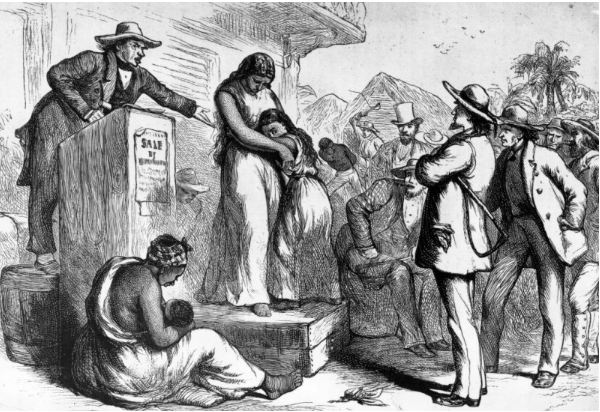
Additionally, Figure 1 marks the unfortunate “Hiring Day” activities, depicting an auction where a lady stands with their daughter, hugging her. Seated on the earth is another enslaved person with an infant in hand. During these times, enslaved people under contract would be exchanged in squares or steps of courthouses. The dynamics of such auctions are typically antecedent to the symbolism of the auction block to black people. Waxman (2019) describes the events in which they were set up on the block, and people would bid for them at the highest price. Race, in this case, was presented as a factor of a lack of humanism for the black communities and the dominance of the white race that had the power to possess people.
Accordingly, the idea of racism is especially affected by the perception of black and white differences tracked through the history of slavery. History is preserved in images, sculptures, plaques, and literature that document these ordeals and are passed down from one generation to the next. Bonam et al. (2018) criticized that racism from white perspectives emphasized its occurrence as isolated incidents. These are principles of denial that the people considered white are underestimating the conceptualization of racism as a component that affects modern society.
Racism, in this case, has been represented as an imperfect genealogy of blacks lacking freedom and being considered brutes. Waxman (2019) documented that the deviants were whipped to force them to submit to commands. In this era, they were considered outcasts meant to serve the dominant race. Based on this view, auctioning people holds significant imprints in modern perceptions linked to replicating the prejudice of a white-dominated society.
Contemporary Racial Inequalities and Public Memory
The impact of racism translates into the modern environment through the existing sociological differences based on history. Modern perspectives reflect on racial wealth gaps presented as a subject of race, especially between the black and white communities (Gale et al., 2020). Shapiro, Meschede, and Osoro (2013) argued that these gaps are the product of racial dynamics that constrain people of color through policy in their communities, workplaces, and schools. These elements influence wealth accumulation, interpreted as a generational deficit in the capacity to bridge these gaps. Thus, race is portrayed as societal dominance exacerbated by the existing racial inequalities.
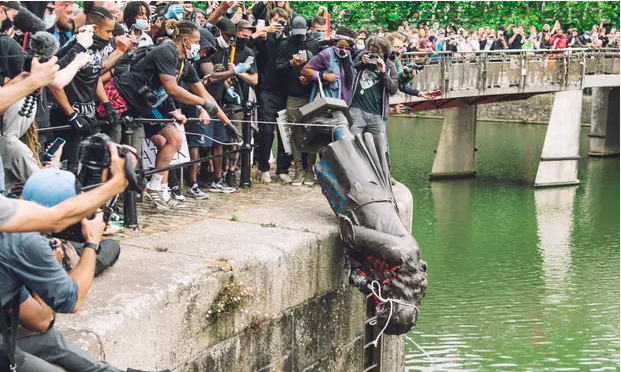
The case of the Colston Statue’s removal provides significant insight into the ideology of race and its impact on modern civilization. Beforehand, it is essential to give context on the case that put Bristol City and the U.K. in headlines, that the Colston statue was based on a slave trader from the 17th century. His actions in history are deemed derogatory to the human rights of the black people he enslaved and auctioned. Nasar (2020) documented that Edward Colston had been responsible for over 84,500 Africans being transported for slavery, and a concurrent death toll of over 19,300 men, women, and children died in his command. Accordingly, the statue, in some ways, presented the element of race imbued in the form of black against white, in which the blacks were a minority group of society at the time.
Consequently, the case raises the debate on whether to protect and leave the statue where it is in Bristol. Racism as a component of history is presented through the statue, as its supporters see it as an opportunity for society to confront and understand its own history, inscribed in stone. Moreover, Nasar (2020) argued that to some community members, the statue was a monumental preservation of history, and its removal was seen as an erasure of history.
The monument was erected as a memorial to Edward Colston, who was advocated and protected by the Municipality. Simultaneously, 175 years after his death, the memorial was erected “Erected by citizens of Bristol as a memorial of one of the most virtuous and wise sons of their city” (Nasar, 2020, p.2). The assumptions presented were a celebration of the person; therefore, his actions in the context of their placement in Bristol’s center presented a symbolic perception of racial identity and prejudice.
The statue was considered a commemoration of a man who improved the city, contributing to the development of schools, hospitals, and churches. The reflection to date extends beyond the statue, as other landmarks are also named with the title, such as Colston Tower, Colston Hall, Colston Street, and Colston Girls’ School (Nasar, 2020). These fundamental attributes are focused on race from a white perspective, which revered his impact on infrastructure and the environments he enjoyed. However, the statue remains a relevant symbol in modern society, particularly in the post-abolition era. The analogy leads to criticism of whether his atrocities were insignificant enough to only focus on his good deed.
Therefore, antiracism activists perceived the statue as an offensive, derogatory symbol, especially for the black communities. As depicted in Figure 2, protestors dropped the statue into a river as retaliation for the oppression through slavery and the inequalities it symbolized (Nasar, 2020). The actions were during a time when racism was a headline topic after the gruesome murder of George Floyd in the US. The actions amidst antiracism protests and their anger led to the rhetoric of dropping the statue into the sea at the city’s harbor.
Nasar (2020) considered the choice poetic, throwing the statue into the harbor where ships docked during the slave trade, positing that the activists threw the statue off Pero bridge. Pero Jones was commemorated as one of the enslaved individuals from Bristol at the time. Thus, the visual analysis presents a circumstance laden with the race dilemma and its impact on modern society. The concept is considered a complex factor, dependent on the impact of racial paradigms on people.
Thus, these events illustrate the notion that race has a profound impact and is a valid concept that affects the global population. Because a death in a different nation sparked a global protest, it is a significant topic. The ordeal served as a premise for understanding the attributions of racism and racial activism. It reviews that it is not just a historic concept, but one that requires sensitivity to the racial inequalities that still exist in modern society. Nasar (2020) stipulated that the British government invested in the 1800s to support the abolitionist movement, with the intention of rewriting history and creating a new narrative as a nation that promoted abolitionism. However, Nasar (2020) reiterated that by virtue of the fact that the dynamics of racial inequalities provided against in legislative law did not imply that the acts of racism completely disappeared.
Therefore, to uncover race and racism, it is critical to consider the association of racial inequalities that have been used to propagate a competition for dominance. Consequently, race is a dynamic attribute that has evolved. The context of its application shapes the meaning of race. In comparison, anthropological views in history on race and racism focused on the black slave trade dynamics.
But in modern environments, race has been a protean element as the concept could be viewed from the Native American scenario that, despite slavery, there were differences of culture and characteristics, and the natives were victims of a social inequality paradigm (Goodman, Moses, and Jones, 2020). Race, in this context, is defined by differences in culture and physical characteristics. The contributions serve as a basis for considering other forms that race has experienced, the race-based auctioning of their rights, and commemorating elements that are not worth celebrating.
Modern societies have experienced race as a factor that imposes compelling restrictions on a particular race. In sports, racial variations are embodied, where it is perceived as an attempt to leverage a race considered athletic and aggressive as a target for profit. Wagner (2020) documented that the NBA was restricted as a white people’s game before 1970, with restrictions limiting black players. Nevertheless, the sport was not profitable and was adapted by integrating charismatic black players.
Griffin (2011) stated that black people were forced to participate in sports and considered a spectacle of brutality and physicality under the colonial gaze. Thus, in its growth, the sport represented a divide in which people were popularized for their natural physical characteristics, but their inferiority in other social spheres remained. The dynamics of the sport represent how those in power are manipulating race and monetizing the cultures and characteristics of people of particular racial identities.
On the other hand, the actions of commemorating an attribute of race and the history of slavery are presented in the case of Charlottesville. A plaque marking an area as a historical location where the slave trade would take place was stolen. The uniqueness of this case lies in the fact that the culprit confessed (Miller, 2020). The 74-year-old perceived the plaque’s placement as disrespectful on the sidewalk, as people trampled on a piece assumed to commemorate the enslaved. The impact of race has multispectral views based on the racial identities of people in society. In Miller (2020), the officer handling the matter as an African American viewed the placement as symbolic, showing the oppression that racism affected black communities. Therefore, the conceptualization of these monuments that mark the negative histories of race is a topic that is intricate and viewed differently by each individual.
Nonetheless, the plaque was replaced, this time placed on the block’s wall. The commemoration of the advent of the slave trade holds symbolic meaning for some who appreciate the memory of what happened as a reminder. The remainder is theorized to inspire people to be different, using the plaque as a symbol of civilization’s progress. The rhetoric portrays race as a permanent and stable element of any civilization, one that may not be erased from history. Visual remembrance of such atrocities presents race as a subject of the past passed on and is experienced by the ages to come. Then those persecuted for their racial identity and the actions of their ancestors for which they are held accountable are an intricate dynamic. The dilemma is the essence of understanding race through racism as a concept rooted in society.
Conclusion
Conclusively, the visual analysis orients the discussion to consider race as a concept firmly based on dominance and oppression. Some might think the object of race has insignificance over time, whereby the history of resulting slavery of the past is eroded. This is not the case, as expressed by the atrocities that continue to occur, morphing in different circumstances. There is, therefore, an urgency to consider race as a sensitive concept that underpins the functioning of society.
People’s distinct physical attributes will be a recurring phenomenon, but the analysis shows that these differences may also be considered an asset to be celebrated. As a result, race is a connotation of diversity that stimulates identity in society. The visual elements in society reinforce the message that race is a social construct that may not be well understood in isolation but only through a multidimensional view of its complexities.
Reference List
Bonam, C.M., Nair Das, V., Coleman, B.R. and Salter, P. (2018). Ignoring History, Denying Racism: Mounting Evidence for the Marley Hypothesis and Epistemologies of Ignorance. Social Psychological and Personality Science, 10(2), pp.257–265.
Bulatao, R.A. (2004). Understanding racial and ethnic differences in health in late life: a research agenda. Washington, Dc: National Acad. Press.
Gale, W., Gelfond, H., Fichtner, J. and Harris, B.H. (2020). The Wealth of Generations, With Special Attention to the Millennials. Brooking Economic Studies.
Goodman, A., Moses, Y. and Jones, J. (2020). RACE: are we so different?. S.L.: Wiley-Blackwell.
Griffin, R.A. (2011). The Disgrace of Commodification and Shameful Convenience. Journal of Black Studies, 43(2), pp.161–185.
Jones, J. (2020). What Bristol should erect in place of the toppled Colston statue. the Guardian.
Messer, R.H. and Gonzalez, G.D.S. (2021). Relationship Between Culture and Race. Encyclopedia of Evolutionary Psychological Science, pp.6538–6540.
Miller, M. (2020). A stolen slave auction plaque shook Charlottesville. But the confession was the real shock. | History News Network. HistoryNewsNetwork.
Nasar, S. (2020). Remembering Edward Colston: histories of slavery, memory, and black globality. Women’s History Review, 29(7), pp.1–8.
Shapiro, T., Meschede, T. and Osoro, S. (2013). The Roots of the Widening Racial Wealth Gap: Explaining the Black-White Economic Divide. Institute of Assets and Social Policy.
Wagner, R. (2020). ‘Shut up and dribble.’ African American English, the NBA, and Instagram. [Masters Thesis].
Waxman, O.B. (2019). ‘The Slaves Dread New Year’s Day the Worst’: The Grim History of January 1. Time.