
Introduction
The present laboratory work evaluated the possibility of manually calculating the frequency of oscillating movements in the resonance state. More specifically, a tuning fork was set in motion, resulting in single-frequency oscillations. The fork’s piston was used to capture the resonance: to do this, the piston mechanism was moved vertically until the sound hitting it was amplified. Increasing the loudness of the sound was responsible for achieving a state of resonance in which the frequencies of the incoming sound wave and the reflected one coincided. The laboratory work verifies this phenomenon employing a simple experiment and calculations.
Data and Analysis
The present experiment was performed at a room temperature of 21.3 °C, which was used to calculate the speed of propagation of the sound wave in space. In particular, using the formula from the instructions gives:
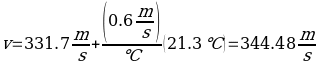
This means that for every second, a sound wave traveled a distance of 344.48 meters in a given room. In addition, the experiment measured two positions of the piston, at which it was possible to obtain a resonant sound. It is worth noting that the distance between these positions, ∆x, was a multiple of half the wavelength, which means it could be used to calculate the frequency. In particular, the Table below shows ∆x for two tuning forks with given frequency values, 1024 Hz and 512 Hz.
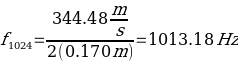
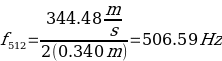
The calculated values of ∆x can be used in the proposed formula to determine the frequency value at the found sound propagation velocity, namely:

That is:
- Each of the two forks sounded only one frequency because they were designed to do so. In other words, the technical features of each instrument excluded the possibility of multi-frequency sounding, so the output signal was pure and homogeneous.
- As stated above, each of the forks sounded at only one wavelength. However, if there was still the use of a device that sounded non-uniform, the output frequencies would be related to each other. In particular, one frequency would produce another because, in this case, the sound wave would reflect off the piston and cause changes in the original frequency of the tuning fork. This would most likely look on the graph either as a large amount of noise around the central peak or as a combination of overtones.
- It is noteworthy that the calculated frequency values were extremely close to the original characteristics of the tuning forks. Thus, a fork that was supposed to vibrate at 1024 Hz was calculated to give a sound wave of 1013.18 Hz. The fork, which was supposed to vibrate at 512 Hz, was calculated to give a sound wave of 506.69 Hz. That is, the deviations were minimal and could be due to the heterogeneity of the airspace in which the waves propagated, the low accuracy of the ∆x measurement, or the outdated equipment of the forks.
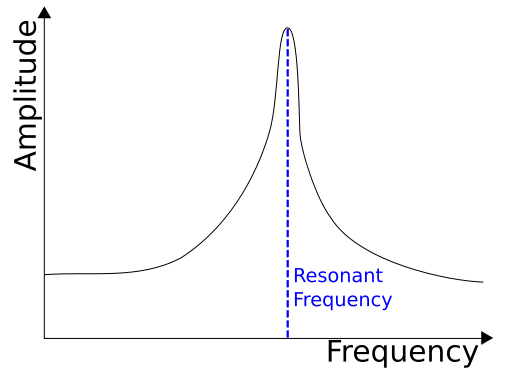
The amplification of a sound signal is based on the process of resonance, which occurs when two waves, not necessarily of a sound nature, are synthesized. Specifically, the oscillation from the fork reached the piston and was reflected from it. The reflected wave reacted along with the original wave and mixed.
If the frequencies of the waves did not coincide, it caused their amplitudes to be suppressed. In contrast, if the frequencies matched, their amplitudes multiplied, as shown in the Figure below (Anderson, 2020). Matching the frequencies is the main manipulation that was done in the experiment by moving the piston position. Since it was necessary to find an ∆x multiple of half the sound wavelength, manually moving the piston to an audible increase in sound volume was appropriate.
Conclusion
In the present experiment, manual manipulation of the piston position was used to determine the state of resonance. In this state, the loudness of the sound wave increased, which means that the incident and reflected waves coincided in terms of frequencies. Calculations showed that the calculated frequencies were close to the original values, which means that the experiment performed is highly dependable. In addition, the work offers answers to post-laboratory questions, deepening the understanding of the resonance phenomenon.
Reference
Anderson, W. (2020). Resonance in physics: Overview & summary. SWH. Web.