
Introduction
In the context of modern corporate management and rapidly changing requirements, successfully implementing strategies requires both transformational change and the selection of suitable adaptation tools. One instrument that has gained prominence is the 7S model of organizational alignment, proposed by McKinsey & Company consultants in the 1980s. It implies a multifaceted foundation for gradual changes within the company, taking into account its main aspects: strategy, structure, systems, staffing, skills, style, and shared values. This paper evaluates the absorption and effectiveness of the 7 S model for formulated change and how these can be influenced by strategic factors. By elucidating the advantages and disadvantages of the 7 S model, one can gain essential insights to inform decision-making and enhance managerial efficiency.
Description of the Chosen Tool
The 7S model of organizational alignment serves as an excellent framework for proposing and implementing changes, enabling consideration of all critical factors. Moreover, it ensures the alignment of elements with the set goal and among themselves, providing a basis for mitigating potential risks. Figure 1 illustrates the interconnected segments within the 7S model, centralizing shared values, as a statement about their inseparability in developing all the other critical components (Dyer et al., 2020). These aspects collectively contribute to the gradual and comprehensive development of the company’s transformations.
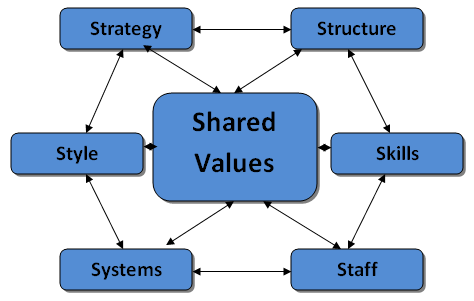
Additionally, seven components are divided into two groups: hard triangle and soft square. Hard components include strategy, structure, and systems, and are considered well-described and studied. These elements are reflected in the company’s approach, corporate plans, organizational structure charts, and documentation (Lima, 2020).
Soft segments comprise style, staffing, skills, and shared values, which take more effort to implement. These features are challenging to convey, constantly change and evolve, and are primarily determined by the people who work in the enterprise (Lima, 2020). Therefore, it is much more difficult to plan or influence those characteristics.
The rationale for choosing a specific tool was its holistic approach to thoroughly assess its effectiveness, readiness for change, and to make informed decisions regarding the management of potential risks and costs accompanying such shifts. The 7S model involves a logical analysis of exemplary use, in which seven dimensions of the enterprise are considered, and an assessment of the company’s current situation and capacity for transformation is carried out (Errida & Lotfi, 2021). Furthermore, it becomes possible to identify weak areas within the organization that may lead to crises and failures.
Assessment of Strategic Influences on the Implementation of the 7S Model
The advantage of the model is that it emphasizes the importance of the human factor in the company’s development and considers the enterprise’s structure not only from the perspective of existing material values. However, it can be a significant influencing factor, potentially negatively affecting the company’s internal and organizational considerations. An excellent example of how the 7S Model was influenced by strategic factors is the case of Boeing under the leadership of James McNerney (Dyer et al., 2020). Faced with ethical misunderstandings within the management chain, followed by further revelations, this significantly impacted the organization’s image.
Nevertheless, McNerney leveraged the 7S Model, based on honesty and resorting to a re-awareness of the element of style. Thus, culturally-centric initiatives and ethical considerations can largely determine the course of a business’s growth (Vitolla et al., 2021). It shows precisely how strategic transformations influence the adjustment of the model’s details to specific conditions.
Explanation of the Usefulness of the 7S Model
As a practitioner and independent scholar working in a dynamic business segment, I see the usefulness of the 7S model, particularly in facilitating thoughtful leadership. Firstly, it enables a leader’s flexibility, allowing them to adjust the balance, synchronize, and align the team, ensuring everyone aims to achieve the same goal. For example, the article by Chmielewska et al. (2022) describes the model’s effectiveness in ensuring alignment between the leadership style and subordinate staff’s expectations. The survey gave the highest scores to the strategy and shared value aspects, providing insight into the criticality of correlating these elements in the holistic management approach I strive to achieve (Chmielewska et al., 2022).
In addition, the model is particularly effective at estimating team progress, thanks to its multi-level structure and adaptability. Hence, the systematic review by Masfi and Sukartini (2022) demonstrates its applicability and suitability for evaluating organizational performance and its correlation with SDG 16 (Sustainable Development Goals) and Accountable Institution. These examples illustrate the broad limits of applying the 7S Model in different business areas and changing goals.
Conclusion
Leading strengths, such as adaptability and comprehensiveness, as well as weaknesses, in particular, human factor exposure and soft element fluctuations, characterize the 7S model as a holistic framework for enabling effective corporate change. Thus, using this model, one can identify ways to improve the enterprise’s internal business processes, optimize the organizational structure, predict potential shifts in each of the seven elements, and effectively implement a suitable leadership style. It is an excellent tool that, with the proper modification, can be used in companies of different directions, sizes, and goals.
References
Chmielewska, M., Stokwiszewski, J., Markowska, J., & Hermanowski, T. (2022). Evaluating organizational performance of public hospitals using the McKinsey 7-S framework. BMC Health Services Research, 22, 1-12.
Dyer, J., Godfrey, P., Jensen, R., & Bryce, D. (2020). Strategic management: Concepts and cases (3rd ed.). John Wiley & Sons.
Errida, A., & Lotfi, B. (2021). The determinants of organizational change management success: Literature review and case study. International Journal of Engineering Business Management, 13.
Lima, M. (2020). Smarter organizations: Insights from a smart city hybrid framework. International Entrepreneurship and Management Journal, 16(4), 1281-1300.
Masfi, A., & Sukartini, T. (2022). Effectiveness of using the Mc Kinsey 7s framework model in assessing organizational performance: A systematics review. Journal of Positive School Psychology, 6(8), 9136-9148.
Vitolla, F., Raimo, N., Rubino, M., & Garegnani, G. M. (2021). Do cultural differences impact ethical issues? Exploring the relationship between national culture and quality of code of ethics. Journal of International Management, 27(1).