Introduction
Electricity plays an important role in the modern world, underpinning many aspects of people’s everyday lives. This element covers residential comfort, uninterrupted operation of commercial enterprises, and, in general, many important processes depend on electricity. In this context, the power distribution industry plays a crucial role, tasked with ensuring a constant and reliable power supply. Through diligent identification, assessment, and mitigation of potential risks, the cooperative strives to mitigate adverse effects and uphold a continuous supply of electricity to consumers.
Risk Strategies
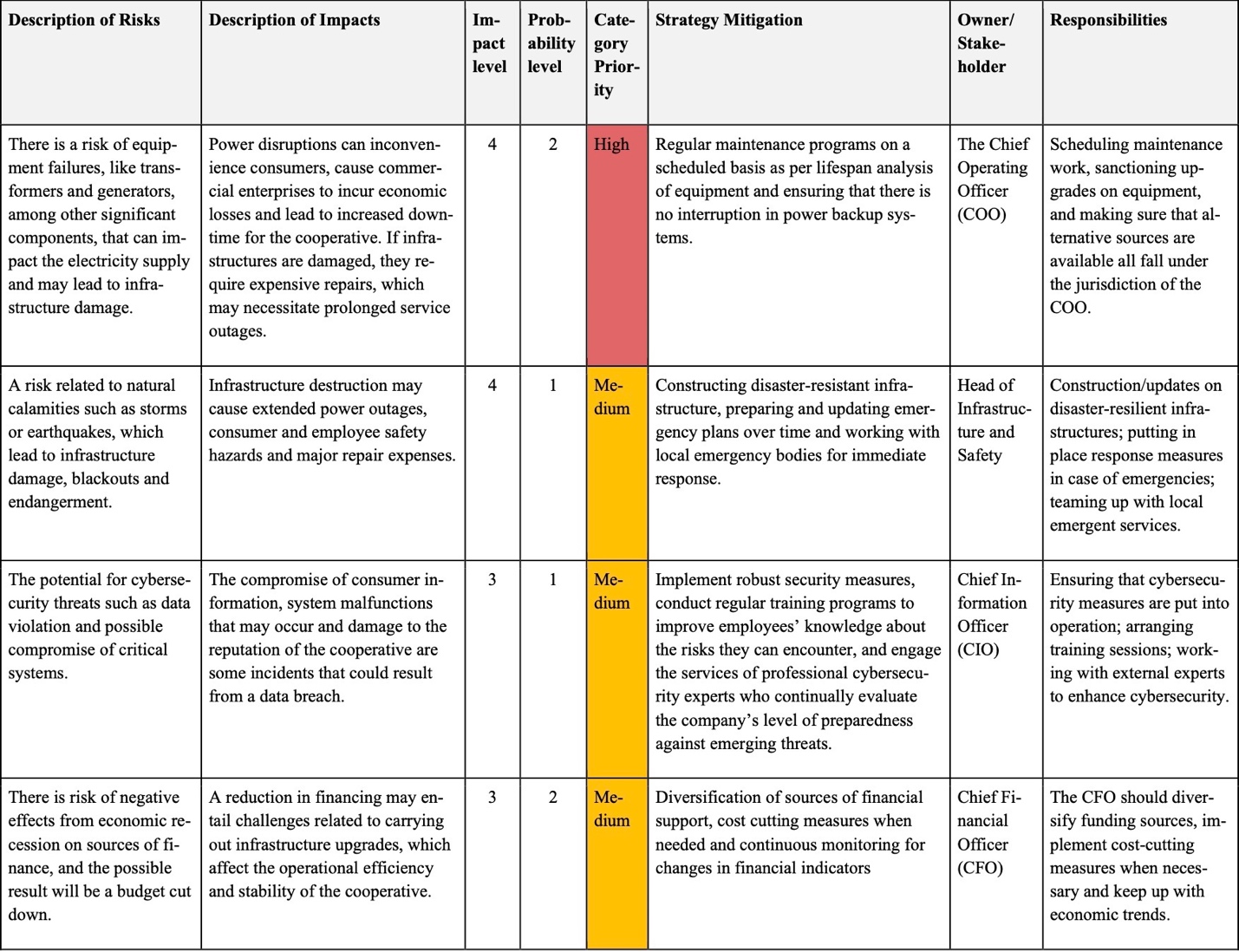
The risk management plan for the cooperative of electrical distribution integrates various tools, techniques, roles, strategies, and responsibilities to create a comprehensive, proactive framework. Utilizing such risk identification methods as brainstorming or historical data analysis will improve the accuracy of potential risk identification during the planning phase (Greening & Bratanovic, 2020). Roles such as head of infrastructure and safety, chief financial officer, general counsel, chief operations officer, and chief information officer identify the need for specialized expertise in managing specific risk domains (See Appendix 1). This shows that their strategies are future-oriented, aiming to prevent disasters.
Security threats pose risks to employees, and reputational risks stem from service failures or stakeholder dissatisfaction. Both groups can cause significant problems for the organization. Labor disputes, non-compliance issues, and economic downturns are additional challenges. Equipment failures, natural disasters, competition, and cybersecurity threats are also among the major challenges for the company (Djenna et al. 2021). In addition, such an analysis enables the development of risk response strategies and the identification of opportunities for improvement in the cooperative’s operations.
Risk Analysis
Once the risks have been identified, the next step is to conduct a thorough analysis and assessment to determine their potential impact and likelihood. This phase of the organization will require the use of structured risk assessment systems to measure each risk against specific criteria and anticipate all possible consequences.
Risks with high probability and criticality indicators should be prioritized for suppression (Bello et al., 2021). This requires increased attention and priority in the formation of risk response strategies. Through systematic risk analysis, the cooperative can skillfully determine the priorities of its risk management activities. This will enable the strategic allocation of resources to mitigate the most critical risks proactively.
Methodology
The project initiation stage lays the foundation for successful implementation. It consists of steps such as predicting the project’s clear goals, which will serve as the main guiding principles. This will accompany every element of achieving the desired result. Stakeholder identification is another necessary aspect, as it ensures that the interests of all involved individuals are considered.
A robust, tailored plan can be laid by defining risk management objectives (Bello et al., 2021). This stage can be outlined by actions such as creating a dedicated risk management team and defining its roles and responsibilities. This is a must for every company because each team member should be engaged in a specific task, not multitasking. Effective communication and collaboration among team members is critical to ensuring that efforts are coordinated and aligned with project goals.
Roles and Responsibilities
After creating a risk management plan, the implementation phase begins, during which the risk response strategy is put into effect. It includes risk mitigation plans developed during the planning phase. Strategies for responding to different risks may differ depending on the area they directly affect (Bello et al., 2021). Also, residual risk monitoring is an important component of the execution phase, as it enables project teams to monitor changes in risk probability and impact and to take measures to respond to unforeseen circumstances. For this stage to be effective and successful, it is worth applying clear communication, cooperation, and coordination among team members.
During execution, the project team diligently implements the risk response strategies outlined in the risk management plan. This includes implementing risk-reduction plans and maintaining flexibility and sensitivity to new risks. Employees should closely monitor residual risks to take action at the slightest change (Bello et al., 2021). This advanced approach allows the team to quickly activate measures in unforeseen situations, minimizing potential disruptions and ensuring the project’s successful completion. Clear communication, seamless collaboration, and effective coordination among project team members are critical at this stage to support timely, effective risk management.
Funding and Critical Analysis
Infrastructure losses from natural disasters and power outages underscore the importance of ongoing preparedness with local emergency services. Cybersecurity threats represent today’s most complex risks, requiring cautionary measures on these critical facilities and their users’ information (Donner et al., 2021). Technology integration across the distribution network should entail ongoing training alongside collaboration with cybersecurity professionals. Economic recessions could disrupt funding sources, leading to possible inadequate upgrades of critical infrastructure, though their likelihood is low. Economic diversification and sound fiscal review processes can only mitigate these financial hazards.
Timing
The planning phase involves developing a detailed risk management plan, which will be key throughout the project. This comprehensive, step-by-step description of actions provides methodologies, processes, and tools for risk management. This approach will ensure the consistency and effectiveness of risk assessment and timely response to them.
At this stage, budget distribution is imperative, as it will determine future success (Bello et al., 2021). Risk identification is a critical process in the planning phase, using various methods such as brainstorming, peer review, and historical data analysis. This systematic approach to risk identification helps ensure that all possible threats, both internal and external, are identified.
Risk Categories
The risks identified in the existing management plan are critical challenges that require scrutiny and strategic remedies. Equipment malfunctions are a significant concern because they can cause severe disruptions to the electricity supply on which consumers depend and affect the cooperative’s operational efficiency. It is vital to have preventive maintenance systems and improvement strategies, as this cooperative relies heavily on intricate infrastructure (Donner et al., 2021). Natural calamities, though infrequent, have a significant impact that requires substantial disaster management measures.
Monitoring & Controlling Process Group
Continuous risk monitoring is a mandatory practice that is essential to the effectiveness of risk management efforts. They should remain clear throughout the project’s life cycle. This primarily involves creating regular progress reports to track changes. This practice will enable the prompt identification of existing gaps or problems and, if necessary, their quick resolution. It will also help to improve certain stages that are not very effective.
Implementing sound response plans can help ensure that risk-trigger monitoring becomes an effective element of the overall response system (Elsayed & Ammar, 2020). Corrective actions can be taken to eliminate deviations from the risk management plan and ensure the success of the entire project. Effective communication and reporting mechanisms are essential to keep stakeholders informed of risk status and progress toward risk management objectives.
Closing Process Group
After the completion of the project, a comprehensive final risk analysis must be conducted to assess the effectiveness of the risk management strategies used throughout the project life cycle. Documenting lessons learned from successful risk management trials and identifying deficiencies provides valuable information for improving future risk management practices.
This reflective process allows project teams to identify best practices, improve existing processes, and implement improvements in subsequent projects. Preparation of all necessary documentation, in combination with risk reduction, can guarantee the adoption of comprehensive decisions that improve the project (Greening & Bratanovic, 2020). Effective risk mitigation ultimately ensures project objectives are met, and tangible value is delivered to stakeholders.
Project Overview
The result involves developing a reliable supply chain, modernizing, and improving existing infrastructure. Enterprises will have the opportunity to improve their efficiency and operational stability. The benefits of the proposed strategies for sustainability and environmental protection are evident (Zhong et al., 2020). There is great potential for effectiveness and perspective of strategic initiatives.
However, risks and uncertainties may also arise in these situations. They are a call for the cooperative to implement systematic, advanced risk management approaches. This project focuses on investigating the best way for an electric distribution cooperative to improve its operations. It offers not only actions such as cooperation with local communities to promote understanding, but also internal operations. This is proof of full coverage of all necessary nuances and of achieving the desired result in all aspects.
Risk Response Planning and Recommendations
After identifying and analyzing the risks, the cooperative can develop appropriate risk response strategies to address each risk effectively. Risk response strategies may include risk avoidance, where possible, to eliminate the likelihood of the risk occurring. Risk mitigation strategies aim to reduce the likelihood or impact of a risk through preventive measures, such as implementing security protocols or strengthening cybersecurity measures (Kitchin & Dodge, 2019).
Risk transfer involves transferring risk to a third party, for example, through insurance or the outsourcing of certain activities. Finally, risk acceptance may be appropriate for low-probability or low-impact risks, where the potential consequences are considered acceptable given the resources required for mitigation. Thus, the main recommendations could be continuous monitoring and the implementation of training programs for employees and senior managers.
Conclusion
Regarding the electric distribution cooperative, an outlined risk management plan can serve as a navigation tool in the complex and changing field of electrical distribution. It is a plan that integrates broad-based tools, techniques, and roles to proactively identify, assess, and mitigate risks. The fact that these strategies include preventive maintenance, disaster-resilient infrastructure, and cybersecurity measures indicates the cooperative’s commitment to ensuring a continuous power supply.
References
Djenna, A., Harous, S. & Saidouni, D. E. (2021). Internet of things meet internet of threats: New concern cyber security issues of critical cyber infrastructure. Applied sciences, 11.
Donner, M., Verniquet, A., Broeze, J., Kayser, K., & De Vries, H. (2021). Critical success and risk factors for circular business models valorizing agricultural waste and by-products. Resources, Conservation and Recycling, 165, 1-11.
Elsayed, N., & Ammar, S. (2020). Sustainability governance and legitimization processes: Gulf of Mexico oil spill. Sustainability Accounting, Management and Policy Journal, 11(1), 253-278.
Greening, H. & Bratanovic, S. B. (2020). Analyzing banking risk: A framework for assessing corporate governance and risk management. (4th ed.). International Bank for Reconstruction and Development.
Khan, A. & Malaika, M. (2021). IMF working paper: Central bank risk management, fintech and cybersecurity. International Monetary Fund.
Kitchin, R. & Dodge, M. (2019). The (in)security of smart cities: Vulnerabilities, risks, mitigation, and prevention. Journal of Urban Technology, 26(2), 47-65.
Zhong, W., Xie, S., Xie, K., Yang, Q., & Xie, L. (2020). Cooperative P2P energy trading in active distribution networks: An MILP-based Nash bargaining solution. IEEE Transactions on Smart Grid, 12(2), 1264-1276.
Appendix
Table 1 – Risk Register