Introduction
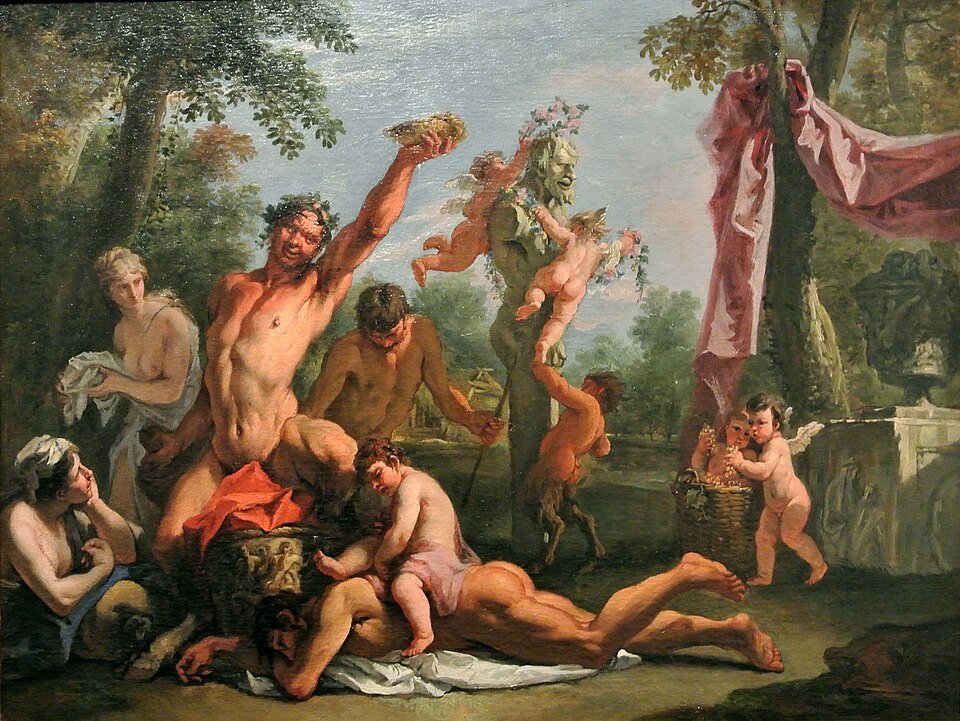
The vivid oil painting A Bacchanal by Sebastiano Ricci captures the essence of the Baroque era, depicting a scene full of festivity and legendary resonance. This piece of art, whose precise date and place of origin in Northern Italy are unknown, adheres thematically and stylistically to the era’s preoccupation with dynamic motion and emotional depth. With oil on canvas, Ricci’s work is currently on exhibit and continues to tell its historical story. This decision enhances the tableau’s vividness and richness of texture.
Painting Analysis
The painting offers an unrestrained vista that is simultaneously a visual extravaganza and a maze of interpretation. A boisterous assembly known as A Bacchanal, heralding Bacchus, is illustrated by Ricci. At the center, a triumphant figure—possibly Bacchus himself—oversees the celebrations with triumphant joy as his adherents give in to the seductive pull of wine and dancing. Each character in Ricci’s portrayal of them is a metaphor for the uncontrollable energies and passions that Bacchic celebrations are known to unleash.
The painting’s picturesque terrain, serving as its backdrop, is ideal for the mythological story. The characters gain a tangible sense of reality through the application of oil on the canvas. Crucially, the medium lets Ricci build up layers of color and texture, constructing a scenario that beckons the audience to immerse themselves in a world of ageless bliss and ceremonial ceremonies. With skillful light manipulation, Ricci creates a shine from within the characters, giving their skin a warm, ethereal luminosity. The dramatic chiaroscuro technique emphasizes the painting’s central theme, a characteristic of Baroque art, and contrasts the revelers with the mottled shadows in the background.
The characters are a study in contrasts; they have soft, rounded flesh, which gives them a lively, dynamic appearance. The artist uses many lines, from the human form’s flowing curves to the small, nearly undetectable lines delineating the branches and leaves that frame the image. The composition’s geometric and organic shapes interact to guide the viewer’s gaze across the canvas, ensuring that every square inch is examined with awe and discovery.
The way color is used in A Bacchanal is quite remarkable. With pink and orange tones set against the rich, deep blues of the sky and the verdant greens of the surroundings, Ricci selects a color scheme that highlights the flesh. The more laid-back background conveys the ephemeral nature of these pleasures, while the warm flesh tones of the characters depict the earthly pleasures they enjoy. The patterns and textures that embellish the foliage and drapery add a layer of intricacy to the composition, further exploring this duality.
Intentional spatial arrangements give Ricci’s paintings a sense of depth and perspective that entices the observer. A testament to Ricci’s deft use of space is the way the figures are positioned, suggesting both the background’s expansiveness and the foreground’s immediacy. Beyond its technical features, the artwork incorporates several design ideas that strengthen its thematic impact. The piece has a rhythm, a physical and figurative flow of movement that reflects both the natural world’s cycles and human tendency toward excess and celebration. Bacchus is the center around which all other aspects revolve, giving the figures an uneven yet harmonic equilibrium.
Without a doubt, the focal point of A Bacchanal is the figure of Bacchus, whose central placement and joyous disposition draw the observer in. The characters’ varying dimensions around him give the image a feeling of scale and add to its energy. Considering Weber’s observations, Ricci’s depiction of Bacchus can be understood as the embodiment of authority and power, not by force but by the collective agreement of his adherents, who voluntarily participate in the Bacchanal. As a result, the picture takes on the symbolic meaning of Weber’s imperative control, in which Bacchus has total power over the situation (153). Nonetheless, the participants’ willing and consistent compliance validates his power.
The collective obedience depicted in the painting is consistent with Weber’s transition to discipline. Even if the celebration is disorderly, there is discipline in the excess and a feeling of order in the insanity that alludes to a shared dedication to the ceremonial elements of the Bacchanal. The participants are constrained by the unwritten laws of their adoration for Bacchus, even as they celebrate freedom and ecstasy; this illustrates Weber’s concept of habituation in the context of mindless, unquestioning obedience (153). Therefore, Ricci’s painting explores the sociological foundations of power dynamics within such events, while capturing the physicality of a bacchanal.
Conclusion
In conclusion, Sebastiano Ricci’s A Bacchanal is a sophisticated piece of art that represents social conceptions of authority and submission and goes beyond its aesthetic appeal. In addition to capturing the essence of its era, this picture provides ageless perspectives on the human condition. The observer is welcomed into a realm where the holy and the mortal coexist, and power is concealed under the pretense of joyous chaos, thanks to Ricci’s skillful manipulation of composition, light, and color. The layers of significance concealed by the painted canvas are revealed by this analysis, highlighting Ricci’s A Bacchanal as a masterwork of technical mastery and profound philosophical insight.
Work Cited
Weber, Max. The Theory of Social and Economic Organization. Translated by Alexander Morell Henderson Talcott Parsons. Oxford UP, 1947.
Appendix