
Introduction
Effective public relations (PR) strategies are essential in contemporary businesses to create a positive brand image, attract customers, and establish connections with partners. One of the most popular approaches in this context used by both small- and large-sized companies is social media. This innovative strategy emerged recently with the development of technologies and rapidly evolved into a critical PR instrument. This paper critically analyzes social media in the PR context, explaining its role, functions, and real-world applications.
Social Media Overview
PR roles and functions constantly evolve in response to new technologies and companies’ needs. Social media is a recent development that has gradually entered the PR market, beginning approximately in 2005 (Page & Parnell, 2020). In general, this strategy refers to direct interaction between companies and their customers through digital platforms, such as YouTube, Facebook, Twitter (X), Instagram, and many others (Page & Parnell, 2020).
Social media has completely changed the way PR works precisely because it enables business-consumer engagement through likes, comments, shares, pins, redirections, and even purchases. Furthermore, unlike many traditional approaches, companies do not need intermediaries, such as media gatekeepers, to communicate with clients.
Social media offers multiple benefits to PR specialists and customers alike. Some of them include 24/7 accessibility, personalized/customizable strategies, a large variety of digital platforms, and a lack of complexity (Page & Parnell, 2020). For example, companies can quickly spread their messages through brief interactions on Twitter, following the principles of network diffusion (Page & Parnell, 2020).
On the other hand, experts report that this echo chamber effect can be detrimental to companies due to the potential for misinformation and negative comments (Cinelli et al., 2021). If someone criticizes the organization on social media, other users might reinforce this idea by sharing, commenting, and generally engaging with these posts (Cinelli et al., 2021). It means that poorly planned social media PR campaigns can frequently harm businesses, which is why it is critical to understand customers’ preferences and public opinion.
There are multiple recent trends regarding social media functions and roles in PR that minimize risks. For instance, Kent and Li (2020) identify six primary principles that should guide PR decision-making when engaging with customers through digital platforms. Namely, social media should prioritize the interests of all stakeholders (including clients) and community engagement, act as a relationship-building instrument, and carefully select appropriate networks (Kent & Li, 2020).
Moreover, PR specialists must remember that social media architecture differs significantly from other media; therefore, they must be better than one-way messengers (Kent & Li, 2020). Ultimately, these principles highlight some of the main benefits and functions of social media, which focus on engagement with individuals and trust building.
Finally, the unique nature of social media’s functions enables multiple flexible strategies that better fit some companies. Wawrowski and Otola (2020) argue that this medium is superior in creative industries, including music, movies, and video games. The authors explain that if the initial perception of the product is positive, social media is the best PR strategy to quickly diffuse this information through popular networks, especially Twitter and YouTube (Wawrowski & Otola, 2020).
In other words, social media is a reliable tool for viral marketing because it offers the widest reach and accessibility among all PR tools. However, as mentioned briefly earlier, this function can be a disadvantage as well if the product’s perception is negative due to the echo chamber effect. In summary, social media is an excellent PR strategy in contemporary businesses with multiple unique roles and functions; however, it can be detrimental if PR specialists do not understand public trends.
Real-World Examples
After examining the theoretical side of social media, it is critical to analyze how companies use it in practice. The first example concerns the video game industry and the Polish company CD Projekt RED. In the 2010s, the firm produced two mainstream games, The Witcher 3 and Cyberpunk 2077, whose popularity soared due to social media PR (Wawrowski & Otola, 2020). Considering the former, the company leveraged the book series’ positive reputation (The Witcher) to launch an echo chamber campaign on digital platforms and draw attention to the new product (Wawrowski & Otola, 2020).
It also had a significant impact on the company’s popularity because the game’s audience was mostly young men, and social media enables targeted advertising based on self-selected networks (Wawrowski & Otola, 2020). As explained, the principles of social media PR led to an approach that established a dialogue between CD Projekt RED and its clients, creating a positive echo chamber. Arguably, no other PR instrument could achieve the same results, attracting gamers and fans of the book series from all parts of the world.
The immense success of The Witcher 3 affected the company’s subsequent games because of high expectations and an extremely positive brand image. The firm’s global reach enabled it to acquire thousands of subscribers for new social media accounts, even though the game had not yet been released (see Table 1). According to Wawrowski and Otola (2020), this is possible because digital platforms maximize creative potential and enable targeted marketing. In summary, social media is an excellent PR choice for creative industries due to its many unique functions and roles.
Table 1 – CD Projekt RED social media statistics (in thousands)
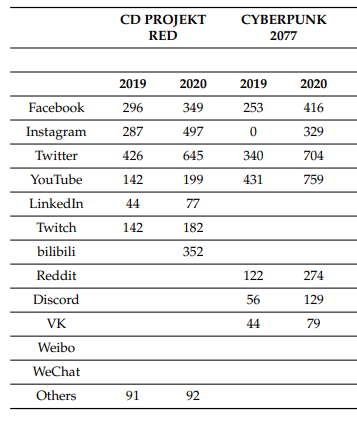
Note. Adopted from Wawrowski & Otola, 2020.
The second example concerns Instagram and luxury brands, including Chanel, Hermes, Louis Vuitton, and Gucci. Instagram is a photo-based platform ideal for marketing visually appealing products. In their study, Torregrosa et al. (2023) found that social media positively impacts customer loyalty, brand image, and sales due to the nature of digital behavior.
On Instagram, the four luxury brands post approximately three times per day, including stories and reels, mostly focusing on their production lines (Torregrosa et al., 2023). Another prominent strategy involves photos of celebrities with luxury goods, such as Chanel bags, to promote products and pique viewers’ interest in the company (Torregrosa et al., 2023). The social media statistics are presented in Table 2 below, confirming the popularity of the PR strategy among luxury brands.
Table 2 – Instagram statistics

Note. Adopted from Torregrosa et al., 2023.
Conclusion
Social media is gradually becoming the most widespread PR tool due to its extensive reach, 24/7 accessibility, direct customer engagement, and numerous other unique features. This strategy maximizes the use of innovative instruments to foster client loyalty and create meaningful connections through likes, shares, and comments. Moreover, its flexible nature is particularly efficient in some industries. For example, global reach in video games and Instagram picture-based approaches for luxury brands are instrumental in academic research. In conclusion, social media is immensely helpful in contemporary PR, and its popularity is likely to increase over time.
References
Cinelli, M., De Francisci Morales, G., Galeazzi, A., Quattrociocchi, W., & Starnini, M. (2021). The echo chamber effect on social media. Proceedings of the National Academy of Sciences, 118(9).
Kent, M. L., & Li, C. (2020). Toward a normative social media theory for public relations. Public Relations Review, 46(1).
Page, J. T., & Parnell, L. J. (2020). Introduction to public relations (2nd ed.). SAGE Publications.
Torregrosa, M., Sánchez-Blanco, C., SanMiguel, P., & del Río Pérez, J. (2023). Instagram: Digital behavior in luxury fashion brands. In International Conference on Fashion Communication: Between Tradition and Future Digital Developments (pp. 14-26). Springer Nature Switzerland.
Wawrowski, B., & Otola, I. (2020). Social media marketing in creative industries: How to use social media marketing to promote computer games? Information, 11(5).