
Introduction
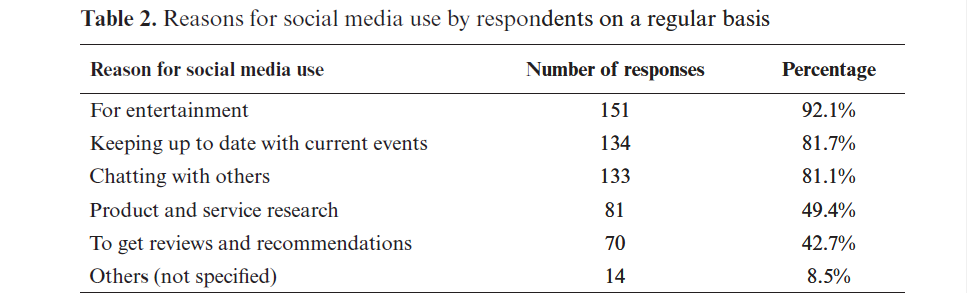
The benefits and drawbacks of social media are constantly debated. By a show of hands, how many people here use social media for at least one hour each day? Judging by the number of hands raised, most of us regularly use social networking sites. In Table 2 below, Turner and Amirnuddin show that the most common reasons people use social media are for amusement, following current occurrences, and chatting with others (41). It was found that respondents utilize social media for a wide variety of purposes and that they are adept at multitasking and displaying cross-platform engagement, using multiple social networking sites for different purposes at the same time.
Today, I will discuss some of the benefits and drawbacks of using social media. Regardless of their age, your closest friends and family members could be at risk in the virtual world of social media, and I want everyone to be aware of this. However, Shane-Simpson and Bakken state that the use of social media to connect with a loved one or friend who lives far away is lovely (3).
Having experienced the cyberbullying of my mother over social media, I know it is terrifying to think that our loved ones, especially our children and elderly relatives, may be at risk of scammers and sexual predators. To make educated decisions concerning one’s use of social media, one must be aware of both the advantages and disadvantages. Since we now understand what we are going to talk about, let us start by looking at the benefits of social media use that can improve one’s quality of life.
Body
The Advantages of Using Social Media
Global Reach
Social media is a wonderful tool to keep in touch with those we may not be able to see very often in person. Creating a successful worldwide marketing campaign may be time-consuming, costly, and difficult to execute using conventional methods. In contrast, the potential audience is enormous because digital marketing occurs online. Even a small local business owner may reach customers worldwide with Internet applications.
Increased Engagement
Enhanced interaction is one of the most valuable benefits of social networking sites. Healey asserts that it is also a great way to connect with distant relatives and long-lost pals (13). By using social media, people can share their unique perspectives and skills with a much larger audience.
Information Availability and Cutting-Edge Research
The widespread use of social media has made it easier for consumers to keep up with world news and the exploits of their peers. Social media, in contrast to traditional media such as television, radio, and newspapers, gives voice to the masses and facilitates the dissemination of truthful information. It helps spread the word about breaking news happening all around the world.
Facilitates Noble Initiative
Social media is a powerful platform for advocating for charitable causes, such as financial support for people battling cancer. Social media is the quickest and easiest way to spread the word about any worthy cause, and anyone can use it to facilitate dignified schemes.
Shortcomings of Social Media Use
After discussing the benefits of social media, we shall now look at the drawbacks that can negatively affect one’s quality of life. If not controlled, the use of social networking sites may generate problems such as addiction and cyberbullying or affect one’s health.
Addiction and Misuse of Time
When you use social media for an extended period, you develop a compulsive need to monitor what everyone else is up to. The fear of missing out occurs when a person has an exaggerated sense that others are enjoying themselves more than they are. Since people want to feel better, they check their notifications every second.
Harassment and Bullying in Cyberspace
Those who utilize social media platforms are vulnerable to various risks, including stalking, identity theft, scams, attacks, and the inappropriate use of their personal information. Engine emphasizes that most of the time, users are responsible when inappropriate material is made public (8). The misunderstanding stems from the fact that many people still do not know the difference between their private and public information online.
As a result, the time-sensitive information is removed, and it may have caused damage to a person’s reputation or career. Turner and Amirnuddin affirm that teens can use social media sites to harass, threaten, and defame others (43). Cyberbullying and harassment are two examples of inappropriate conduct that can flourish in the anonymity of social media.
Harm to Emotional Well-Being and Sense of Worth
Hughes avers that emotional connections are hampered by the prevalence of social media because all communication takes place via networking sites, which might limit the range of expressions shared between people (par. 3). People lose their creativity when they text each other instead of going to meet one other physically to say hello.
Methods for Ethically Engaging in Social Media Platforms
After talking about the advantages and drawbacks of social media use, we will now discuss how one can enhance the associated benefits and minimize the shortcomings. There is a need to regulate social media use and improve privacy controls on social networking sites to ensure that one exploits the gains and mitigates the negative effects.
Controlled Application
Individuals should exercise self-control in their social media activities by restricting themselves to helpful platforms, avoiding negative groups, and following only trustworthy links. Regulating digital communication technologies like social media can ensure users benefit from applying them rather than the potential drawbacks.
Observing Consumption Patterns
Limiting daily use to about thirty minutes has been linked to improved health, decreased isolation, and less depression. Australian Government establishes that the time you devote to social networking sites should be as limited as possible (par. 2). Hughes asserts that teenagers in the United States are spending a significant portion of their day gazing at their smartphones, with the vast majority, 90%, owning one (par. 7). Keeping track of how much time you spend on your phone, viewing reports in real-time, and limiting specific apps to particular blocks of time is easy if you own a smartphone.
The Confidentiality Context
Maintaining a secure social media presence is essential; you should be familiar with the many privacy controls available on each platform you use. You can control who may view your profile, messages, and images on Facebook. Site policies may shift from time to time, so be sure your preferences are always up to date. In addition, watch what you have made public about yourself.
Now that we understand how we can maximize the benefits of social media use, we shall move to the concluding remarks.
Conclusion
Recognizing the benefits and drawbacks of social media use is crucial to make well-informed choices about your participation. Today, we have learned that social media has the potential to be a helpful resource for building relationships and gathering knowledge, but irresponsible use could have a detrimental impact on our psyches. Limiting our time spent on social media, being selective about what we share, and striking a healthy balance between our online and offline lifestyles will help us get the most out of the platforms while minimizing the adverse effects.
Works Cited
Australian Government. “Social Media for Business.” Business, Web.
Engine, Content. “Social Media: Pros and Cons.” CE Notices Financiers, Web.
Healey, Justin. Social Impacts of Digital Media. Vol. 415, The Spinney Press, 2017.
Hughes, Virginia. “Does Social Media Make Teens Unhappy? It May Depend on Their Age.” The New York Times, Web.
Shane-Simpson, Christina, and Tatiana Bakken. “Students’ Fear of Missing Out Predicts In-Class Social Media Use.” Teaching of Psychology, 2022, pp. 00986283211060752, Web.
Turner, Jason, and Puteri Amirnuddin. “Social Media Privacy and the Law: Perspectives from Malaysian and UK Consumers.” Search: The Journal of the South East Asia Research Centre, vol. 10, no. 2, 2018, pp. 31-58. ResearchGate, Web.