
Introduction
The economy of the United Kingdom has managed to recover from the COVID-19-associated financial disruptions due to the measures of emergency support aimed at projecting jobs and income. However, the economy is slowing down due to supply shortages and increasing inflation rates. Therefore, the country’s fiscal policies must address the ongoing tightening by establishing well-targeted short-term support to populations vulnerable to rising living costs, sustaining growth, and managing the significant need for investment. This paper aims to provide a detailed economic report focusing on the UK’s GDP growth rates while also studying the connections between this indicator and unemployment and inflation rates.
Annual Gross Domestic Product Growth Rate
The annual gross domestic product (GDP) growth rate represents the yearly average rate of change of the indicator within a national economy at specific market prices, estimated based on a constant local currency throughout a specified period. It signifies the gaps between GDP values from one period to another as a proportion of the GDP from the previous period and is usually multiplied by a hundred (WHO, 2023). Notably, the GDP growth rate can differ from the actual growth rate between the two periods.
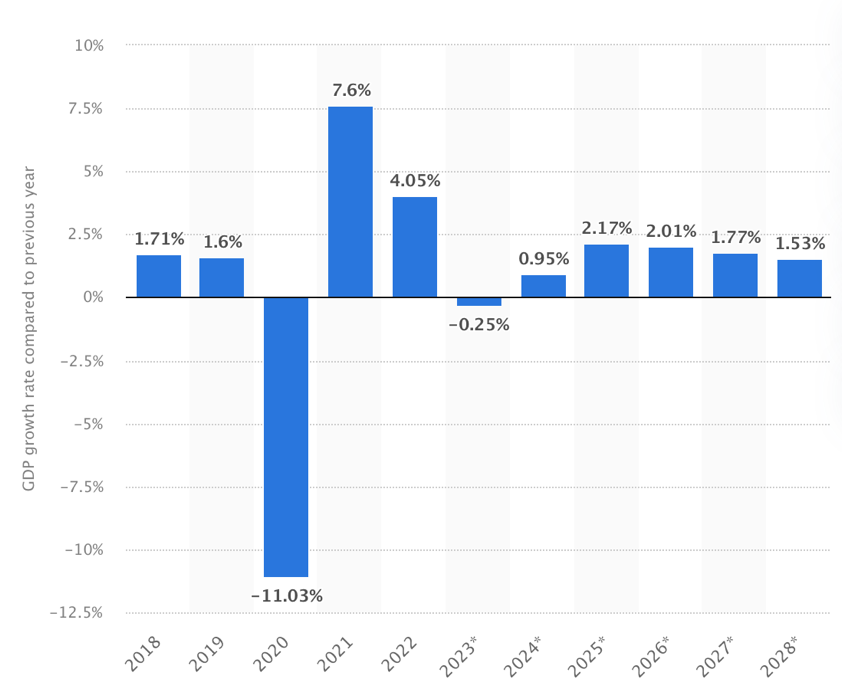
The graph above illustrates the real GDP growth rate in the country between 2018 and 2022, while the projections are available until 2028. In 2019, the growth rate decreased compared with the previous year and plummeted to 11.03% in 2020, which is indicative of the adverse impact of the COVID-19 pandemic on the UK’s economy (Statista, 2023b). This was the worst financial recession in the last hundred years (Partington, 2022). Based on the historical statistical data from Macrotrends (2023), the annual change in the GDP growth rate between 2019 and 2020 was -12.64%. As the country’s economy adjusted to the new context and the government implemented emergency stabilization measures, the GDP growth rate increased to reach 7.6%, which represented an 18.56% annual change compared with the previous year (Macrotrends, 2023a).
Fiscal Policies
Fiscal policies implemented in 2020 played a crucial role in helping businesses and the population get through the economic crisis. The fiscal polity response entailed implementing a budgetary intervention worth £192.3 billion, or around 10% of GDP (Scottish government, 2020). In addition, the UK was among the advanced economies that announced fiscal stimulus measures to facilitate quick economic recovery when the impact of the pandemic began decreasing in the summer (Scottish government, 2020). The sectors of the economy that were the most affected in the country included those that depended on social contracts, such as hospitality and entertainment.
Due to the increasing number of restrictions associated with the pandemic and the national lockdown in England, the UK government had to implement several economic support measures. Specifically, the Job Retention Scheme (JRS) was carried out in England, Scotland, Wales, and Northern Ireland and aimed at helping workers not in a position to maintain their current workforce because of the operation disruptions due to COVID-19. Eligible employers could apply to HM Revenue and Customs to receive grants toward the costs of employment for individuals temporarily out of work or working reduced and part-time hours. In addition to JRS, the Kickstart scheme was implemented in England, Wales, and Scotland, targeting 16-24-year-old individuals who had been claiming Universal Credit and risk experiencing long-term unemployment. For smaller businesses, Statutory Sick Pay (SSP) refunds were implemented, covering companies with fewer than 250 workers that would be able to pay up to two weeks of absence due to COVID-19.
Economic stimulus measures that allowed to stabilize the GDP growth rate included the Coronavirus Business Interruption Loan Scheme for smaller businesses, the Coronavirus Large Business Interruption Loan Scheme, and the COVID-19 Corporate Finance Facility. The UK government allocated a Future Fund for high-growth companies to facilitate business growth and improve the GDP growth rates. The fund entailed a £500m scheme of loans to ensure that companies with high growth in the country get the investment they need to continue their work during a crisis. The issued loans were intended to automatically transform into equity on an organization’s subsequent qualifying funding. The Bounce Back loan scheme for small businesses was implemented to cover small organizations to continue operations.
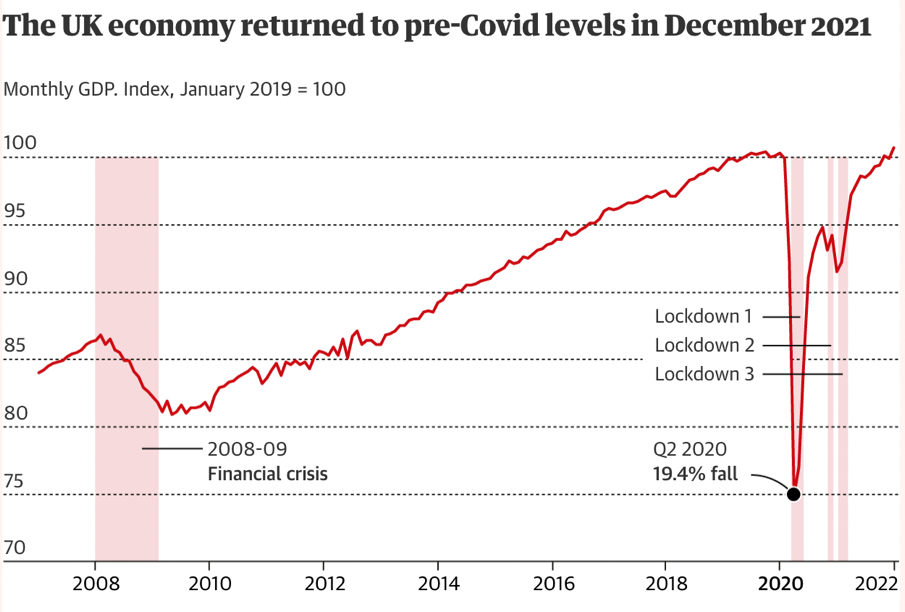
In general, the UK government needed to implement a sustainable recovery policy to accelerate the restart of businesses, including domestic tourism, encouraging domestic holiday travel while reducing reliance on cars. In February 2021, the Prime Minister outlined a “one-way road to freedom” during which schools reopened, with non-essential retail stores reopening. Improved business confidence in 2021 was associated with an upward revision in estimating new household savings. Only in December 2021, the country’s economy returns to the pre-pandemic levels, as seen in the graph below:
The Bank of England set the objective of getting finances back on their route as one of the main budget themes due to the £261.4 billion budget deficit (How strong might the UK’s post-Covid economic recovery be? 2021). Markets had priced in the potential of the Bank of England to cut the interest rates below zero earlier in 2021. The bank’s committee maintained rates and asset purchases on the same levels due to the better news on vaccinations, the plans to reopen the economy, better-than-expected growth, and increased inflation on a short-term basis.
Unemployment and Inflation in the UK
The unemployment rate represents the number of unemployed individuals as a percentage of the labor force, which is the sum of the unemployed and employed. According to the Macrotrends (2023b) data, the unemployment rate in the United Kingdom was 3.74% in 2019, a 0.26% decline from the previous year. However, as the pandemic hit, the rate increased to reach 4.47%, which was a 0.73% rise from 2019 (Macrotrends, 2023b). In the following year, 2021, the unemployment rate was 4.53%, a 0.05% rise from 2020 (Macrotrends, 2023b). By February 2023, the unemployment rate in the UK was 3.8, which was retained in the previous three months and represented the lowest rate since 1974 (Statista, 2023a). There are several reasons for the country’s decreasing rate.
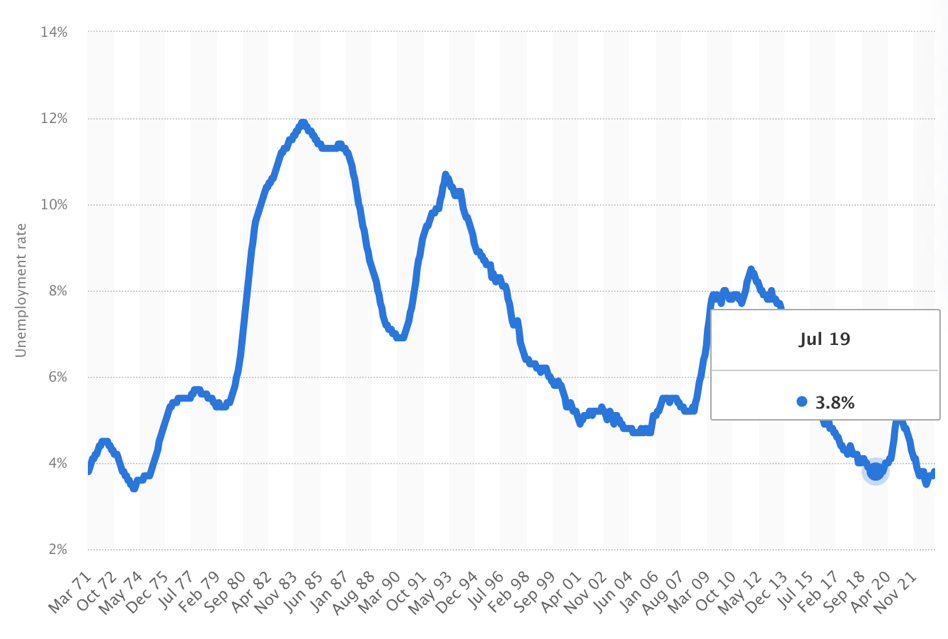
As seen in the graph, the rise and fall in unemployment rates is associated with the country’s economic situation due to the COVID-19 pandemic. Thus, in contrast to the three winter months in 2021, when the unemployment rate was 5%, the highest since August 2016 (Statista, 2023a). As a result of the remedial economic efforts of the government and the reopening of most businesses, the unemployment rate began falling. Nevertheless, the labor market is expected to cool down by the end of 2023 as the number of vacancies is declining (Statista, 2023a).
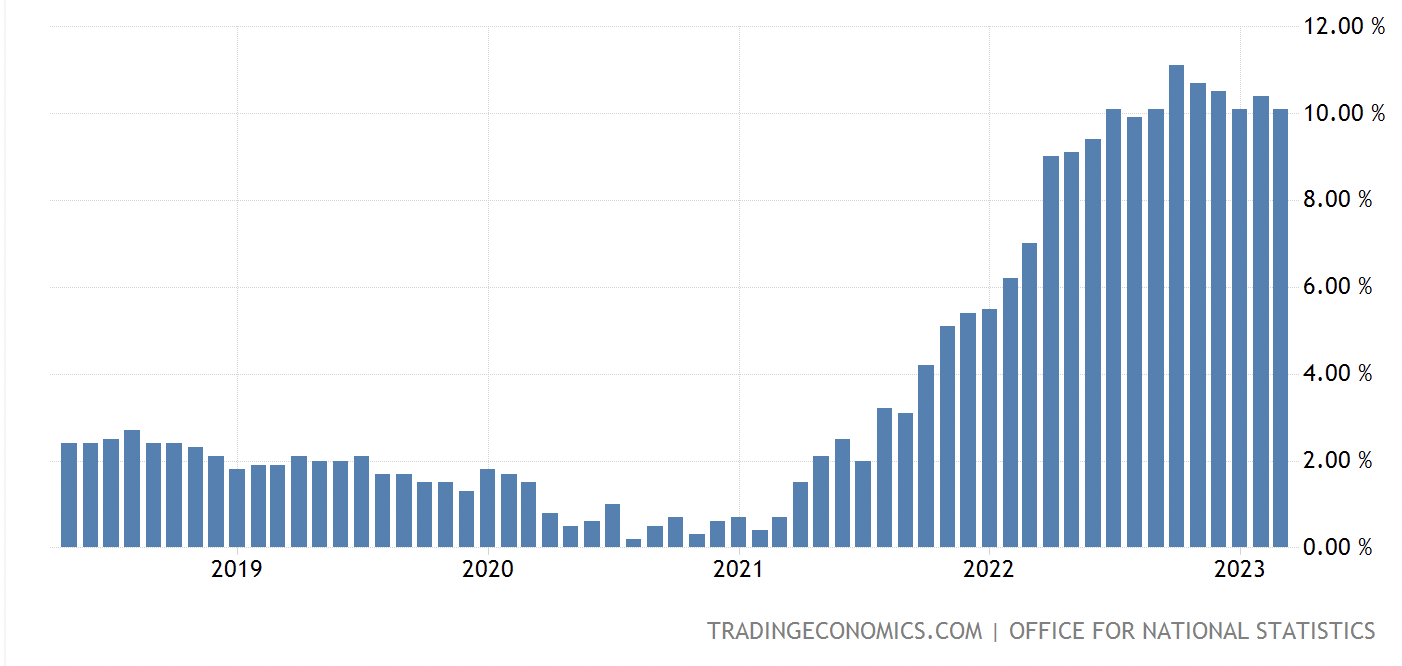
Inflation rates have increased significantly between 2019 and 2023, with a notable dip occurring in 2021 before witnessing a rise (Trading Economics, 2023). Toward the end of 2022, the highest inflation rate was 11%, likely correlated with the financial crisis in Europe associated with the Russian invasion of Ukraine (Trading Economics, 2023). In February 2023, the annual inflation rate averaged 10.4%, 0.3% from 10.1% in January (Trading Economics, 2023). Overall, the financial burdens and rising costs did not allow the government to maintain inflation on the pre-COVID-19 and during-COVID-19 indicators after the pandemic.
Conclusion
There is a negative relationship between unemployment and inflation rates, inflation rates, and GDP growth. However, the association between unemployment and GDP growth is positive. To summarize, the economic well-being of the United Kingdom was significantly affected by the COVID-19 pandemic, which caused a significant disruption in business operations, leaving people without work, lowering their purchasing capacity, and leading to higher inflation.
Reference List
How strong might the UK’s post-Covid economic recovery be? (2021). Web.
Macrotrends. (2023a) U.K. GDP growth rate 1961-2023. Web.
Macrotrends. (2023b) U.K. unemployment rate 1991-2023. Web.
Partington, R. (2022) How has the UK economy fared in the two tumultuous years since Covid? The Guardian. Web.
Scottish Government. (2020) Coronavirus (COVID-19) – UK fiscal path: update – November 2020. Web.
Statista. (2023a) Unemployment rate in the United Kingdom from March 1971 to February 2023. Web.
Statista. (2023b) United Kingdom: Real gross domestic product (GDP) growth rate from 2018 to 2028 (compared to the previous year). Web.
WHO. (2023) Annual GDP growth rate. Web.