
Introduction
The purpose of this work was to study the kinetics of motion of a smart cart, which was propelled by adding the mass of a suspended weight. The cart moved on a horizontal plane without any additional reinforcement; it follows that only the gravity of the weight suspended on a thread to the cart made the device move forward. Using a digital device, information about the kinetics of the cart was recorded: this included values of the applied force (in N) and values of acceleration (in m/s2). Thus, this lab work was designed to investigate the relationship between the weight of the load and the applied force, as well as the acceleration of the smart cart.
Data
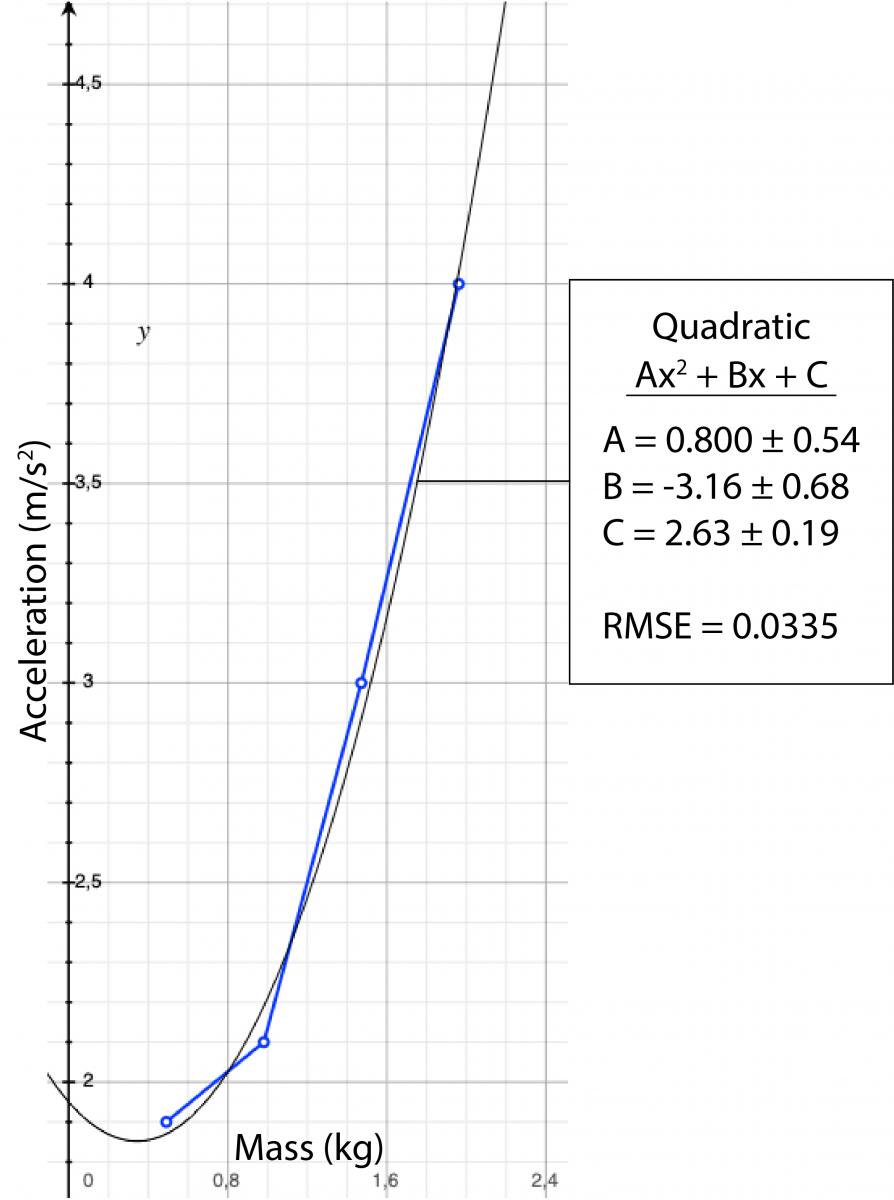
Table 1 below shows the results of direct measurements of the acceleration of the cart as a function of the weight of the weight that was suspended from the device. The pattern is, at first glance, obvious: as the weight of the weight was increased, there was a decrease in acceleration. In other words, the smart cart accelerated slower when the mass was maximum. A visualization of this relationship is shown in Figure 1: although the relationship is not strictly linear, a linear approximation gives reliable results for this set because the RMSE appears to be extremely low (Wheeler, 2021). The linear regression equation for the two variables is y = -0.0022x + 2.3804, which implies that as the mass of the weights increases by each gram, there is a natural drop in an acceleration of 0.0022 m/s2. The Y-intercept, in this case, makes no physical sense since it defines an impossible scenario in which, at zero mass (no motion predictor), there is a nonzero acceleration of the smart cart at rest.
Table 1. Results of direct measurements of acceleration as a function of the mass of the weight
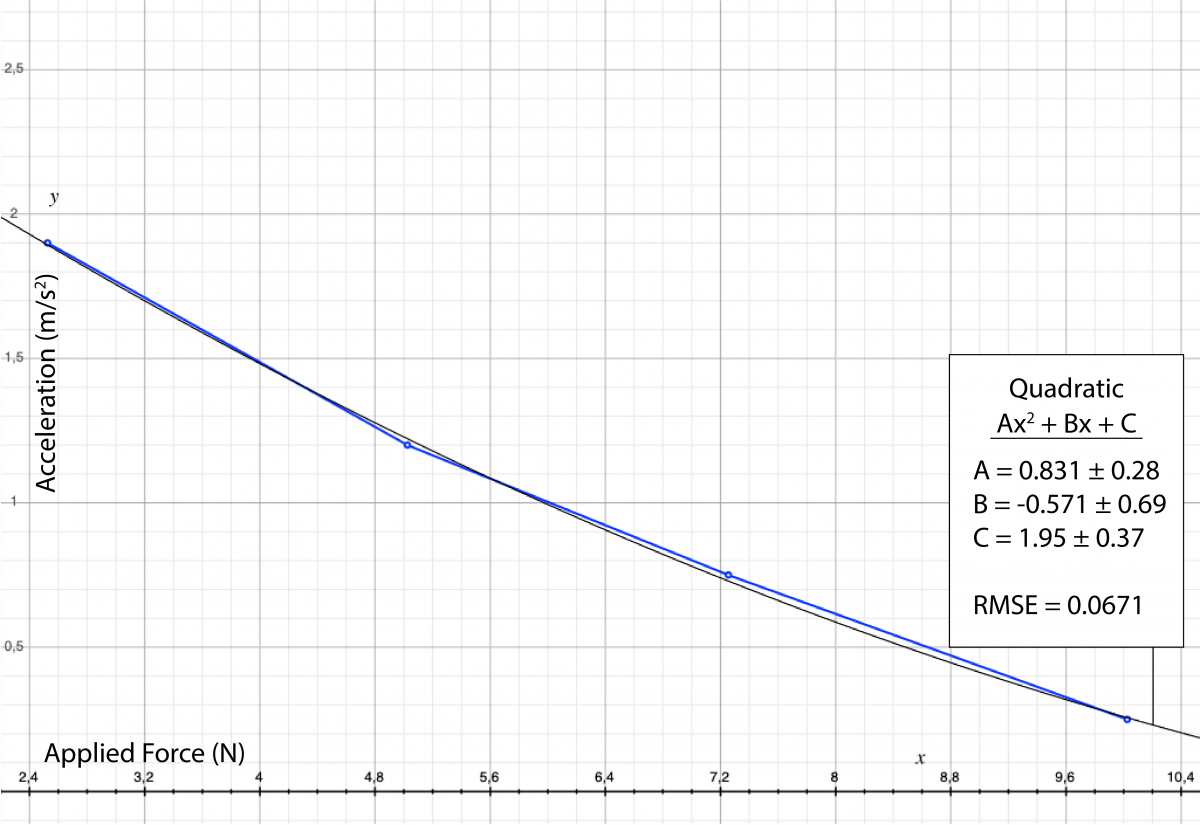
An additional relationship analysis was performed for the pair of variables of acceleration and applied force. In this case, it is worth understanding that the only force that caused the cart to move was the gravity of the weight, F = mg. Since the force depends on the mass of the weight, and it has been shown that mass and acceleration are related almost linearly, one would expect that acceleration would also depend linearly on the applied force. As can be seen in Table 2, as the applied force increases, so does the acceleration of the cart. The relationship is visualized in Figure 2: the linearity was not as strict, but the level of error was still low. The linear regression equation was defined as y = 1.4679x + 0.95, from which it follows that as the value of the applied force increases for every N, there is an increase of 1.4679 m/s2 in acceleration. As before, the physical meaning of the y-intercept was missing since there is no nonzero acceleration under conditions of zero applied force.
Table 2. Findings from direct acceleration measurements in relation to applied force
It is easy to see that the acceleration was linearly proportional to the applied force and inversely proportional to the mass of the load. This is in complete agreement with the theoretical expectations postulated by Newton’s second law: F=ma → a=F/m. It follows that the results obtained satisfy well-known physical concepts and, combined with a low level of statistical error, demonstrate a high level of reliability of the conclusions.
Conclusion
The purpose of this paper was to determine the nature of the physical relationship of acceleration to mass and applied force. The motion of the smart cart was motivated by the addition of mass weights. It was shown that acceleration is inversely but linearly dependent on mass and directly proportional to the applied force. It follows that the findings are consistent with Newton’s second law and show reliability. The errors associated with the non-ideality of the linear form of the dependence (RMSEs ≠ 0) are determined by both errors and uncertainties in the measurements.
Reference
Wheeler, W. (2021). Evaluating linear regression models using RMSE and R². Medium. Web.