
Introduction
The complex structure of human memory has been the subject of scientific research for many years. In particular, short-term visual memory is organized in a complex manner. Luck and Vogel propose differentiating human-observable material into objects and their features in the simplest tests, represented by the colors and orientations of classical geometric figures (1997). These researchers’ results showed that a person can accurately store information about the features of at least 4 objects without placing much strain on memory resources (Luck and Vogel, 1997).
Further work introduced many additional determinants of memory resource expenditure into this problem – eye movements, the original objects’ complexity, and much more (Bays & Husain, 2008). By that time, the limits of human short-term memory were still an unsolved problem in the field, but resource factors were being considered in increasing detail, with proposed models and conclusions often contradicting other similar studies (Bays & Husain, 2008; Pavlov & Kotchoubey, 2022; Zhang & Luck, 2008). In this regard, a specific error suggested itself due to a person’s subjective abilities, which had to be identified by gradually complicating the proposed research methods.
This study tests the hypothesis that such features influence the quality of short-term visual memory, including sequential comparison tasks involving objects’ color, orientation, or both, as well as the number of consecutive similar tasks. The complexity of the experiment in this direction stems primarily from contradictions in the results of similar studies, as well as the need to identify the most important determinants of this ability to understand the mechanism of its action better. In this case, the independent variables are size, reflecting the number of objects in the picture, and task type, divided into three types: with a difference in color, orientation, or acceptable differences in both the represented objects. The dependent variable is the number of correct answers participants give in the experiment, indicating whether they can distinguish between the two presented pictures.
Methods
Participants
Six people participated in the experiment, each completing 40 attempts for three different task types.
Stimuli
Using software written in Python, participants in the experiment saw two pictures on a screen for a short period, then had to determine whether they differed by pressing the corresponding key on the keyboard. The first independent variable – task type – had t, ls, in the first of which differences in the objects of the two pictures appeared only in the orientation (angle of rotation) of the figures; in the second level, in the orientation (angle of rotation) of the figures; in the third, both differences were possible. The second independent variable – set size – indicated the number of objects in the picture, which could take the values 2, 4, 6, or 8.
Procedure
Participants in the experiment, which took place in the laboratory, were instructed that if they did not notice the differences in two specified pictures, they had to press the “s” key and “d” if they noticed the differences. Respondents gave their answers after each task; a short break of no more than 2 minutes was provided between attempts, and no less than five minutes between blocks. In total, across the three task types, participants provided answers for 120 trials, 40 per type. At the same time, the set size varied each time and was not strictly regulated.
Design
The experiment was carried out in blocks: first, a block of 40 attempts was used to assess short-term visual memory, in which only the colors of the objects changed, while the set size was set arbitrarily for each attempt. The second block was assessed under conditions of potentially different object orientations, and the third accounted for both possible changes.
Data Analysis
As a result, a sample of data was obtained based on respondents’ responses to this test. Then, the correct and incorrect answers were counted for each block and automatically recorded in the software. Using two-way ANOVA, the influence of two independent variables, set size and task type, on the number of correct answers was analyzed, with alpha set at 0.05.
Results
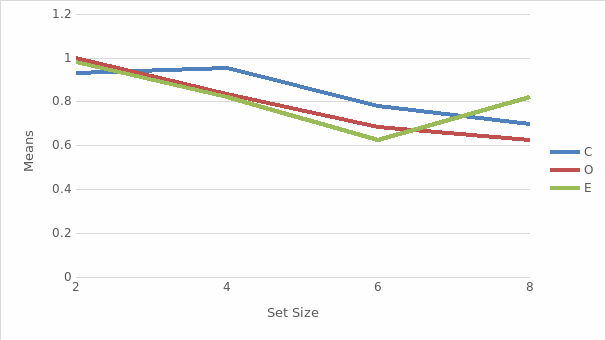
According to Figure 1 and Tables 1 and 2 below, there is a noticeable, clear trend of worsening results as the set size increases. At the same time, participants’ short-term visual memory, on average, worked better when the color of objects changed than when their orientation changed as the set size increased. Non-obvious results include a noticeable increase in correct answers with a high set size and with the third task type, when both the colors and the orientation of objects changed; however, when assessing differences in only one of them, the results were generally linear, with an increase in this independent variable. Participants performed almost ideally on low-set sizes when assessing orientation or both features.
Table 1 – Descriptive Statistics
Table 2 – Inferential Statistics
According to Table 2, the independent variable, set size, is statistically significant in predicting the number of correct answers respondents gave (p < 0.038). Task-type analysis showed that the results were not statistically significant when assessing this sample. However, even a general analysis of the means shows that differences, or their absence, were recognized worst of all in the orientation of objects across multiple trials and best of all in color. In contrast, the presence of both possibilities of differences did not reduce the overall result but set it between the first and second types of tasks.
Discussion
The initial hypothesis was only partially confirmed: set size, as the number of consecutive tasks used to assess differences, really affects the quality of visual short-term memory. In contrast, the results for task type, namely differentiation of differences by the colors of objects, their orientation, or both features at once, were not statistically significant. As set size increases, quality decreases, but not in the case of the third type of task, where differences in two object characteristics are possible – it is very likely that such differences are more easily identifiable than when observed in only one aspect.
Conclusion
Overall, the work supports the study by Luck and Vogel (1997), which shows that when there are more than four objects, memory performance decreases, which may be due to the resources spent on eye movements to identify more objects (Bays & Husain, 2008). Limitations of the study are that only two independent variables were considered, when in reality, there are more determinants of the quality of visual short-term memory (Zhang & Luck, 2008), and a lack of consideration of sample demographics, while age and various health indicators can significantly influence ability (Pavlov & Kotchoubey, 2022). Future studies should take these factors into account by expanding the number of independent variables and moving to a more comprehensive methodology, such as regression analysis.
References
Bays, P. M., & Husain, M. (2008). Dynamic shifts of limited working memory resources in human vision. Science, 321(5890), 851-854.
Luck, S. J., & Vogel, E. K. (1997). The capacity of visual working memory for features and conjunctions. Nature, 390(6657), 279-281.
Pavlov, Y. G., & Kotchoubey, B. (2022). Oscillatory brain activity and maintenance of verbal and visual working memory: A systematic review. Psychophysiology, 59(5).
Zhang, W., & Luck, S. J. (2008). Discrete fixed-resolution representations in visual working memory. Nature, 453(7192), 233-235.