
Introduction
Understanding the Yemeni predicament requires a more nuanced approach that goes beyond media coverage. The goal of this report is to analyze the complex Yemeni conflict using concepts and methods of conflict transformation. The paper aims to investigate the conflict’s historical, political, and social foundations by conducting a thorough literature review, analyzing its dynamics, and identifying practical peace-building strategies.
The paper attempts to provide a thorough explanation of the roots of the conflict, stakeholder motivations, and impediments to peace by synthesizing evidence from multiple sources. The creation of contextually appropriate initiatives to reduce violence and lay the groundwork for long-lasting peace in Yemen will be guided by the findings of this investigation. The final objective is to offer a methodical examination that clarifies the complex characteristics of the Yemeni war. Such a position substantially advances the subject of conflict studies by outlining doable tactics for resolving conflicts and promoting peace.
Background
The war in Yemen has deep historical roots that are entwined with sporadic periods of political unrest and violence. Following the Arab Spring in 2011, which sparked a change from President Saleh’s long-standing authoritarian administration to a more fragmented polity, the modern phase of the war intensified dramatically (Albasoos & Hinai, 2020). After that, an attempt was made to create a new governance structure, but the process was difficult and led to a civil war in 2015 (Egel et al., 2021). With the involvement of numerous armed groups and outside parties, this civil war grew more intense and revealed rudimentary political, tribal, and regional divisions.
Consequential changes have occurred in Yemen’s political landscape, including the transition from Saleh’s protracted control to Hadi’s internationally recognized government. Unfortunately, this shift only served to splinter further and destabilize the area rather than bring about stability. According to Zaim & Aya (2023), attempts at achieving peace were hampered by external meddling and power struggles among local and regional actors. Al-Tamimi & Venkatesha (2021) describe how different parties, such as the Houthis, Southern separatists, and extremist organizations, took advantage of the political void to forward their own objectives in the absence of effective state control.
In addition to being political, Yemen’s conflict has deep roots in the nation’s social and cultural fabric. Elayah & Verkoren (2019) discuss how social structures and tribal affiliations have historically shaped alliances and battles. Because local traditions and tribal allegiances frequently take precedence over national interests and the law, conflict resolution becomes more difficult. Understanding the cultural context is essential to understanding why certain peace initiatives fail and why outside interventions frequently fail to take local demands and realities into account. The Yemen conflict is a prime example of a protracted social conflict in which local, regional, and international elements interact, driven by historical, political, and social factors that continually compound its complexity.
Literature Review
It is necessary to integrate structural and cultural theories into an implicit analysis of Yemen’s conflict, promoting an interdisciplinary approach to identify the principal problems driving the unrest. Nassereddine et al. (2020) have presented theoretical frameworks that elucidate the convolutions of the conflict in Yemen, emphasizing the importance of incorporating structural and cultural theories. To better handle the complexities of the real-world dispute, they support a multi-methodological approach that integrates Soft OR and Game Theory. This implies that, to resolve conflicts in Yemen effectively, consideration must be given to both the more overt governmental and economic systems and the more subtle, often unseen cultural norms and tribal allegiances that shape interpersonal dynamics and behavior.
A crucial case study for more general conflict transformation models is the conflict in Yemen. According to Sowers & Weinthal’s (2021) analysis of the conflict’s effects on civilian infrastructure, past crises in the MENA area have shown comparable patterns of devastation. They detail the severe harm done to Yemen’s water, agriculture, and health sectors, which is suggestive of a larger tactic in which civilian infrastructure is targeted during modern conflicts. This comparison highlights common issues in safeguarding civilian infrastructure and maintaining human security during conflicts, and helps situate the Yemeni crisis within the broader geopolitical struggles in the region.
The frequent adoption of foreign initiatives without sufficient analysis of their efficacy and consequences represents a substantial vacuum in the literature. The efficacy of civil society organizations in Yemeni peace-building is criticized by Elayah & Verkoren (2019), who note that political espionage and security threats regularly jeopardize these initiatives. Similar criticism of the Gulf Cooperation Council’s (GCC) operations in Yemen is leveled by Hoetjes (2021), who claims that the GCC has largely focused on constructing negative peace rather than addressing the central social and political problems that drive the conflict.
These criticisms underscore the need for a clearer understanding of regional and international operations, raising concerns about their compatibility with Yemen’s labyrinthine social structure and local demands. The literature review spotlights how foremost it is to take into account both the structural and cultural aspects of disputes. It also stresses the necessity of critically evaluating regional and global peace initiatives, noting that well-meaning actions could unintentionally worsen the problems they are meant to address.
Country Analysis
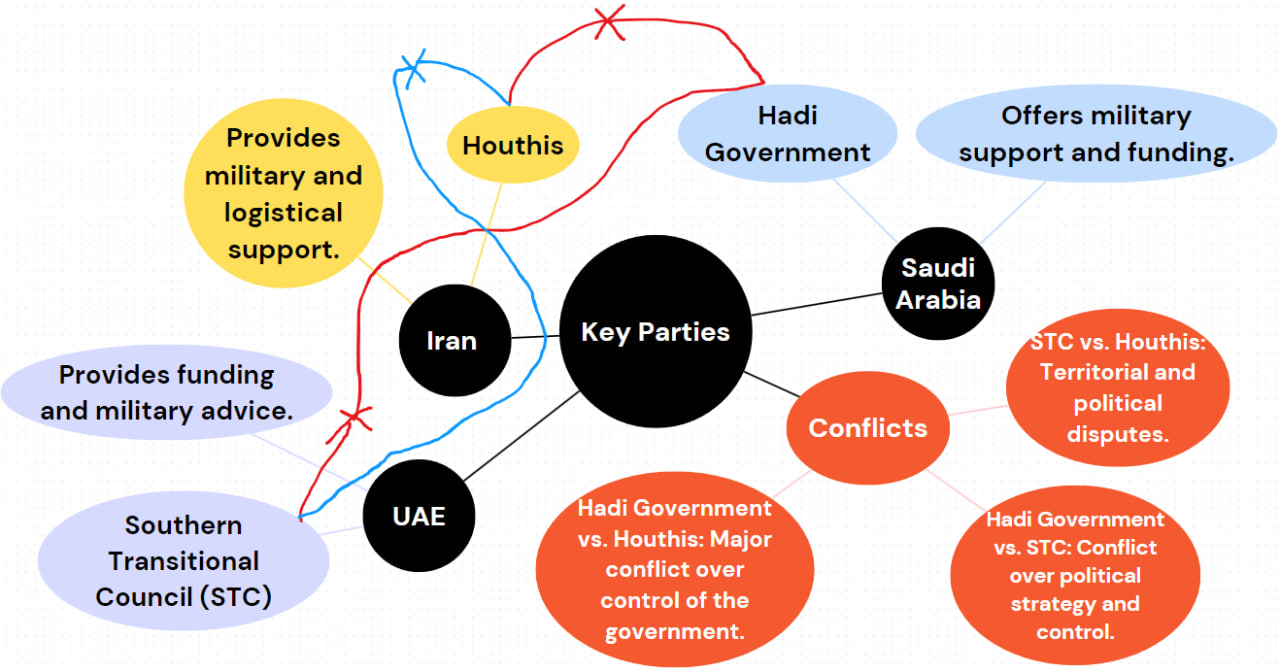
From the Arab Spring to today’s serpentine power dynamics, there is evidence of escalating conflict in Yemen (see Figures 1, 2, 3). This position demonstrates how both internal and external forces have impacted the current situation. Albasoos & Hinai (2020) delineate the evolution of Yemen’s conflict through several pivotal phases, commencing with the political turmoil sparked by the Arab Spring in 2011 and culminating in President Saleh’s overthrow and the subsequent descent into civil war by 2015.
They paint a picture of a situation in which several groups—including the Houthis, the Hadi government, separatists in the south, and radical organizations like Al-Qaeda—continually change in terms of power and influence. Al-Tamimi & Venkatesha (2021) deepen this mapping by highlighting the external factors and socioeconomic pressures that have sparked and sustained the conflict. When taken as a whole, these sources paint a picture of a fractured national environment in which outside actors are dominant players in both conflict and attempts at mediation. These actors are represented as a complicated network of stakeholders with intersecting and frequently opposing interests.
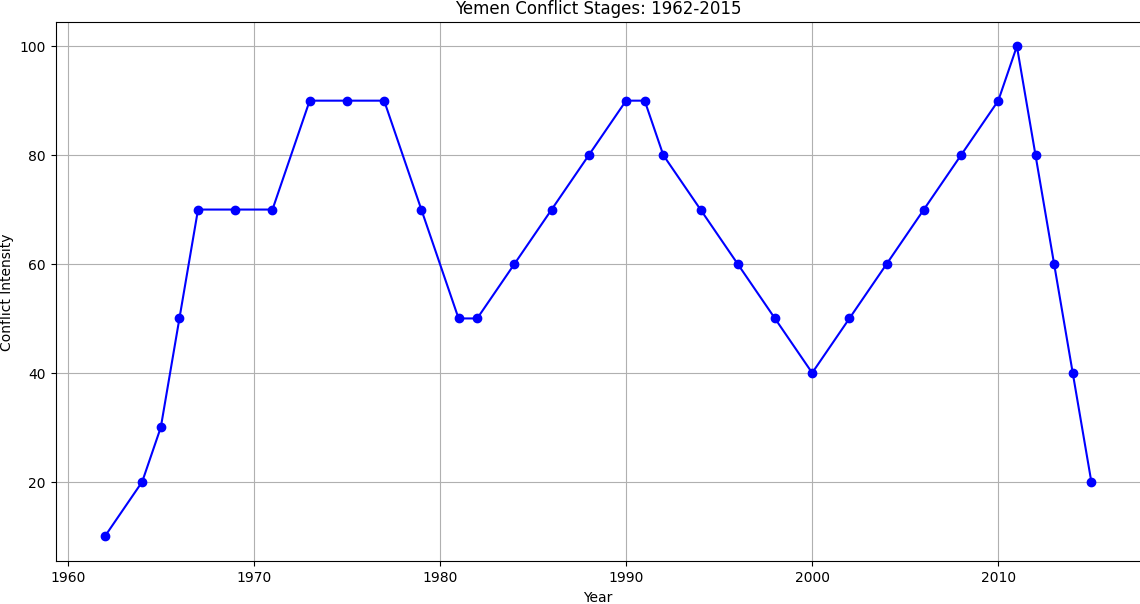
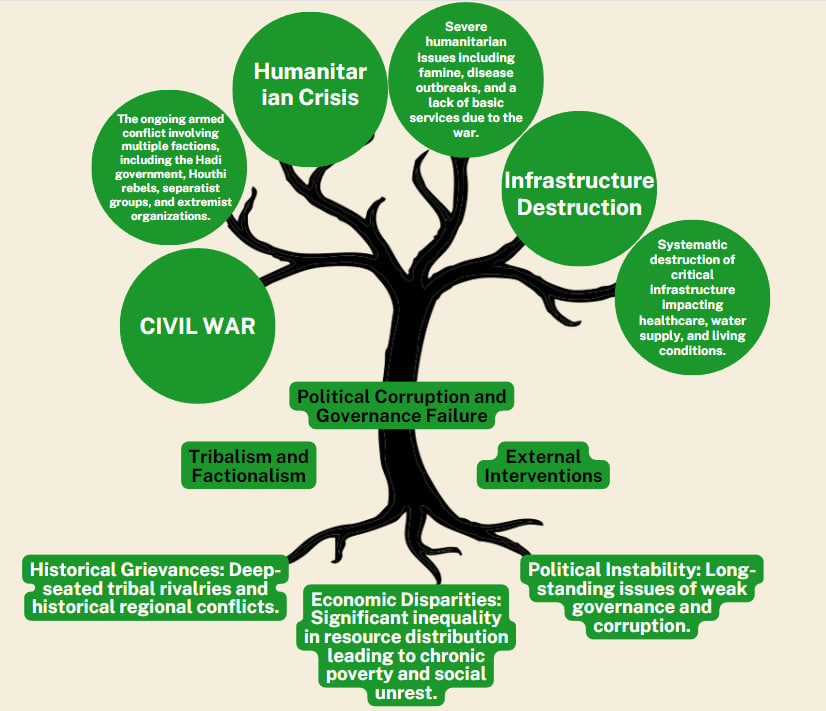
The socio-political processes and historical grievances at the core of Yemen’s unrest have been recognized, providing insight into the enduring obstacles that impede attempts toward peace and reconciliation. Based on the comprehensive paradigm offered by Egel et al. (2021), historical grudges between the north and the south, as well as between different tribal groupings, and political disenfranchisement are the main reasons for the Yemeni conflict.
Power struggles, resource control, and outside political influence—especially from Saudi Arabia and Iran, which have both exacerbated the war’s proxy dimensions—are among the fundamental challenges. Widespread humanitarian disasters, such as starvation, disease outbreaks, and large-scale population displacement, are signs of the conflict. This study aids in understanding the deeper systemic problems that must be addressed to find a lasting solution, as well as the surface-level causes of conflict.
The findings offer a sophisticated perspective on the Yemeni war, demonstrating that it is a multifaceted issue shaped by the interplay of regional, local, and global factors. The roles of international actors are further explained by Zaim & Aya (2023), who describe how interventions—while frequently well-intentioned—have occasionally worsened conflict dynamics due to partial interests or a lack of awareness of local contexts. Major regional powers’ involvement has not only prolonged the fighting but also heightened the precariousness of the peace process.
Any effective intervention method must consider these complex causes and symptoms, according to the conflict tree analysis. An in-depth conflict tree analysis, combined with conflict phases and mapping, offers a thorough picture of the Yemeni conflict. It reiterates the significance of a bilateral, inclusive approach to peace-building that takes into account the complex web of local and international stakeholders involved and addresses the conflict’s symptoms as well as its root causes.
Targeting civilian infrastructure is a common practice in modern warfare that raises alarms and accentuates the urgent need for comprehensive plans to safeguard these vital services throughout wars. Sowers and Weinthal’s (2021) account of the devastation in Yemen offers a crucial perspective for analyzing the effects of war on non-combatants’ necessities, within the broader framework of humanitarian crises caused by warfare. Through methodical examination of the frequency and severity of attacks on civilian infrastructure, such as schools, hospitals, and water and sanitation systems, researchers can identify trends that could inform the development of international regulations and safeguards in war-affected areas.
Additionally, there are significant implications for post-conflict recovery and peace-building initiatives due to the disruption of civilian life and the deterioration of infrastructure. Infrastructure destruction requires massive restoration efforts, which, if handled improperly, can exacerbate human misery and impede economic recovery. In Yemen, the ongoing devastation has eroded the fundamental social fabric of communities, making the establishment of long-lasting peace more challenging (Sowers & Weinthal, 2021). This is made worse by the fact that the destruction frequently goes after the civilian population’s basic means of subsistence, creating a cycle of poverty and displacement that can last for generations.
To address these concerns in the literature, it is necessary to investigate the long-term implications for society’s stability and growth, as well as document the episodes and understand their immediate repercussions. Analyzing post-conflict recovery and reconstruction initiatives can clarify the viability of different international aid initiatives and the resilience of local people in the face of hardship (Sowers & Weinthal, 2021). Furthermore, a more nuanced understanding of the prerequisites for lasting peace and the roles various stakeholders must play in promoting them could result from such an approach. Those include local governments, international organizations, and civil society.
Another crucial area of attention is incorporating conflict sensitivity into the design and execution of development projects in war-torn regions. Development initiatives can avoid unintentionally increasing existing tensions or igniting new ones by using conflict-sensitive strategies (Sowers & Weinthal, 2021). Stakeholders can create interventions that address immediate humanitarian needs and promote long-term stability and development in areas affected by violence by putting these concepts into practice.
There is a critical need for theoretical developments in the study of how conflict affects infrastructure, as well as practical remedies. To more accurately forecast the effects of attacks on infrastructure, social cohesion, economic stability, and public health, current models must be updated (Sowers & Weinthal, 2021). Novel research approaches that use machine learning and data analytics may reveal previously undiscovered trends and predictions, allowing for early interventions and more efficient mitigation techniques.
Careful consideration must be given to the ethical implications of conducting research and implementing treatments in conflict environments such as Yemen. To avoid ongoing conflicts and ensure that the populations they aim to assist are not harmed by their work, researchers and practitioners must navigate difficult moral terrain (Sowers & Weinthal, 2021). This calls for constant ethical examination and adherence to global humanitarian and ethical standards for research, which need to be spelled out precisely and firmly.
Proposed Conflict-Sensitive Project
The project is planned to elevate peace building and reconciliation in Yemen through non-native contributions and regional precinct administration. The undertaking will venture community-based mediation measures presided by tribal and provincial authorities, drawing on Hoetjes (2021) and Weerasinghe (2022), with consent from capacity-building workshops subsidized by transnational funders. These programs aim to identify current conflicts and provide a framework for continued stability while ensuring that interventions are politically and culturally acceptable. This approach aims to improve community resilience against forthcoming conflicts and close intermissions between dissimilar parties.
Critical Evaluation
The approaches used in the literature review on the conflict in Yemen have certain advantages and disadvantages. The cross-disciplinary approach that Nassereddine et al. (2020) promote, which blends Game Theory with Soft OR to address the complexity of real-world conflicts such as that in Yemen, is one of its main strengths. This method is especially useful because it enables a more nuanced analysis of the strategies and motivations of different stakeholders, leading to a more effective understanding of the conflict perspective.
These methods do, however, have certain drawbacks. For example, the conflict tree analysis used by Egel et al. (2021) efficiently pinpoints the cardinal causes and symptoms of a dispute. Still, it may oversimplify the relationships among aspects of conflict, possibly missing cardinal but less obvious components. Further, relying heavily on secondary data limits the breadth of knowledge, especially in conflict situations, for which primary data may provide more pertinent and timely insights.
In Yemen, cultural considerations are very predominant when using conflict resolution techniques. Elayah & Verkoren(2019) point out that failing to consider Yemen’s deeply ingrained tribal and societal systems has frequently limited the effectiveness of civil society organizations in peace-building. When conducting research and intervening in such situations, ethical issues also come up. The representation of vulnerable groups, consent, and potential harm are all problems that researchers and practitioners must navigate to ensure that their interventions do not exacerbate the conflict or have unintended consequences.
Many biases may also affect the existing literature on the crisis in Yemen, especially regarding how other countries view the situation and their operations. Due to their cultural or geopolitical objectives, Western academics and practitioners may introduce biases that distort the study and suggested remedies. According to Zaim & Aya (2023), external interventions have frequently failed to fully grasp the particularities of the conflict in Yemen, resulting in solutions that are out of step with local demands and realities. This draws attention to a pervasive ethnocentric bias in which outside solutions are imposed without sufficient dialogue with local stakeholders or consideration of local dynamics.
Furthermore, the literature frequently reflects the prejudices of its sources, which may have been shaped by funding organizations or political affiliations. Due to these biases, some narrative threads, such as international proxy wars or sectarianism, may receive undue attention at the expense of other, equally prime issues, including local government shortcomings or economic marginalization. Although the approaches used in the literature offer insightful analyses of Yemen’s conflict, it is important to apply them with mindful awareness of their limits and of Yemen’s cultural and ethical circumstances. To create practical, long-lasting conflict-resolution techniques, researchers and practitioners should aim for a balanced approach that reduces prejudice and prioritizes local people’s welfare and viewpoints.
Conclusion
The Yemeni conflict has been recognized in this research as a very complex issue that calls for many-sided approaches to peace-building and settlement. The interplay of numerous parties, each with distinct and often competing objectives, and the conflict’s progression through different stages creates a web of difficulties that impede attempts at both understanding and settlement. Both internal conflicts and external factors shape Yemen’s complex political and social environment.
There are salient aftermaths for Yemen’s efforts to promote peace. Ceasefires and top-down concurrences are not abundant for attaining feasible peaceableness. Moderately, it calls for a thorough generalship that addresses the primitive circumstances that have long split Yemeni society. Those include historical grievances, economic marginalization, and political disenfranchisement, as revealed by the conflict tree analysis (see Figure 3). The roles of external actors must also be considered in peace efforts, as they can either intensify or mitigate the conflict.
To ensure that any peace process is inclusive and representative of all Yemenis, effective conflict resolution strategies should therefore incorporate comprehensive stakeholder engagement, including not only the major political actors but also local communities, tribal leaders, and civil society organizations. International activities must also be well-coordinated and mindful of the local environment; rather than adopting a one-size-fits-all strategy, interventions should be customized to the unique requirements and political and social dynamics of Yemen.
A sustained effort that combines a thorough understanding of the conflict’s convoluted origins with creative, culturally relevant tactics that meaningfully and constructively engage all pertinent parties will be necessary to bring about enduring peace in Yemen. Future studies in Yemen should examine hybrid peace processes that combine regional customs with global norms. This approach stresses long-term plans that address systemic problems while respecting Yemen’s cultural background. Moreover, conducting continuous monitoring and assessment may enhance the flexibility and credibility of peace ambitions in response to shifts in Yemen’s political stance.
Recommendations
To support peace-building in Yemen, several contextually relevant activities are suggested. Based on studies by Hoetjes (2021) and Weerasinghe (2022), the first step would be to create a community-based mediation project that would empower local tribal leaders and community representatives to mediate disputes at the local level. This strategy would honor and leverage Yemen’s robust tribal structure to heal rifts within communities and reduce local hostilities.
Second, a program of economic reconstruction should be launched, with an emphasis on the areas where the war has had the greatest impact. To alleviate poverty and reduce the economic imbalances that fuel violence, this program would prioritize rebuilding vital infrastructure, supporting regional agriculture, and creating sustainable industries. It is also advised to launch an educational program to help young Yemenis develop a culture of peace and reconciliation. Curriculum changes to incorporate peace education, training in conflict resolution, and the emergence of a common national identity that cuts across tribal and sectarian boundaries are all part of this endeavor.
Future research in several areas is recommended to deepen comprehension of the Yemen conflict and provide practical resolution techniques. A vital field of study is the in-depth analysis of effective local peace processes. Examining local success stories may yield scalable ideas for larger-scale peace-building projects. The effect of outside interventions on internal dynamics should be the subject of additional study, with a specific focus on how various forms of foreign assistance and intervention have either lessened or intensified the conflict.
The impact of economic forces on the conflict also warrants further research, particularly given the potential to leverage resource allocation and economic opportunities to advance peace initiatives. Studying the potential of Yemen’s natural resources as instruments of peace rather than conflict is one aspect of this. Finally, studies on the diaspora’s involvement in peacekeeping and conflict resolution may open new avenues for engaging the international community in Yemen’s efforts at reconstruction and reconciliation. These suggested initiatives and lines of inquiry aim to address the complex nature of the conflict in Yemen by engaging domestic and global actors in developing long-term peace options.
References
Albasoos, H., & Hinai, B. A. (2020). Understanding the root causes of the conflict in Yemen. Bussecon Review of Social Sciences, 2(2), 14–20.
Al-Tamimi, A. a. A., & Venkatesha, U. (2021). The main factors of Yemeni conflict: An analysis. JDP (Jurnal Dinamika Pemerintahan), 4(2), 1–14.
Egel, D., Johnston, T., Rhoades, A. L., & Robinson, E. (2021). Building an enduring peace in Yemen. Five Years of RAND Research, 1–58.
Elayah, M., & Verkoren, W. (2019). Civil society during war: The case of Yemen. Peacebuilding, 8(4), 476–498.
Hoetjes, G. (2021). The Gulf cooperation council and the failure of peacebuilding in Yemen. The International Spectator, 56(4), 151–166.
Nassereddine, M., Ellakkis, M. A., Azar, A., & Nayeri, M. D. (2020). Developing a multi-methodology for conflict resolution: Case of Yemen’s humanitarian crisis. Group Decision and Negotiation, 30(2), 301–320.
Sowers, J. L., & Weinthal, E. (2021). Humanitarian challenges and the targeting of civilian infrastructure in the Yemen war. International Affairs, 97(1), 157–177.
Weerasinghe, D. (2022). Yemen civil war: Practical use of theories of conflict resolution. Social Science Research Network, 1–16.
Zaim, S., & Aya, W. (2023). External interventions in internal conflicts: A case study of Yemen. Humanities & Natural Sciences Journal, 4(6), 25–33.