
Introduction
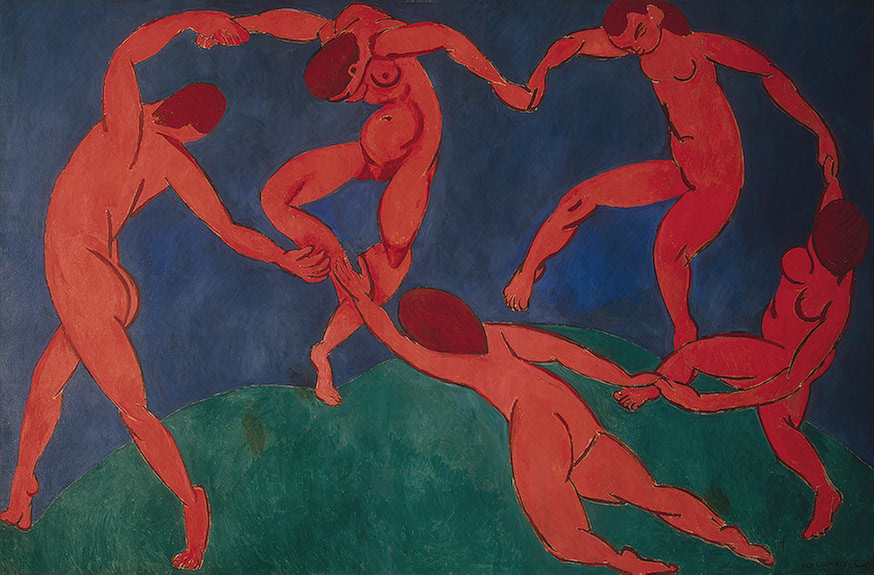
One of Henri Matisse’s most significant works, “The Dance,” painted in 1910, is a decorative panel of oil painting on canvas. This masterpiece, now housed at The Hermitage in St. Petersburg, was commissioned by a Russian businessman, and dance is pictured symbolically as the power of dance. The work is masterful in the sense of the acting out and the illustration of a dynamic composition.
Understanding “The Dance”
“The Dance” by Henri Matisse illustrates a rich image of dance’s vitality, dynamic, and essentially human delight. Matisse’s commissions for Sergei Shchukin showed him celebrating movement, probing into the depths of human emotions conveyed and explored via dance (Jacobus and Martin, 2022). The representation of figures intertwined as they dance in a circle, set against a simplified landscape, highlights the universal nature of dance as an expression not tied to any particular time.
The application of brilliant colors and the free shapes by Matisse add to the painting’s emotional appeal, the artist showing his innovative approach, which can be considered the master’s outstanding demonstration of the essence of all motion and the human spirit. Form and color have been in dynamic interaction with the work “The Dance,” becoming its hallmark in the context of modern art, drawing attention not only to the art of dancing but also to its capacity to manifest complex feelings and build a sense of communal unity.
Personal and Professional Reflection
Analyzing “The Dance” by Henri Matisse has significantly increased my understanding of the importance of creativity and innovation in life and work. This art reveals my true passion, which should overcome existing norms to produce true expression and connection. It has opened my eyes to novel approaches and unconventional problem-solving techniques, revealing Matisse’s talent for expressing complex emotions through a simple yet profound visual language. This strategy has motivated me to integrate artistic thinking into professional settings, actively embracing an approach that gives prominence to my instincts and emotional intuition in decision-making.
Contextual and Symbolic Meaning
The fact that “The Dance” was created during significant artistic and social changes offers insight into the work’s timeless significance and symbolic power. Matisse’s interest in the ideas of freedom, pleasure, and human nature’s propensity to express and unite reflects a broader shift in culture toward accepting modernity and redefining the boundaries between tradition and the contemporary. (Brown, 2021).
The painting’s ode to the freedom of motion and the social nature of dance could be interpreted as a symbol of liberation, a call to shun the dictates of society and live a more accessible and honest life. Shchukin’s guests received the painting, but the simple joy it inspired in a village dance, offering different people with whom to relate (Shabir, 2023). The Dance embodies the idea that art can bridge differences, promote understanding, and sublimate common human experience; therefore, it is a deep reflection on the role that creativity and expression play in society.
Influence of Specific Disciplines
Immersion in art history, focusing on interpreting “The Dance” by Henri Matisse, has revolutionized my understanding of cultural narratives and their impact on modern society. Studying this discipline has provided me with the tools of analysis that enable me to explore the multiple aspects of images, revealing their underlying layers of meaning. For example, learning Matisse’s approach to the fusion of color, form, and composition has improved my aesthetic understanding and critical interpretation of socio-political factors that influence artistic creativity (Brown, 2021). This critical lens enabled me to explore a broader range of interpretations of art and its social ideas in modern life, thereby enriching my professional skills in cultural analysis and content creation.
Potential Impact on Career and Personal Life
The knowledge gained from analyzing “The Dance” will affect my career and personal development. In a professional sense, a fuller understanding of art’s place in society enables a more attentive engagement with cultural currents and social changes, improved anticipation, and innovation in the field. The analytical art-historical skills enable me to use a wide range of tools to address complex problems and create engaging stories needed in any professional environment, from marketing to educational outreach.
Regarding personal development, the study of art, with its historical contexts, fostered a more understanding and knowledgeable worldview. It has made me appreciate diversity and discover what lies beneath the different cultural manifestations, promoting a sense of global citizenship and a deeper understanding of human creative heritage. This finding motivates me to live a life of curiosity and lifelong learning and serve my community through positive cultural contributions.
Conclusion
Through close analysis of the painting, its historiography, and its metaphoric meaning, this essay emphasizes the role of arts and humanities disciplines in shaping our perception of cultural narratives, social transformations, and human feelings. “The Dance” strongly reflects the omnipresence of artistic expression, its potential to fill cultural gaps, and the value of adopting a spirit of cooperation in both private and professional spheres. Moreover, the study of Matisse’s work deepened understanding of the interplay of color, form, and composition.
References
Brown, K. (2021). Henri Matisse. Reaktion Books.
Jacobus, L. A., & Martin, F. D. (2022). The humanities through the arts. McGraw-Hill US Higher Ed.
Shabir, S. (2023). Expression of the human imagination and creative ability in visual form. Journal Of World Science, 2(6), 877-885.
Wikipedia. (2024). Dance (Matisse).