
Overview of Apple Inc.
Apple Inc. is a worldwide innovation firm that makes and sells PC equipment, programming, and administrations. Apple Inc. was laid out by Steve Occupations, Steve Wozniak, and Ronald Wayne in 1977 and is situated in Cupertino, California. The iPhone, iPad, Macintosh, iPod, Mac television, and Mac Watch are all equipment items. Simultaneously, Apple’s products and administrations incorporate the iOS and macOS working frameworks, the iTunes Store, the Application Store, and iCloud.
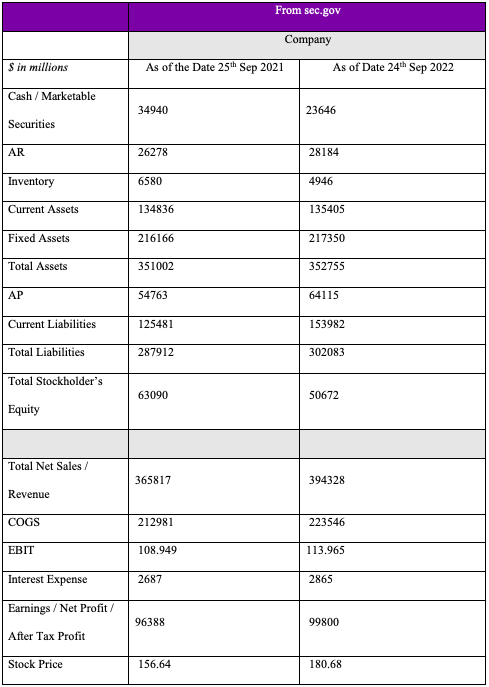
The firm has retail facades and a web-based business website, and it works with different dealers to sell its products in more than 100 nations. Apple’s corporate contributions include Apple Business Director and School Chief, AppleCare specialized help, Apple Pay, and other customer confronting contributions (Apple, 2023). Apple had over 147,000 FTEs after its monetary year 2021 and 511 retail stores across 25 nations. Deals of iPhones drove most of Apple’s $365.6 billion in net deals for 2021.
Challenges, Strategies, Growth Plans, Product Changes, and Mission Statement Alignment
The COVID-19 epidemic severely threatened Apple’s business, supply chain, and global economy. The epidemic disrupted outsourcing partners, component suppliers, and logistical service providers, leading to a lack of essential goods and services. Moreover, foreign currency weakness negatively impacted net sales of all products and services. Apple had adopted several tactics to lessen the epidemic’s effects, such as broadening its product line and sourcing from various vendors (Edgar, 2023). Along with these updates, Apple also introduced a buy now, pay later service and new versions of the MacBook Pro, iPhone, iPad, and Apple Watch.
Apple wants to increase its quarterly dividend, repurchase its common shares, pay dividends and dividend equivalents, and increase the amount authorized for its Program from $315 billion to $405 billion as part of its expansion strategy. Apple has updated its MacBook Pro, iPhone, iPad, and Apple Watch lines, among others, with significant modifications (Edgar, 2023). Apple has also released new versions of its operating system and other devices, including iOS 16, macOS Ventura, iPadOS 16, and watchOS 9.
Apple should keep up with its obligation to its motivation by proceeding to spend money on research and development to foster new items and administrations that give the most fantastic conceivable client experience. Apple’s (2023) official statement of purpose expresses that the organization’s essential objective is “to bring the best client experience to its clients through its creative equipment, programming, and administrations.” In accordance with the organization’s ecological and social obligation, it should likewise ensure its production network is economical, moral, and socially mindful.
Recent Trends in the Company’s Stock Price
From the observations, the stock cost of Apple Inc. has been on a vertical pattern from 2021 to 2022, ascending from $156.64 to $180.68. Apple’s monetary solid exhibition is one justification behind the rise in stock prices. Apple’s 2021 10-K recording demonstrates that the business had its best-ever monetary execution, with net deals of $274.5 billion and net benefits of $57.4 billion (Edgar, 2023). Furthermore, Apple has kept up its example of inventive and fruitful item delivery, similar to the iPhone 13.
The general success of the technology industry may also influence Apple’s market valuation. Apple’s stock price is susceptible to market fluctuations and investor attitudes toward technology businesses because of the company’s prominent position in the sector. One possible explanation for Apple’s rising stock price is the increased demand for technological goods and services caused by the COVID-19 epidemic (Edgar, 2023). From 2021 to 2022, Apple Inc.’s stock price rose, likely due to the company’s strong financial performance, innovation, and technology industry trends.
Overall Financial Strength
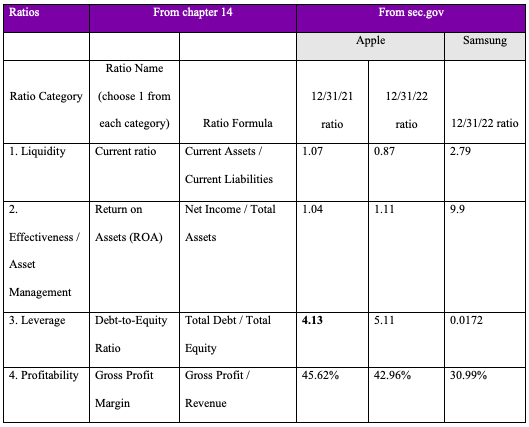
A company’s liquidity indicates how well it can satisfy its present liabilities with its available cash and other short-term assets. A popular indicator of liquidity is the current ratio, defined as existing assets divided by current liabilities (Husna & Satria, 2019). Apple’s liquidity has worsened as its current ratio dropped from 1.07 in 2021 to 0.87 in 2022. In 2022, however, Apple saw a massive increase in its current ratio to 2.79, indicative of a healthy liquidity position. Apple’s leverage rose from 4.13 in 2021 to 5.11 in 2022, as measured by the company’s debt-to-equity ratio (Husna & Satria, 2019). However, Apple’s debt-to-equity ratio decreased to 0.0172 in 2022, indicating a reduced advantage.
Increases in current assets, such as cash and cash equivalents, and decreases in current liabilities undoubtedly contributed to Apple’s better liquidity situation in 2022. Solid sales and revenue growth and careful management of its working capital are likely causes of this uptick. Samsung, Apple’s primary competitor, had a debt-to-equity ratio of 0.52 in 2021 but a current ratio of 1.95 (Husna & Satria, 2019). This means that in 2021, Samsung had better liquidity and less advantage than Apple. However, it is essential to note that Apple’s liquidity and leverage ratios increased dramatically in 2022 to the point where they overtook Samsung’s.
Evaluation of Efficiency and Effectiveness
Apple Inc.’s efficiency and profitability/effectiveness ratios for 2021 and 2022 are mixed. The growth in ROA from 1.04 to 1.11 indicates improved efficiency in turning capital into profit. However, profitability has declined as the gross profit margins shrunk from 45.62% to 42.96%, as shown in Table 2. Apple’s high ROA proportion in 2021 and 2022 is empowering since it shows the business is productively transforming its resources into benefits (Sugiartha & Nurasik, 2023). The corporation may have been able to weather market upheavals because of its commitment to innovation and the reliability of its brand name.
However, the shrinking gross profit margin is a concern because it points to diminishing profits (Nariswari & Nugraha, 2020). There might be several causes for the drop in gross profit margin, including higher manufacturing costs, new pricing tactics, or a modified product lineup. Examining Apple’s income statement may help us understand the root reasons for this pattern by pointing out any areas of rising costs or falling revenues.
References
Apple. (2023). Apple. Web.
Husna, A., & Satria, I. (2019). Effects of return on asset, debt to asset ratio, current ratio, firm size, and dividend payout ratio on firm value. International Journal of Economics and Financial Issues, 9(5), 50–54. Web.
Nariswari, T. N., & Nugraha, N. M. (2020). Profit growth: Impact of net profit margin, gross profit margin, and total assets turnover. International Journal of Finance & Banking Studies (2147-4486), 9(4), 87–96. Web.
Edgar. (2023). Apple 10k Filings. Edgar search results. Web.
Sugiartha, W., & Nurasik, N. (2023). Effect of net profit margin, return on assets and current ratio on dividend policy. Web.