Introduction
The Great Recession was among the worst economic disasters in modern US history. It started at the end of 2007 and ended in June 2009 and is considered the longest since World War II (Schoen, 2017). Bank of America is one of the financial institutions that survived the recession, and it is important to understand what led to the problem.
This study’s research design is diagnostic because it investigates the aspects posing challenges to the business. The purpose of this research is to examine the practices of Bank of America during the financial crisis. To achieve this, concepts such as the TARP Legislation and the Dodd-Frank Act as measures undertaken by the federal government to help financial institutions revive the economy will be explored (Vanatko, 2018). Therefore, the Bank of America survived the recession due to the bailout strategy introduced by the government through TARP and Dodd-Frank legislation.
The Methods for Data Collection and Analysis: Data Collection Techniques
Data collection is a set of methods for gathering information about a specific topic. Qualitative and quantitative research will be used to collect data from all the relevant sources to find answers to the research (Mkandawire, 2019). Based on this, secondary research techniques will be utilized to obtain relevant information about Bank of America during the 2007 to 2009 economic recession.
The data will be retrieved from data sources within and outside the bank. Internal sources will be financial statements of Bank of America, executive summaries, and organizational records. On the other hand, external sources for the study will be business journals, press releases, and the internet (Mkandawire, 2019). As a result, secondary research methods will assist collect information about the organization.
Data Analysis Techniques
The research will use secondary data analysis to draw insights from the information collected. Thematic analysis will be used because it summarizes important features of a large data set (Mkandawire, 2019). It is a flexible technique that guarantees that qualitative data aids researchers in generating fresh thoughts and discoveries. One of the numerous advantages of theme analysis is that it facilitates examining qualitative data for researchers who are beginning to learn. The information collected from secondary sources will be organized based on themes to develop a clear understanding of the research.
Descriptive statistics will draw insight from quantitative data (Mkandawire, 2019). It aids in understanding the specifics of your data by summarizing it and identifying trends in a specific data sample.
Discussion of The Bank of America
Bank of America offers a wide range of financial services to its customers. They provide checking accounts to their customers, which enables them to withdraw, deposit, pay bills, and keep track of their spending (Bank of America, 2022). It allows clients to open a savings account, integral for building emergency savings for short- and medium-term goals. The bank has developed money market accounts for its customers with a high interest rate in exchange for committing the funds to a given time.
In addition, the institution provides different loans, such as auto loans, home loans, and mortgages. A client of the bank can apply for a specific loan if eligible (Bank of America, 2022). Furthermore, they have established a platform that assists customers with investment opportunities in the market.
Moreover, Bank of America offers their customers special banking benefits and financial education. They provide a suite of benefits on specific banking services to employees with a company payroll direct deposit into an existing or new eligible personal Bank of America checking or savings account (Bank of America, 2022). The organization ensures that its customers acquire important financial insights. They engage clients through their online platforms, such as by improving their money habits. The workshops and webinar choices for on-site and virtual interactions with a local specialist aim to educate the clients. Versatile tools and calculators are essential because they help an individual to spend smartly and save more.
Market Share
Market share is among the most important metrics that organizations can use to determine their performance. According to Statista (2022), Bank of America has a market share of about 17.8%, which is second to JPMorgan Chase. It is a percentage of the total sales generated in the financial sector. A higher market share means typically greater sales, a reduced effort to sell more, and a substantial barrier to entry.
However, the market share of the Bank of America shows that it has less impact on the market. This is because the organization must employ intense marketing strategies to attract customers and increase its sales. Thus, the market share shows that there is high competition in the banking sector in the US market.
Geographical Location
Bank of America has its main office in Charlotte, North Carolina, which is in the US. The physical address of the building is 100 North Tryon Street, Charlotte, NC, 28255. The building where the bank’s headquarters is housed is commonly known as the Bank of America Corporate Center (Bank of America, 2022).
In addition, the financial institution has five central hubs worldwide in New York City, Hong Kong, Toronto, London, and Minneapolis. Apart from the US, Bank of America operates in Canada, Europe, the Middle East, Latin America, Asia Pacific, and Africa. As a result, although the bank has its headquarters in the US, it has expanded its operations in different parts of the world.
Major Competitors
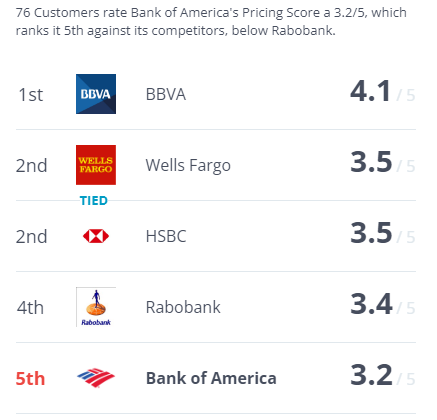
Competition is the rivalry between organizations offering similar products and services in the market. As shown in the appendix, in the banking industry, competition is based on market share, customer service, quality and range of products and services offered, price, reputation, interest rates on loans and deposits, and customer convenience (Comparably, 2022). The main competitor of the Bank of America is JPMorgan Chase because it has a high market share. Furthermore, the other rivals of the bank are Wells Fargo and BBVA since they are leading in the area of customer service, pricing score, culture, and diversity score. Therefore, Bank of America has a number of competitors in the market.
The Evaluation of Business in Taking Risks
The collapse of the housing market in the United States in 2007 was the initial event that triggered the financial crisis. One of the factors that influenced my decision is the Bank of America’s participation in the economic downturn by pursuing high-risk methods. The bank could offer approximately 98% of the loans despite having a reduced or non-existent record of the borrowers’ eligibility (Lawson & Kulam, 2021). However, they placed themselves in a risky position by neglecting to evaluate the borrowers’ capacity to repay the loans. The problem started when there was an increase in the number of people who defaulted on their loans, and the bank could not retrieve the money it had given to its customers. Therefore, increased borrowing contributed to the fall of the economy.
Bank of America started trading subprime mortgage securities, which failed to deliver the anticipated value. When the financial crisis began, the bank traders purposefully misled investors about the caliber of the home mortgages stashed away in the securities the bank sold. The other reason behind my decision is that Bank of America was sued in civil court because they ignored the risks of millions in securities backed by home loans (Lawson & Kulam, 2021). The charges were some of the consequences faced by the bank, which was hit with a number of lawsuits related to the housing crisis. The bank discriminated against people who wanted to get a mortgage, leaving the government with billions of dollars in bad loans and a number of problems with foreclosures.
The Bank of America engaged in risky investments during the crisis, which had an adverse impact on its liquidity. In 2008, the organizations decided to purchase Merrill Lynch for about $50 billion to avert a deepening financial crisis (The Columbus Dispatch, n.d). Another factor that impacted my decision is the fact that the merger gave Bank of America a presence in almost every part of the banking business and placed it in the country’s top tier of financial institutions. The decision prompted the organization to require funding from the TARP program. Therefore, although the merger decision was considered risky due to the timing because the bank wanted more funding during the crisis, it enhanced its performance in the market.
The Ramifications of The Firms Getting TARP Funds
The TARP funds had an adverse impact on the Bank of America during the recession period. According to scholars, the average risk of new loans at large TARP banks was higher in 2009 than at non-TARP banks (Lawson & Kulam, 2021). Even though TARP money was given to banks to make them safer and less likely to take too many risks, it was given with the idea that it would be used to increase lending when risks were higher. These two goals have opposite effects on how much risk the banks were willing to take. This may be why TARP had a different effect on how many large and small banks were willing to lend. Large banks such as Bank of America were more likely to make bad decisions when the government gave them bailout money.
The Actions Implemented to Prevent Future Financial Crisis
Bank of America has undertaken several steps to prevent future financial crises. Firstly, the organization has created a financial policy committee that monitors and addresses risks from institutions and operations across the globe (Bank of America, 2022). The department’s main purpose is to help detect crisis triggers and develop appropriate mitigation strategies. Secondly, the bank has increased its integrity to ensure that it engages in operations that protect everyone’s interests. Therefore, the actions adopted by the bank are to ensure that appropriate mitigation strategies are introduced to thwart any financial crisis.
The TARP Program
The Troubled Asset Relief Program (TARP) was a program developed and run by the US government to stabilize the financial system and restore the economy. At first, TARP allowed the Treasury to purchase things worth $700 billion (Vanatko, 2018). However, the Dodd-Frank Act reduced the amount to $475 billion. The TARP fund was used to purchase shares in banks, insurance firms, and automobile manufacturers, as well as to make loans to financial institutions and homeowners (Vanatko, 2018). It was adequate for all the financial institutions struggling to survive during the crisis. All the organizations eligible for the funding were funded, and they restored their operations.
The federal government initiated the Resolution Trust Corporation (RTC) and TARP to help financial institutions. In 2008, it was hard to manage wealth because there was a lack of credit. Therefore, access to secured and unsecured loans was key to the company’s success. In addition, the government tried to limit merchant fees by ensuring rules were followed. Because of this, Bank of America was unable to make much money. However, while TARP was formed to offer financial support to the affected financial institutions during the crisis, RTC was established to oversee the disposal of assets from failed savings and loan (S&L) institutions (Lawson & Engbith, 2021). Therefore, TARP was monetary, while RTC was about management operations to ensure they work effectively.
There are similarities and differences between TARP and Home Owners Loan Corporation (HOLC). They are both legislations developed by the federal government to solve a problem. Financial-based initiatives are introduced to prevent specific organizations from collapsing (Solomon, 2019). On the other hand, the TARP was established in 2008, but the HOLC was founded in 1933. The primary objective of the HOLC program was to facilitate the refinancing of currently delinquent mortgages in order to forestall bankruptcies and increase the number of potential buyers of homes (Solomon, 2019). On the other hand, the primary purpose of the Troubled Asset Relief Program (TARP) was to assist in stabilizing the financial system in the United States, restarting economic growth, and preventing bankruptcy.
The Pros and Cons of The TARP Program
The TARP program has both advantages and disadvantages, even with its primary purpose of restoring the economy. Firstly, the initiative reinforced the financial system’s stability (Vanatko, 2018). The organizations obtained the funds needed to support their operations during the crisis. Secondly, funding was available to all financial firms affected by the recession. However, as an initiative, TARP failed to provide oversight of the operations of the organizations to prevent the crisis from happening. The program increased the possibility of firms engaging in risky businesses due to the availability of funds from the government to support them. As a result, despite having some faults, TARP had more benefits.
The classification of banks as “too big to fail” can influence them to engage in risky business operations, especially in the area of investment. The phrase indicates that the organization is important to the financial system of the country and that a federal government would not allow it to go bankrupt due to the economic repercussions. This indicates that the government would do everything possible to bail them out to prevent economic disaster. Based on this, organizations are more likely to engage in risky behavior because the government covers the risks. They will not be afraid of becoming bankrupt due to failure.
The Impact of Dodd-Frank on The Bank of America
The Dodd-Frank Act had a significant impact on a number of financial institutions, including Bank of America. It bailed out financial institutions from devastating bankruptcies and other financial constraints. Dodd-Frank increased the amount of loss-absorbing equity capital in banks and made other changes to regulations, such as making liquidity rules and stress tests stricter. (Vanatko, 2018).
In addition, the financial institution is required to reserve some capital to shield itself and its customers from any potential losses. The provisions of the law enabled the Bank of America to establish the appropriate system for financial stability. The Dodd-Frank Act will be helpful in preventing future catastrophes because it prevents banks from engaging in risky investments.
Summary and Conclusion
During the financial crisis of 2007-2009, Bank of America was among the organizations in the financial sector that experienced the consequences. This was when the value of assets dropped, resulting in a recession. The crisis was caused by risky actions of financial institutions such as Bank of America for increased lending. However, the federal government introduced the TARP and Dodd-Frank legislation to curb the situation.
After the TARP Law was passed, it was easy for the company to pay back the loans. At the time, all other financial institutions in the United States were affected. The Federal Deposit Insurance Corporation (FDIC) and the Federal Reserve have taken more steps to ensure all money is safe. However, there are still laws to keep this kind of financial disaster from happening again. Therefore, financial institutions must be cautious and avoid engaging in risky operations to prevent future financial crises.
References
Bank of America. (2022). Bank of America Company Values & Purpose. Web.
Comparably. (2022). Bank of America Competitors. Web.
Lawson, A., & Kulam, A. (2021). US Capital Purchase Program. The Journal of Financial Crises, 3(3), 821-890.
Lawson, A., & Engbith, L. (2021). US Resolution Trust Corporation. The Journal of Financial Crises, 3(2), 129-175. Web.
Mkandawire, S. B. (2019). Selected Common Methods and Tools for Data Collection in Research. Marvel Publishers.
Schoen, E. J. (2017). The 2007–2009 financial crisis: An erosion of ethics: A case study. Journal of Business Ethics, 146(4), 805-830. Web.
Solomon, M. (2019). “The Ghetto is a Gold Mine”: The Racialized Temporality of Betterment. International Labor and Working-Class History, 95, 76-94. Web.
Statista. (2022). Market share of leading banks in the U.S. 2022, by total assets. Web.
The Columbus Dispatch. (n.d). Financial upheaval swallows 2 giants. Web.
Vanatko, N. (2018). Regulatory Reform 10 Years After the Financial Crisis: Dodd-Frank and Securities Law. Congressional Research Service 7, 5700.
Appendix
Competitors
Figure 1: Quality score
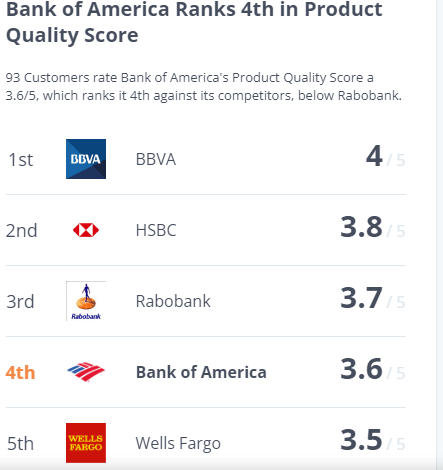
Figure 2: Pricing